

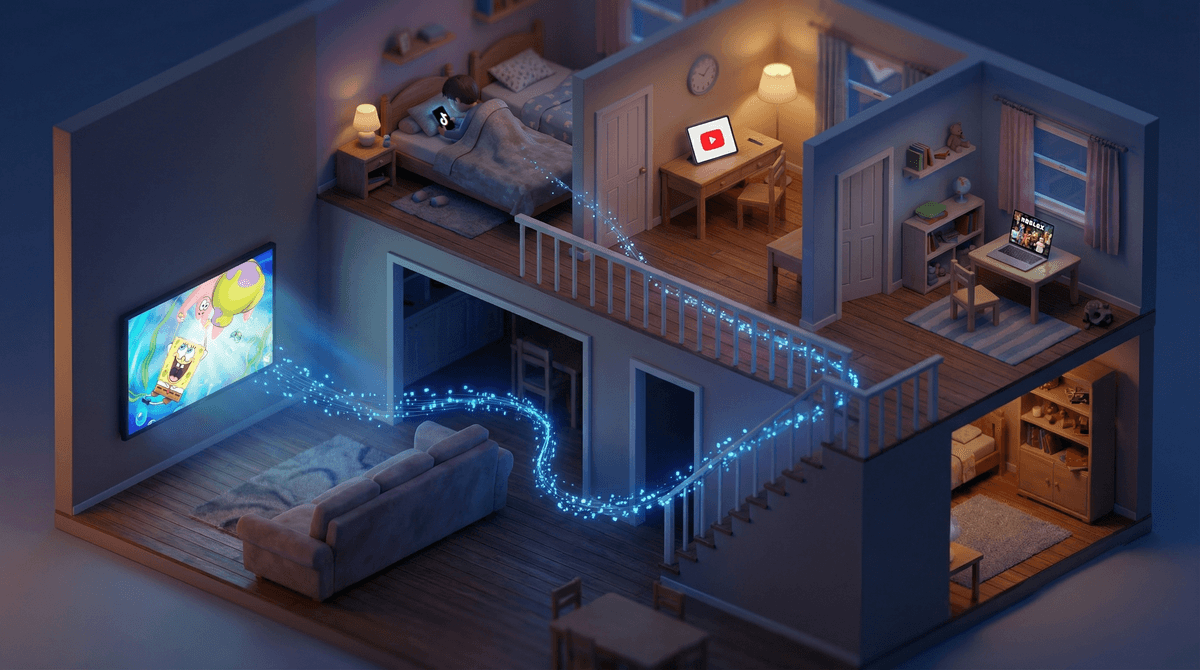
Remember when "screen time" meant the family TV in the living room? When you could walk by and see exactly what your kid was watching, and maybe even sit down and watch SpongeBob with them for a few minutes?
Yeah, those days are fading fast.
The shift is real and it's dramatic: kids' screen time is migrating from shared devices to personal ones, primarily phones and tablets. And it's not just teens anymore—this is happening with elementary schoolers, middle schoolers, and honestly, a lot of preschoolers too.
According to research from Common Sense Media, the average tween (8-12) now spends about 5.5 hours daily on entertainment screen media, while teens clock in at 8.5 hours. And increasingly, that's happening on devices we can't easily monitor, in spaces we can't casually observe.
This isn't about whether screens are "good" or "bad." It's about understanding a fundamental shift in how our kids are consuming content, and what that means for family connection and oversight.
The tech got personal. Phones and tablets are now powerful enough to do everything a TV or computer can do, but they're portable, private, and always available. Your kid can watch YouTube in their room, play Roblox under the covers, or scroll TikTok in the car.
Schools normalized it. Many districts handed out Chromebooks and iPads during the pandemic and never took them back. Suddenly, having a personal device isn't a luxury—it's a school requirement. And once kids have a device for homework, the line between "educational tool" and "entertainment portal" gets real blurry, real fast.
Social life moved there. For tweens and teens especially, social connection increasingly happens through devices. Group chats, gaming with friends, sharing videos—it's not just entertainment, it's how they maintain friendships. Not having access feels like social isolation.
Content is designed for it. TikTok, YouTube Shorts, mobile games—these platforms are specifically engineered for the small screen and the scroll. They're not designed to be watched on the family TV. They're designed to be consumed privately, endlessly, with algorithmic precision.
Let's be honest about what changes when screen time goes mobile:
What we've lost:
- Casual oversight. You can't just glance at a phone screen the way you could glance at the TV.
- Shared experiences. Less "everyone watching Bluey together on Saturday morning," more "everyone in the same room staring at different screens."
- Natural conversation starters. It's harder to talk about what they're watching when you have no idea what they're watching.
- Built-in breaks. TV shows end. Mobile content is designed to auto-play forever.
What we've gained:
- Personalized content. Your 7-year-old isn't stuck watching what your 12-year-old wants to watch.
- Educational access. Good content is more accessible than ever—Khan Academy, Duolingo, amazing podcasts like Brains On!.
- Creative tools. Kids can make videos, edit photos, create music, code games—all on a phone.
- Social connection. For kids with social anxiety or niche interests, finding "their people" online can be genuinely meaningful.
The question isn't whether to allow mobile devices. For most families, that ship has sailed. The question is: how do we maintain connection and oversight in this new reality?
Ages 5-8: If possible, keep screen time primarily on shared devices in shared spaces. When they do use tablets, consider keeping them in common areas. Use parental controls heavily—this guide to YouTube Kids vs. YouTube is a good starting point.
Ages 9-12: This is when the pressure for personal devices intensifies. If you do give them a phone or tablet, start with significant restrictions. Use Screen Time (iOS) or Family Link (Android) to set time limits, approve apps, and monitor usage. Co-view content regularly—sit with them while they show you their favorite YouTubers or Minecraft worlds.
Ages 13+: More autonomy is developmentally appropriate, but oversight still matters. Focus less on blocking everything and more on ongoing conversation. Ask about what they're watching, who they're talking to, what's trending. Make it clear that privacy and trust are earned, not automatic.
Parental controls are imperfect but necessary. No system is foolproof. Kids are resourceful. But that doesn't mean you throw your hands up. Use the tools available, even knowing they're not perfect. Learn how to set up parental controls on whatever devices your kids use.
Location matters more than you think. Devices in bedrooms = significantly less oversight. Devices charging overnight in kids' rooms = sleep deprivation and 2am TikTok spirals. Consider making bedrooms device-free zones, especially at night.
The "just check their phone" approach backfires. Constantly demanding to see their phone breeds resentment and sneakiness. Better approach: regular, casual conversations about their digital life. "What's everyone at school watching right now?" "Can you show me that video you were laughing at?"
Not all mobile time is equal. Watching a video essay about World War II on YouTube is different from watching someone eat gross food for clicks. Playing a creative building game is different from mindlessly scrolling. The device is just the delivery mechanism—the content still matters.
You can't monitor everything, and that's okay. Seriously. You will not catch every inappropriate video, every sketchy DM, every concerning search. Your goal isn't perfect oversight—it's building a relationship where your kid comes to you when something feels wrong.
The shift to mobile isn't inherently bad, but it does require intentionality. When screens were stationary and shared, oversight happened almost automatically. Now it requires active effort.
The families who navigate this well aren't the ones who ban mobile devices entirely (though if that works for you, genuinely, great). They're the ones who:
- Stay curious about what their kids are actually doing on devices
- Maintain some shared screen experiences (family movie nights, watching The Great British Baking Show together, whatever)
- Use parental controls as guardrails, not surveillance
- Talk about digital life the way they talk about school or friends—regularly, casually, without panic
Your kid's screen time is moving to mobile whether you like it or not. The question is whether you're moving with it—staying connected, staying informed, and staying in conversation.
Right now: Check what parental controls are actually active on your kids' devices. Not what you think is set up—actually log in and look.
This week: Have one conversation about what they're watching/playing that isn't framed as interrogation. Just genuine curiosity.
This month: Establish one new boundary around mobile devices that makes sense for your family. Maybe it's no phones at dinner. Maybe it's devices charge in the kitchen overnight. Start somewhere.
And if you want to understand your family's screen habits in context with what other families in your community are doing, take the Screenwise survey—it's eye-opening to see where you actually fall on the spectrum.