

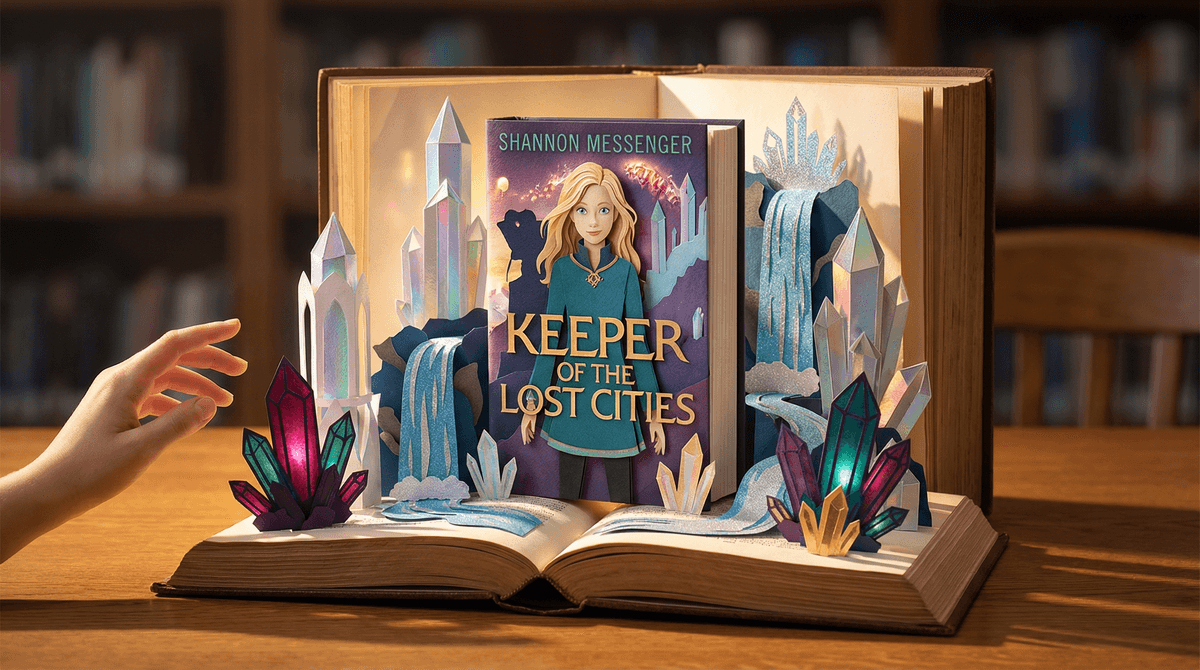
Keeper of the Lost Cities: When Your Kid Discovers Their Next Book Obsession
TL;DR: Shannon Messenger's Keeper of the Lost Cities series is a sprawling, nine-book fantasy epic about a telepathic girl who discovers she's an elf living among humans. It's got found family vibes, slow-burn romance, political intrigue, and enough cliffhangers to keep kids reading well past lights out. Perfect for ages 9-14, especially if your kid loved Percy Jackson or Harry Potter and is ready for something meatier.
Quick recommendations if they finish the series: The School for Good and Evil, Fablehaven, Trials of Apollo
Keeper of the Lost Cities follows Sophie Foster, a 12-year-old who's always felt different—she can hear people's thoughts and has a photographic memory. Turns out, she's not human at all. She's an elf who was hidden in the human world as part of a mysterious experiment, and now she's whisked away to the Lost Cities, a hidden realm of elves with glittering cities, telepathic abilities, and a whole lot of secrets.
The series spans nine books (yes, nine—commit now or forever hold your peace), published between 2012 and 2024. Each book is a doorstop, averaging 500-700 pages, with the final book clocking in at over 800 pages. Shannon Messenger knows how to keep a plot thread dangling, and your kid will absolutely beg for the next book before they've finished the current one.
This series has a chokehold on the middle-grade fantasy crowd, and for good reason:
The world-building is immersive without being overwhelming. The Lost Cities are full of cool details—light leaping (teleportation via crystals), animal telepathy, alchemy, and elite schools that make Hogwarts look quaint. But Messenger doesn't info-dump; she reveals the world gradually, which keeps kids engaged without drowning them in lore.
Sophie is a deeply relatable protagonist. She's smart but insecure, powerful but overwhelmed, and constantly questioning where she belongs. She's not a Chosen One in the traditional sense—she's more like a science experiment gone rogue, which gives her agency and complexity. Kids who've ever felt like they don't quite fit in (so, all of them) will see themselves in Sophie.
The romance is slow-burn and age-appropriate. There's a love triangle (well, more like a love pentagon by book five), but it's all very sweet and awkward. Hand-holding is a Big Deal. There's pining, blushing, and lots of "does he like me?" anxiety, but nothing beyond that. It's perfect for kids who are starting to notice crushes but aren't ready for anything more intense.
The stakes escalate beautifully. Book one is about Sophie adjusting to her new life. By book nine, she's dealing with political coups, ethical dilemmas about genetic manipulation, and the fate of multiple species. The series grows with its readers, which is why kids who start it at 10 are still reading at 14.
The found family hits hard. Sophie's relationships with her friends—Keefe, Fitz, Biana, Dex, and others—are the emotional core of the series. These kids support each other through trauma, loss, and impossible choices. It's the kind of friendship kids dream about having.
This is a commitment. Nine books, each 500+ pages. If your kid gets hooked, you're looking at months of reading (or weeks, if they're a fast reader). The good news? They'll be reading. The bad news? They'll be asking for the next book constantly, and the series isn't cheap (though libraries are your friend here).
The tone gets darker as the series progresses. Book one is pretty light—think magical school with some mystery. By the later books, there are terrorist attacks, torture, PTSD, and characters dealing with serious trauma. It's never gratuitous, but it's emotionally heavy. Kids who start the series at 9 or 10 will likely be fine with the early books, but you might want to check in as they get deeper into the series.
There's some violence, but it's not graphic. Characters get hurt, some die (mostly off-page), and there are battles and kidnappings. It's more Hunger Games-lite than Game of Thrones. Nothing that would give nightmares, but sensitive kids might need to talk through some scenes.
Themes worth discussing: The series tackles some surprisingly complex ideas—genetic engineering, prejudice (elves look down on other species), the ethics of memory manipulation, and what it means to be "other." These are great conversation starters, especially for kids who are starting to think critically about social issues.
The fandom is HUGE. Your kid will find fan art, fan fiction, and endless online discussions. The fandom is generally positive and creative, but as always, keep an eye on what they're engaging with online. The official Shannon Messenger fan community is pretty wholesome, but Tumblr and TikTok can get intense.
Shannon Messenger is active and accessible. She's on social media, does virtual events, and genuinely engages with her readers. If your kid is into the series, following her on Instagram or checking out her website can be a fun way to feel connected to the story.
Ages 9-11: Perfect for strong readers who loved Harry Potter or Percy Jackson. The early books are lighter and focus more on school, friendship, and discovery. Some kids this age might struggle with the length, so consider audiobooks (the narration is excellent).
Ages 12-14: The sweet spot. Kids this age will appreciate the deeper themes, the romance subplots, and the increasingly complex world-building. They'll also have the emotional maturity to handle the darker turns in the later books.
Ages 15+: Some teens will still enjoy it, especially if they started the series younger and want to see it through. But be aware that it's solidly middle-grade in tone and pacing. High schoolers looking for more mature fantasy might prefer Six of Crows or The Cruel Prince.
Once your kid finishes Keeper (and trust me, they will finish it), here are some great next reads:
- The School for Good and Evil: Another sprawling series with complex friendships, moral ambiguity, and a fairy-tale twist.
- Fablehaven: If they loved the magical creatures and hidden worlds of Keeper, this series by Brandon Mull is a perfect fit.
- Trials of Apollo: Rick Riordan's later series has the same humor and heart as Percy Jackson, but with more emotional depth.
- Nevermoor: A girl with a mysterious curse joins a magical society. Whimsical, adventurous, and full of heart.
- Amari and the Night Brothers: A Black girl discovers a secret supernatural agency. Great for kids who want more diverse protagonists in their fantasy.
For more ideas, check out our guide to books like Percy Jackson or fantasy books for middle schoolers.
Keeper of the Lost Cities is one of those rare series that keeps kids reading voraciously. It's long, it's immersive, and it's emotionally satisfying. Yes, it's a commitment, but if your kid is into fantasy, this is one of the best middle-grade series out there.
The books encourage empathy, critical thinking about social structures, and the value of chosen family. They also happen to be wildly entertaining. If your kid is begging for the next book at 10 p.m. on a school night, that's a parenting win in my book.
Next steps: Grab book one from the library or pick up a used copy. If your kid devours it, consider buying the set (or spacing out library holds to avoid the "I need the next one NOW" meltdown). And if they're really into it, Shannon Messenger's website has bonus content, character art, and a map of the Lost Cities that makes a great companion.
Also, if your kid finishes the series and is in mourning (it happens), point them toward our guide on what to read after finishing a beloved series. The book hangover is real, but there are so many great stories waiting.