

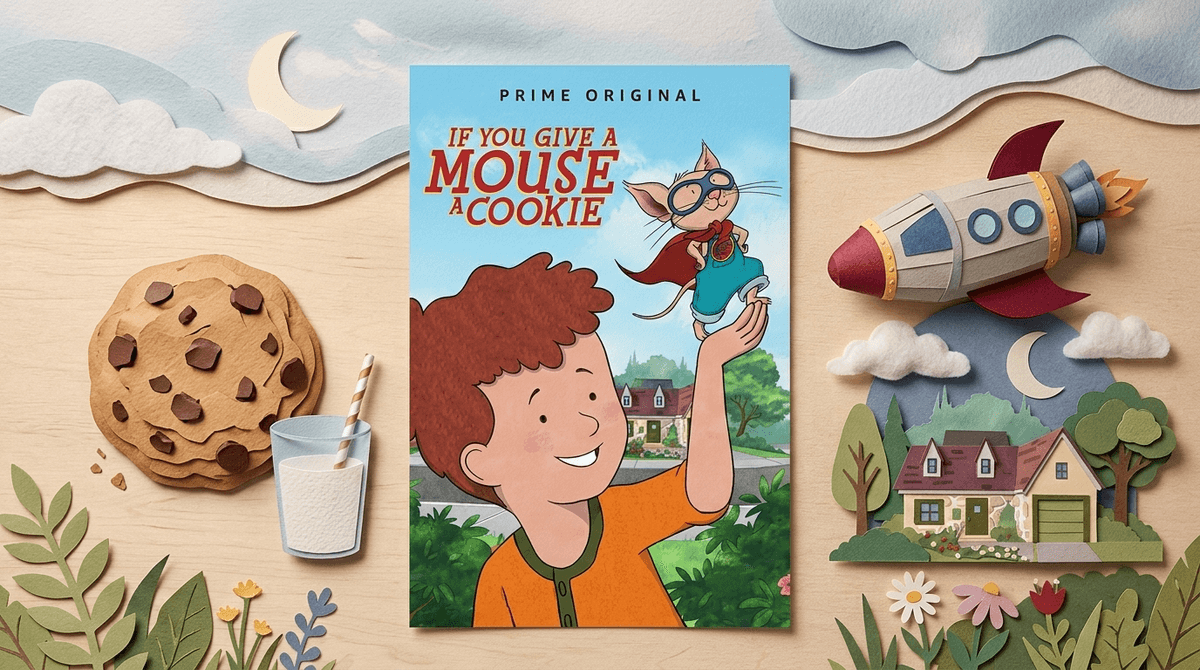
TL;DR: If You Give a Mouse a Cookie is the ultimate "low-stimulation" win for parents of preschoolers and kindergarteners. It’s the antithesis of the high-speed "brain rot" found on YouTube, focusing on creative problem-solving, circular logic, and genuine friendship. If you’re looking for a show that won’t leave your kid vibrating with overstimulation, this is a top-tier choice.
Quick Links:
If you’ve spent any time in a library or a dentist’s waiting room in the last thirty years, you know the book. Laura Numeroff’s classic "If You Give a Mouse a Cookie" is the foundational text of circular logic for toddlers. The Amazon Prime series takes that "one thing leads to another" premise and expands it into a full-blown neighborhood of animal friends and their patient human counterparts.
The show follows Mouse, Pig, Moose, Dog, and Cat, along with their favorite humans (Oliver, Piper, Leo, Henry, and Esme). Each episode is a gentle exploration of what happens when a simple plan goes off the rails—not because of a villain or a "bad guy," but because curiosity and momentum are powerful forces.
Unlike a lot of modern animation that feels like it was edited by a caffeinated squirrel, If You Give a Mouse a Cookie moves at a human pace. It’s bright and colorful, but the "cuts" between scenes are slower, the colors are slightly more muted, and the soundtrack—featuring original songs by Lisa Loeb—is actually pleasant to listen to from the other room.
There is a specific kind of magic in seeing "cause and effect" play out in a way that feels like a game rather than a lecture.
Kids love it because Mouse is a chaotic neutral force of nature. He isn't trying to be difficult; he just has a lot of ideas. When he decides he needs to build a spaceship, he doesn't just "get" a spaceship—he has to find the cardboard, which leads to needing tape, which leads to needing a snack, which leads to... well, you know the drill. It mirrors the way kids actually play.
Parents love it because it models a very specific, rare trait: patience.
The human characters, especially Oliver (Mouse's best friend), are masters of the "yes, and" school of improv. When Mouse accidentally floods the kitchen or turns a simple craft project into a neighborhood-wide event, the humans don't lose their cool. They pivot. In a world where we’re all constantly stressed about the "schedule," watching Oliver navigate Mouse’s distractions is basically a meditation for parents.
We talk a lot at Screenwise about "brain rot"—that specific brand of high-decibel, high-saturation, fast-cutting content (think Cocomelon or certain YouTube Kids channels) that triggers dopamine hits every three seconds.
If You Give a Mouse a Cookie is the antidote.
- Frame Rate & Pacing: The scenes breathe. You can actually see the characters thinking.
- Prosocial Conflict: The "problems" are things like "we ran out of glitter" or "it’s raining and we wanted to play baseball." These are the real-world tragedies of a four-year-old, and the show treats them with respect while showing how to move past them.
- No "Sass": Unlike some shows for slightly older kids where the humor comes from being mean or "snarky," the humor here is purely situational and sweet.
The show succeeds because the ensemble cast represents different "types" of childhood personalities.
The engine of the show. He is the embodiment of the preschooler brain. He is imaginative, slightly impulsive, and deeply kind. He’s the one who starts the chain reaction.
Pig is the "planner." She’s often trying to organize a fair, a play, or a business. She represents the ambitious side of kids, and her "if/then" moments usually involve needing more supplies for her grand visions.
Moose is the artist. He’s gentle, a bit slow-moving (physically and mentally), and loves snacks. He’s great representation for the "chill" kid who just wants to paint a mural and have a muffin.
Dog is the athlete—high energy and always ready for a physical challenge. Cat is the fashionista/perfectionist. Watching them interact teaches kids how to navigate different "vibes" in a friend group.
Recommended Ages: 2–6
- Ages 2-3: They will enjoy the bright colors and the physical comedy. The "circular logic" might go over their heads, but the pacing is safe for their developing brains.
- Ages 4-5: This is the "sweet spot." They’ll start to predict the "if/then" transitions, which is great for cognitive development.
- Ages 6+: They might start to find it a bit "babyish" if they’ve already moved on to Pokemon or Minecraft, but it’s still a great "wind-down" show for after school.
1. It’s a "Safe" Show
There are zero "scary" elements. No villains, no monsters, no "bad" behavior that goes unaddressed. If you have a sensitive kid who gets anxious during the "peril" scenes in Disney movies, this is their safe harbor.
2. The Logic is Educational
The show actually teaches Executive Function. It’s about planning, sequencing, and dealing with the frustration of things not going according to plan. When Mouse needs a straw, he has to remember why he needed it in the first place. That’s a workout for a toddler's working memory.
3. The Music is Genuinely Good
Lisa Loeb (yes, the "Stay" singer) provides the music. It’s folk-pop that won’t make you want to throw your television out the window. It’s catchy without being an earworm that haunts your dreams.
4. Commercialism
Since it’s an Amazon Original, there is, of course, a line of toys and books. However, the show itself doesn't feel like a 22-minute toy commercial in the way that Paw Patrol sometimes can.
Ask our chatbot about other shows with great soundtracks for parents
If you want to turn "screen time" into "learning time" without being a buzzkill, try these prompts after an episode:
- Predicting: "Mouse just found a big box. What do you think he’s going to want to do with it? What will he need next?"
- Empathy: "Moose looked a little sad when his painting got smudged. What did Mouse do to help him feel better?"
- Patience: "Oliver was so patient when Mouse wanted to stop and look at every rock on the way to the park. How do you think Oliver stayed so calm?"
- The "If/Then" Game: Practice the logic in real life. "If we give you a bath, then you're going to need a towel. If you get a towel, then you're going to want your pajamas..."
If You Give a Mouse a Cookie is a rare gem in the current streaming landscape. It manages to be entertaining and funny without relying on snark, violence, or "bouncy" editing that overstimulates young kids.
It’s a "yes" from Screenwise. It’s the kind of show that actually helps your kid's brain settle down rather than revving it up. If you need 20 minutes to start dinner or just drink a coffee while it’s still hot, this is a guilt-free way to do it.
If your kid loves Mouse and his friends, you might want to check out these other "gentle" recommendations:
- For more nature vibes: Puffin Rock (Netflix)
- For emotional intelligence: Daniel Tiger's Neighborhood (PBS/Amazon)
- For creative play: Tumble Leaf (Amazon Prime)
- For the gold standard of modern parenting: Bluey (Disney+)
Compare these shows in our guide to the best preschool media