

TL;DR: The Best Preschool Shows for a Sane Household
If you’re in the trenches of the toddler years, you know that "screen time" is often less of a luxury and more of a survival tool so you can finish a coffee or send one coherent email. But not all shows are created equal. If you want to avoid the post-show "Cocomelon meltdown" and actually enjoy what’s on the screen, here are the top picks:
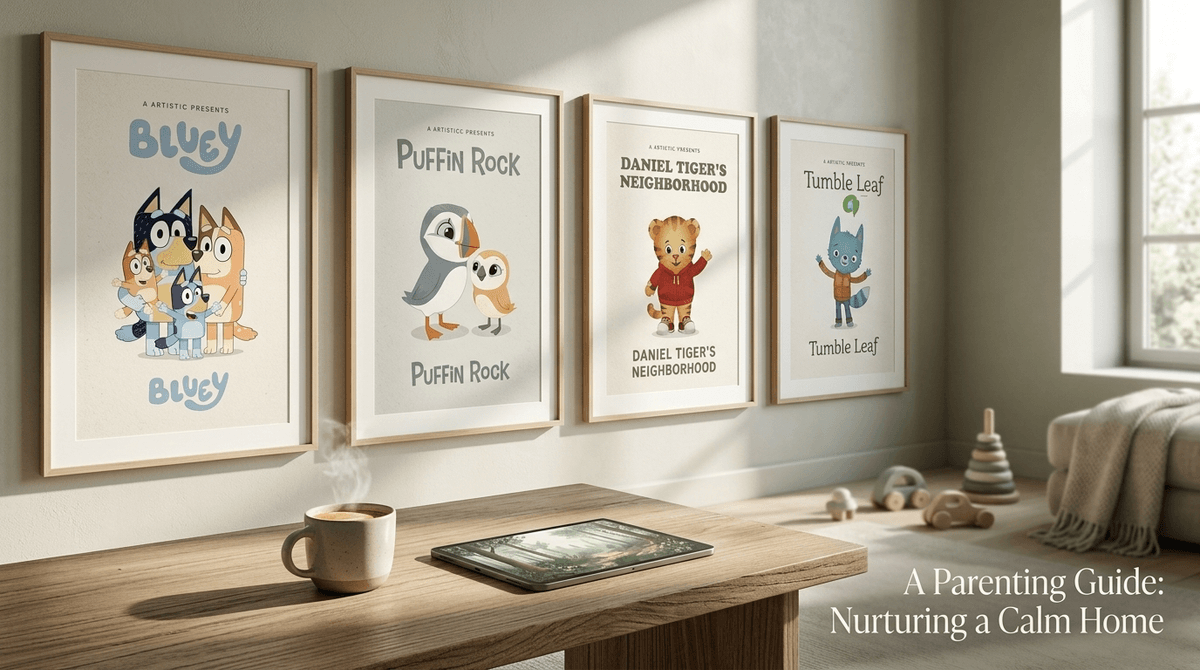
- The Gold Standard: Bluey — Unmatched for emotional intelligence and parent relatability.
- The Chill Choice: Puffin Rock — Low-stimulation, beautiful animation, and narrated by Chris O'Dowd.
- The EQ Builder: Daniel Tiger's Neighborhood — The modern successor to Mr. Rogers that actually gives kids (and parents) a vocabulary for feelings.
- The Creative Spark: Tumble Leaf — Stop-motion magic that focuses on "figuring it out" through play.
- The Hidden Gem: Trash Truck — A gentle, sweet show about a boy and his best friend (who happens to be a garbage truck).
Get show recommendations for your kid's specific interests
We’ve all seen it. Your kid is watching a show, and they look like they’ve been hypnotized. Their eyes are glazed, they aren't blinking, and the second you turn the TV off, they transform into a screaming puddle of emotions.
This isn't just "kids being kids." It’s often the result of overstimulation. Many modern preschool shows—think Cocomelon or Blippi—are designed with incredibly fast cuts (sometimes a camera change every 1-3 seconds), bright neon colors, and constant, high-pitched audio. It’s essentially "digital candy." It provides a massive dopamine hit, but it doesn't give the developing brain any time to process what it’s seeing.
When the show ends, the dopamine drops, and the brain struggles to transition back to the "slow" real world. That’s why we’re focusing on "gentle" media: shows with slower pacing, more natural colors, and stories that actually mean something.
There is a reason why parents talk about Bluey more than their kids do. It is, quite simply, the best children's programming ever made. It follows a family of Blue Heelers in Australia, but it’s really a show about imaginative play and the complex dynamics of family life. It doesn't talk down to kids, and it depicts parents (Chilli and Bandit) who are tired, make mistakes, and are trying their best.
- Why it’s great: It teaches conflict resolution and empathy without being "preachy."
- Ages: 2-7 (and 30+).
If you grew up with Mr. Rogers, this is the animated legacy. Daniel Tiger uses "strategy songs" to help kids handle big emotions—like "When you feel so mad that you want to roar, take a deep breath and count to four."
- Why it’s great: It gives your family a shared language for handling tantrums and transitions.
- Ages: 2-4.
Based on the "Zen Shorts" book series, this show features three siblings and their neighbor, a wise panda named Stillwater. It’s incredibly beautiful and focuses on mindfulness and gaining perspective. It’s the ultimate "calm down" show.
- Why it’s great: It’s slow-paced and deeply meditative.
- Ages: 3-6.
Check out our guide on the best low-stimulation shows for toddlers
This stop-motion series is a visual masterpiece. Fig the Fox finds an object in a "Finding Place" and spends the episode figuring out how it works—reflecting light, shadows, simple machines, etc.
- Why it’s great: It encourages scientific thinking and persistence through play.
- Ages: 3-6.
Produced by the Obamas' Higher Ground, this show (based on the popular book) follows a young Black girl with a giant curiosity. It’s fast-paced but in an intellectual way, focusing on the scientific method: Ask a question, make a hypothesis, test it.
- Why it’s great: It celebrates diversity in STEM and the idea that "not knowing" is the first step to learning.
- Ages: 4-7.
The Kratt brothers have been the kings of animal education for decades. While it has some "superhero" elements that can be a bit high-energy, the actual zoological facts are top-tier.
- Why it’s great: Your kid will start telling you random facts about the "creature powers" of an aardvark that you definitely didn't know.
- Ages: 4-8.
If you need a show that feels like a warm hug, this is it. It follows Oona and her little brother Baba on an island off the coast of Ireland. The animation is flat-out gorgeous (from Cartoon Saloon, the studio behind Song of the Sea), and the stakes are appropriately low for a preschooler.
- Why it’s great: Zero "attitude," zero yelling, just sweet sibling bonding and nature.
- Ages: 2-5.
Hank is a 6-year-old boy who is best friends with a giant, honking trash truck. Along with a cast of animal friends, they go on simple adventures. It’s quiet, the color palette is muted and natural, and the friendship is pure.
- Why it’s great: It captures the magic of childhood imagination without the noise.
- Ages: 2-5.
Based on the classic books by Arnold Lobel, this show perfectly captures the "grumpy friend/cheerful friend" dynamic. It’s slow, it’s thoughtful, and it celebrates the quirks of friendship.
- Why it’s great: It’s a literal breath of fresh air compared to the frantic energy of most modern animation.
- Ages: 3-7.
Let's be real: not everything on Netflix or YouTube Kids is good just because it's under the "Kids" tab.
- Cocomelon: We’ve mentioned it, but it’s worth repeating. It’s designed to be addictive. If you notice your kid "zoning out" and then having a hard time coming back to reality, this is likely the culprit.
- Blippi: While Blippi visits cool places (museums, fire stations), the character's manic energy and high-pitched voice can be very overstimulating. Plus, the educational value is often surface-level.
- Paw Patrol: It’s not "bad," but it is essentially a 22-minute toy commercial. The formula is repetitive, and it doesn't offer much in the way of emotional depth. It’s the "fast food" of kids' TV.
Learn more about why some shows cause more tantrums than others
For preschoolers, how they watch is often as important as what they watch.
- Co-view when possible: I know, the whole point of the TV is so you can do something else. But even sitting for 5 minutes and asking, "Why do you think Bluey did that?" helps their brain move from "passive consumption" to "active processing."
- Use the "Transition Warning": Preschoolers struggle with transitions. Instead of just turning the TV off, give a "one more episode" or "5-minute" warning. Better yet, use a physical timer.
- Check the "Vibe": If a show makes you feel anxious or annoyed (looking at you, Caillou), it’s probably overstimulating for your kid, too. Trust your gut.
You don't have to be a "zero screen time" parent to be an intentional parent. The goal is to choose media that respects your child’s development rather than exploiting it for views.
Start with Bluey or Puffin Rock. See how your kid reacts compared to when they watch higher-energy shows. You might find that the right show actually makes your afternoon easier instead of ending in a 4:00 PM meltdown.
- Audit your queue: Go through your Netflix or Disney+ "Continue Watching" and remove the shows that usually lead to bad behavior.
- Try a "Slow Media" week: Commit to only watching the gentle shows listed above for one week and see if you notice a difference in your child's mood.
- Explore more: If your kid is aging out of these, check out our guide on the best shows for elementary schoolers.