

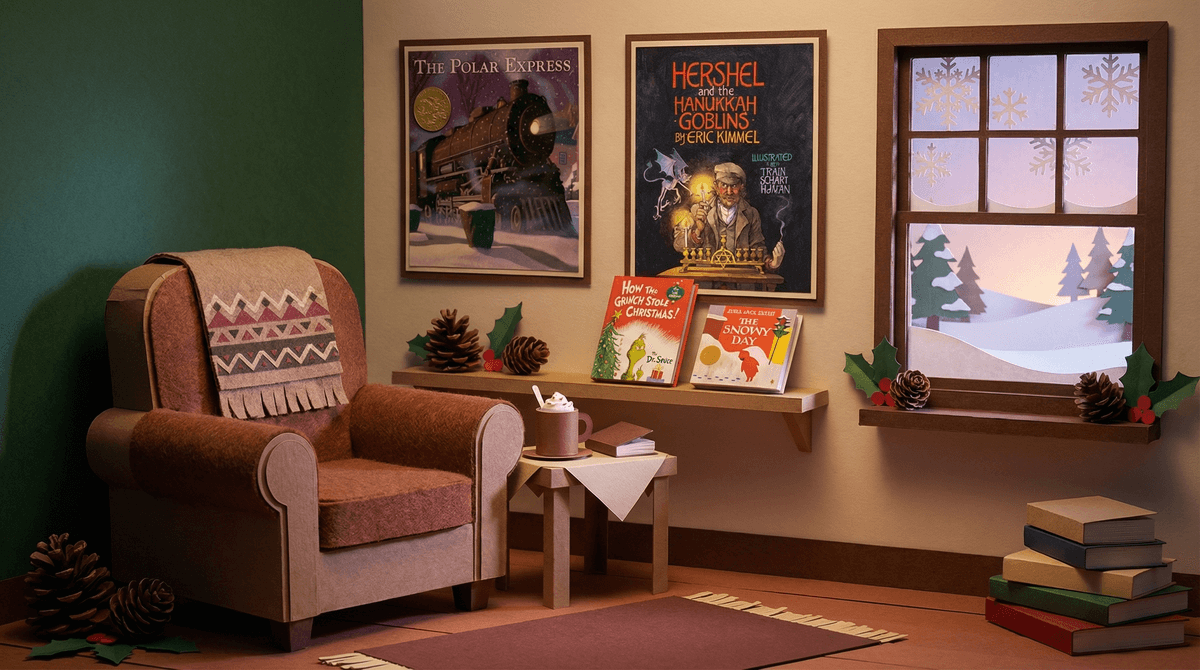
Holiday books are seasonal stories that capture the magic, traditions, and chaos of winter celebrations — from Christmas and Hanukkah to New Year's and everything in between. They're the books that come out of storage each December, get read under blankets with hot chocolate, and somehow become as much a part of your family traditions as the weird ornament your kid made in kindergarten.
But here's the thing: in 2026, holiday books aren't just competing with other books for your kid's attention. They're competing with Roblox, YouTube shorts, and whatever new brain-melting content TikTok is serving up. And honestly? That makes them more valuable than ever.
Winter break is a weird time. School's out, routines are shot, everyone's home more, and the screen time battles can get intense. According to research on media usage patterns, kids' screen time typically spikes by 30-50% during school breaks. Not judging — it's survival mode for many families.
But here's what makes holiday books different from your average "read a book instead of watching YouTube" suggestion: they're naturally ritualistic. They have a built-in expiration date (you're not reading The Polar Express in July), which makes them feel special. They're tied to cozy, low-pressure moments — before bed, by the tree, while cookies are baking. And unlike a random chapter book, they're usually short enough that even screen-saturated kids will sit still for one.
The real magic? You're not just reading a book. You're building a tradition that exists completely outside the digital ecosystem. And in a world where your 8-year-old's memories are increasingly shaped by which Minecraft worlds they built or which YouTube videos they watched, that matters.
Let's be honest: you're not going to eliminate screens during winter break. Nor should you try — that way lies madness and resentment. But what you can do is create intentional analog moments that don't feel like punishment.
Holiday books work because they're not positioned as "screen time alternatives" (which kids immediately reject). They're positioned as special traditions. You're not saying "stop watching Bluey and read this." You're saying "it's our annual reading of How the Grinch Stole Christmas night — grab your pajamas."
The difference is huge.
Ages 2-5:
- The Snowy Day by Ezra Jack Keats (a classic for a reason)
- Llama Llama Holiday Drama by Anna Dewdney (great for managing holiday overwhelm)
- Bear Stays Up for Christmas by Karma Wilson (cozy winter vibes)
These are short, repetitive, perfect for wiggly toddlers who have the attention span of a goldfish. Read them 47 times. It's fine.
Ages 5-8:
- The Polar Express by Chris Van Allsburg (yes, it's everywhere, but it's genuinely beautiful)
- How to Catch an Elf by Adam Wallace (funny, interactive, works for kids who think they're "too old" for baby books)
- The Wild Robot Protects by Peter Brown (not technically a holiday book, but it's winter-themed and a gateway to a fantastic series)
- Hershel and the Hanukkah Goblins by Eric Kimmel (spooky, funny, not your typical Hanukkah story)
Ages 8-12:
- A Christmas Carol by Charles Dickens (the real version — they can handle it, and it's actually wild)
- The Best Christmas Pageant Ever by Barbara Robinson (hilarious, chaotic, perfect for kids who love Diary of a Wimpy Kid)
- Dasher by Matt Tavares (a gorgeous, lesser-known gem about Dasher's origin story)
- The Girl Who Drank the Moon by Kelly Barnhill (winter fantasy vibes, great for Harry Potter fans)
Ages 12+:
- Let It Snow by John Green, Maureen Johnson, and Lauren Myracle (interconnected stories, perfect for teens who claim they're "too old" for holiday stuff)
- Dash & Lily's Book of Dares by Rachel Cohn and David Levithan (NYC holiday romance, became a Netflix series)
- Honestly, at this age, just getting them to read anything that's not Reddit threads is a win
Here's how to make holiday books stick without your kids rolling their eyes:
Start small. Don't announce "WE'RE DOING FAMILY READING TIME EVERY NIGHT NOW." Just... start reading one book on December 1st. See what happens.
Make it cozy, not mandatory. Hot chocolate, blankets, dim lights, maybe the tree lights on. You're creating an experience, not a homework assignment.
Let them pick sometimes. Even if they pick the same book five nights in a row. Even if it's Captain Underpants with a vaguely winter-themed chapter. Control is the enemy of tradition.
Don't compete with screens — coexist. Some nights, they'll want to watch The Grinch instead. That's fine. The goal isn't perfection; it's creating moments that sometimes happen.
Read aloud even to older kids. Yeah, your 10-year-old can read independently. But there's something about being read to that hits different. It's low-effort for them, and it's connection time that doesn't involve negotiating Fortnite time limits.
Look, I'm not going to be a purist about physical books. If your kid will listen to The Polar Express on audiobook during a car ride, that counts. If they'll read Dash & Lily on a Kindle, great.
But here's the thing: the ritual matters more than the format. Audiobooks while doing other stuff? That's passive consumption, basically the audio version of background TV. Audiobooks while lying together looking at the ceiling? That's different.
E-readers are fine, but they don't have the same "pull this special book off the shelf once a year" magic. They're just... another screen. Not bad, just different.
The sweet spot? Physical books for the annual tradition reads, digital for everything else.
Holiday books aren't going to solve your screen time battles. They're not going to make your kids suddenly reject YouTube in favor of leather-bound classics. And they're definitely not going to make winter break magically peaceful.
But they will give you a low-stakes, high-reward way to build traditions that exist outside the digital noise. They'll create cozy moments that don't involve negotiating in-app purchases or explaining why no, you can't download that app that all their friends have.
And in 15 years, when your kid is adulting somewhere and pulls out a battered copy of The Snowy Day for their own kid? That's the win.
This week:
- Dig out whatever holiday books you already have (even if it's just one)
- Hit up your local library — they have massive holiday book displays right now
- Pick one night this week for a trial run (low pressure, just see what happens)
If you want to go deeper:
And if you're thinking "but my kid literally won't sit still for books anymore," let's talk about that — because that's a real thing, and there are actual strategies that work.
Happy reading. Or happy trying. Both count.