

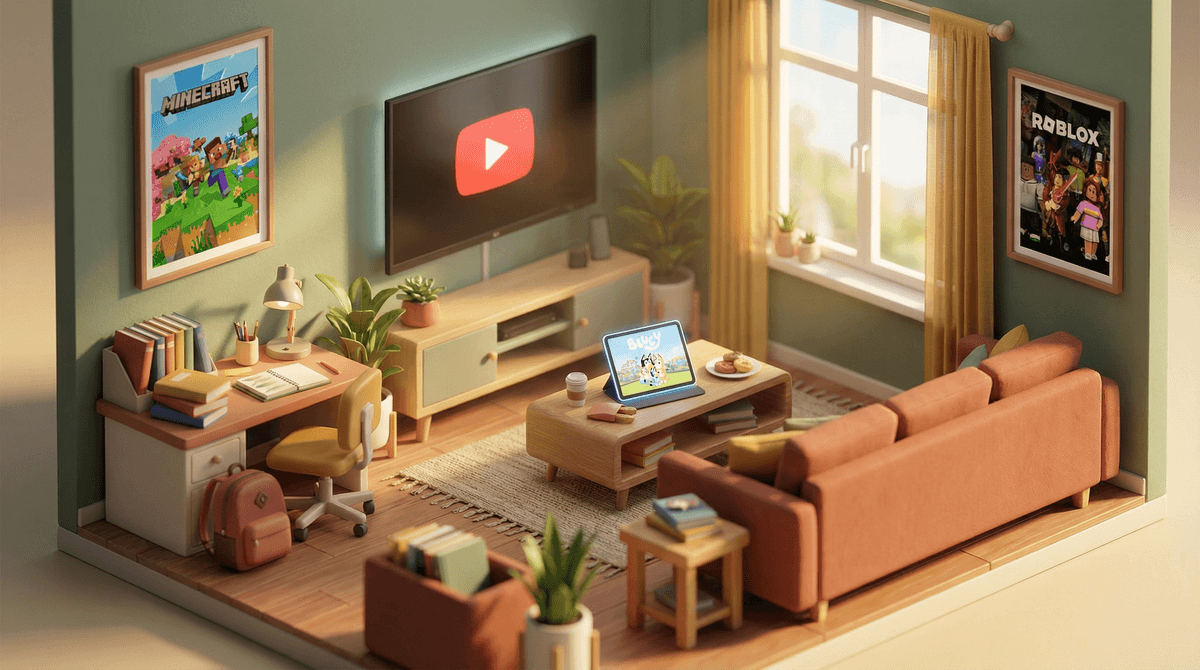
You know that moment when the last day of school hits and suddenly your carefully calibrated screen time routine just... evaporates? The structure that kept everyone (mostly) sane for nine months disappears, and you're staring down weeks of "I'm bored" and "Can I play Roblox?"
Screen time during school breaks is exactly what it sounds like—but it's also a pressure cooker for all our digital parenting anxieties. Should the rules relax because it's vacation? Should they stay rigid because consistency matters? And why does it feel like every other family has figured this out except yours?
Here's what the data tells us: In our community, kids average 4.2 hours of screen time per day during the school year, with weekdays at 4 hours and weekends hitting 5 hours. During breaks, that number tends to creep up—sometimes significantly—and parents feel caught between wanting to give kids a break (literally) and worrying about brain rot.
School breaks expose something we can usually ignore during the regular routine: screens are the default activity when structure disappears. And that's not entirely a bad thing! But it does require intentional thinking.
The challenge isn't just about the hours—it's about what happens to family dynamics when screens become the primary activity for days or weeks at a time. About 42% of kids in our community use YouTube solo (not supervised), and 55% are gaming regularly. When school's out, those percentages can shift as supervision becomes harder to maintain consistently.
Plus, breaks often mean different households if you're co-parenting, grandparents with different rules, or older kids home who influence younger siblings' habits. The lack of structure reveals all the cracks in our digital boundaries.
"Should screen time rules be different during breaks?"
Short answer: Probably, yes. But "different" doesn't have to mean "unlimited." Think of it like bedtime—you might let it slide an hour later during summer, but you're not going full Lord of the Flies.
What works for many families is shifting from time-based limits to activity-based expectations. Instead of "two hours max," try "after you've done something active, something creative, and something helpful." This acknowledges that a rainy Tuesday in July is different from a school night, while still maintaining some structure.
"How do I avoid the constant negotiation?"
Set the framework early—ideally before the break starts. Have a family meeting (I know, I know) where you establish what the break routine looks like. Maybe mornings are screen-free. Maybe there's a daily "outside time" requirement. Maybe Fridays are movie days where the rules relax more.
The key is making it predictable. Kids can handle almost any boundary if they know what to expect. It's the constant case-by-case negotiations that drain everyone.
"What about educational screen time?"
Here's where it gets nuanced. Yes, Minecraft can be creative and Duolingo is technically learning, but if your kid is spending 6 hours a day on "educational" content, we're splitting hairs.
A more helpful framework: Is this screen time active or passive? Creating something in Roblox Studio, video chatting with cousins, or following a YouTube tutorial to learn origami is different from zombie-scrolling TikTok or watching someone else play video games for hours.
Ages 5-8: Structure is your friend here. These kids still respond well to visual schedules and timers. Consider a "token" system where they earn screen time through other activities. About 68% of kids in this age range don't have smartphones yet, which actually makes boundaries easier to enforce.
Ages 9-12: This is the sweet spot for teaching self-regulation. They're old enough to understand trade-offs but still young enough to accept parental boundaries. Try involving them in creating the break schedule. With 22% of kids in our community having smartphones, you're also navigating the reality that some of their friends have different access levels.
Ages 13+: You're mostly negotiating at this point, not dictating. Focus on responsibilities (chores, summer reading, job/volunteer work) and sleep schedules. The goal is helping them practice the self-management they'll need in college. Learn more about age-appropriate smartphone guidelines .
.
The "Boredom Jar": Fill a jar with activities (both screen and non-screen). When kids say they're bored, they pick from the jar. Include things like "30 minutes of Stardew Valley" alongside "bake cookies" and "build a fort."
The "Yes Day" approach: One day a week (or per break), rules relax significantly. This gives kids something to look forward to and makes the other days easier to manage.
The "Create vs. Consume" rule: For every hour of passive screen time (watching shows, scrolling), kids need to do 30 minutes of creative screen time (making videos, coding, digital art) or non-screen activity.
Screen-free mornings: This one is surprisingly effective. No screens until lunch (or whatever cutoff makes sense). Mornings become for reading, playing outside, projects, or yes, even sleeping in.
About 40% of families in our community use Netflix Kids while another 40% use regular Netflix. During breaks, family movie time can be a genuinely positive screen experience—it's shared, it's bounded, and it's intentional.
The trap is when streaming becomes the default babysitter all day, every day. If you're going to lean into shows during breaks, make them count: Bluey for younger kids, Avatar: The Last Airbender for tweens, The Great British Baking Show for family viewing. Get age-appropriate Netflix recommendations.
Perfect balance during school breaks is a myth. Some days will be screen-heavy, and that's okay. The goal isn't to eliminate screens during breaks—it's to make sure they're not the only thing happening.
Your kid will probably exceed their normal screen time during breaks. They'll also probably have more time for the things that matter: sleeping in, reading for pleasure, seeing friends, being bored enough to get creative, and spending unstructured time with family.
The families who navigate this best aren't the ones with the strictest rules—they're the ones who've thought through what matters to them and communicated it clearly. They've accepted that breaks are different, planned for it, and given themselves grace when it doesn't go perfectly.
- Have a pre-break family meeting to set expectations
- Identify 3-5 non-screen activities your kids actually enjoy
- Decide which screen time rules stay firm and which can flex
- Plan at least one screen-free family adventure per week
- Explore alternatives to default screen activities
And remember: summer break ends. Spring break ends. Winter break ends. You're not setting permanent patterns—you're navigating a temporary shift in routine. Give yourself permission to experiment, adjust, and try again next break.