

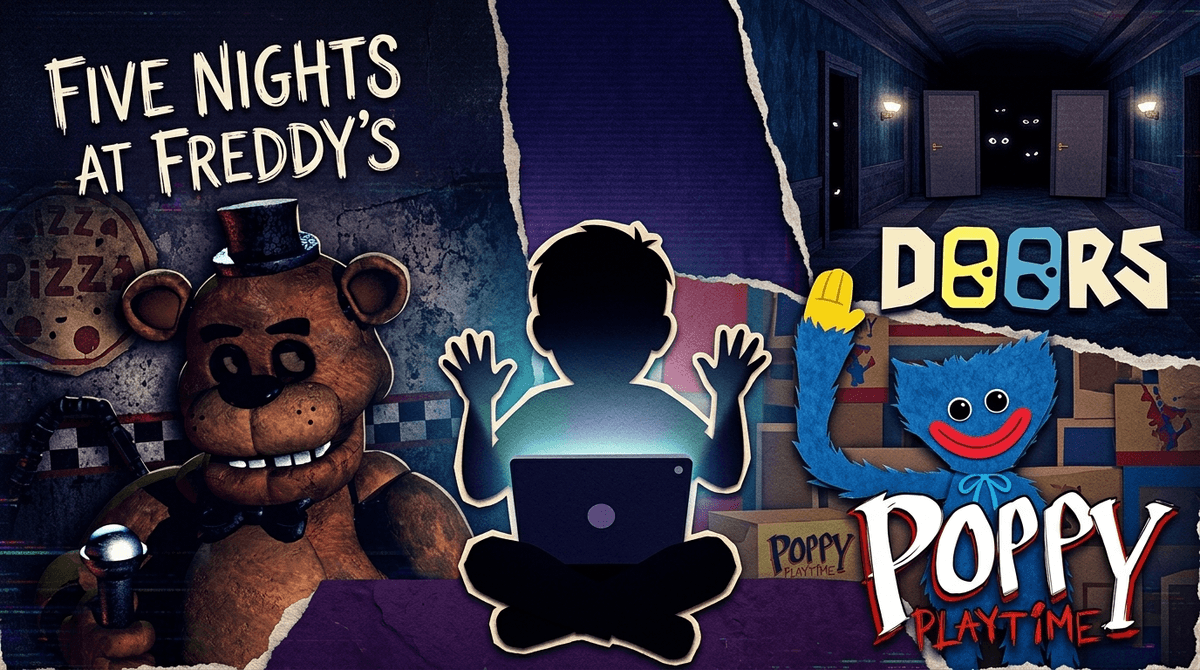
From FNAF to Doors: Why Kids Love (and Fear) Jump Scares
Jump scares are everywhere in kids' digital worlds right now—from Five Nights at Freddy's to Roblox horror games like Doors. The good news? That startle response is actually a normal part of development, and with the right approach, scary play can help kids build emotional resilience. The key is understanding your specific kid, setting boundaries they help create, and knowing when a jump scare crosses from "fun scary" to genuinely distressing.
Quick navigation:
- Five Nights at Freddy's - The OG animatronic nightmare
- Doors (Roblox) - The current Roblox horror obsession
- Poppy Playtime - Creepy toys come alive
- Understanding horror games for kids
Here's the biology: jump scares work by hijacking the startle response, a hardwired survival mechanism. That sudden loud noise + visual shock triggers an involuntary reaction—your kid literally cannot shield themselves against it. It's why even when they know it's coming, they still jump.
The startle response involves the amygdala flooding the body with stress hormones before the rational brain even processes what's happening. For kids whose brains are still developing emotional regulation (so, all of them), this can be particularly intense.
But here's what's fascinating: research shows that scary play can actually help children learn. When kids engage with manageable scares in a safe environment, they're practicing emotional regulation, learning to distinguish real from pretend threats, and building confidence in their ability to handle discomfort.
The key word? Manageable.
If you're wondering why your 8-year-old is begging to play a game about murderous animatronics, you're not alone. According to our Screenwise data, 55% of families report their kids engage with gaming, and a significant chunk of that includes horror content.
Kids are drawn to scary games for a few reasons:
Social currency - FNAF, Doors, and Poppy Playtime are huge in kid culture right now. Not knowing about them can feel like being left out of playground conversations. With 60% of kids in our community playing on Roblox servers (not just offline), horror experiences are social experiences.
Controlled risk - Kids crave the adrenaline rush of being scared, but in an environment where they can pause, quit, or watch someone else play first. It's like a training ground for handling fear.
Mastery and bragging rights - Surviving a jump scare or beating a horror game level gives kids a genuine sense of accomplishment. "I made it past the screaming nun in Doors" is a real flex.
The predictable pattern - Most horror games for kids follow a suspenseful but predictable rhythm. Kids learn the patterns, which helps them feel in control even when they're scared.
I know you want a definitive answer about whether jump scares are okay, but the research is frustratingly clear: it really does depend on the kid.
Some kids genuinely love the thrill. They'll squeal, freeze, laugh, and immediately want to play again. Others find jump scares intensely distressing, leading to nightmares, anxiety, or reluctance to engage with screens at all.
Signs your kid might handle jump scares well:
- They seek out mildly scary content (spooky books, Halloween decorations)
- They can distinguish fantasy from reality pretty reliably
- After being startled, they recover quickly and laugh it off
- They're asking to play/watch the scary thing themselves
Red flags that jump scares might be too much:
- Nightmares or sleep disruption
- Increased anxiety or clingy behavior
- Avoidance of previously enjoyed activities
- Physical symptoms (stomachaches, headaches) before screen time
- They're watching because older siblings are, not by choice
Toddlers and very young kids don't always have the frame of reference for what's "scary" that older kids do—they might be terrified of something you think is mild, or totally unfazed by something intense.
Ages 5-7: Most kids this age aren't developmentally ready for jump scares. Their ability to distinguish pretend from real is still forming, and the intensity can be genuinely traumatic. If they're encountering jump scares through older siblings or YouTube, consider redirecting to gentler content. With 42% of kids in our community watching YouTube solo (unsupervised), accidental exposure is real.
Ages 8-10: This is where it gets individual. Some kids are ready to dip their toes into mild horror (think: Goosebumps-level scares), others absolutely aren't. Start with "scary lite" content—games with spooky themes but minimal jump scares, or watching gameplay videos before playing themselves.
Ages 11-13: Many kids this age actively seek out horror content. They're better at emotional regulation and understanding fiction. That doesn't mean anything goes—FNAF and Doors can still be intense—but they're more equipped to handle it. This is also prime age for peer pressure, so talk about it being okay to tap out if something's too much.
For all ages: Let your kid lead. If they're curious, start small. Watch them play or play together. Have an easy exit strategy. And seriously, just because their friend's parents allow something doesn't mean you have to.
Co-play or co-watch first - Before your kid dives into FNAF alone, watch a gameplay video together or play it yourself. You'll understand what they're asking for, and they'll see how you react to scares.
Establish a "tap out" system - Create a judgment-free way for kids to say "this is too much." Maybe it's a code word, maybe it's just pausing and talking. The goal is building their self-awareness about their limits.
Time it right - Horror games at 9pm when they're about to sleep? Terrible idea. Mid-afternoon with time to decompress? Much better. Only 30% of families in our community actively manage bedtime routines around screens—this matters more than you think.
Use the "scary with training wheels" approach - Start with games that have horror themes but less intensity. Minecraft with the lights off can be spooky without being traumatic. Luigi's Mansion is cartoonish scary. Build up gradually.
Talk about the mechanics - Explaining how jump scares work can reduce their power. "The game designer put that there specifically to make you jump—it's a trick!" helps kids feel more in control.
Watch for the aftermath - If your kid played Doors on Saturday and is still asking to sleep with the lights on Thursday, that's feedback. Scale back.
Leverage Roblox's settings - Since Doors and other horror experiences live on Roblox, use the platform's parental controls. You can restrict certain experiences by maturity level.
Here's a sneaky one: kids aren't just getting jump scared by playing games themselves. They're watching FNAF reaction videos , horror game compilations, and streamers playing Doors. The scares can be just as intense, but kids feel less in control because they can't pause or look away as easily.
With 42% of kids watching YouTube solo, they're encountering this content whether you've approved it or not. Consider:
- Using YouTube Kids for younger kids (though it's not perfect)
- Checking watch history regularly
- Teaching kids to recognize clickbait horror thumbnails
- Having conversations about why they're drawn to watching others get scared
Jump scares aren't inherently harmful, but they're also not universally fine. Your job isn't to shield your kid from ever being startled—that's impossible and probably not even beneficial. Your job is to know your specific kid, create boundaries together, and help them build the skills to recognize when something's too much.
If your 10-year-old is thriving, sleeping fine, and genuinely enjoying horror games? That's probably okay. If your 7-year-old is having nightmares after accidentally seeing a FNAF video? Time to pull back and redirect.
The goal isn't perfect protection—it's building digital resilience. And sometimes that means letting them be a little scared, as long as you're there to help them process it.
-
Have a conversation - Ask your kid what they find scary and why they want to play/watch it. Their answer will tell you a lot.
-
Set up guardrails - Whether it's Roblox parental controls, YouTube restrictions, or just a "no horror after 6pm" rule, create structure.
-
Check in regularly - "How did you feel when that monster jumped out?" is a better question than "Was that scary?"
-
Trust your gut - If something feels off for your family, it probably is. You know your kid better than any guide can.
See if Five Nights at Freddy's is appropriate for your child if you need more personalized guidance.