

Look, we're all trying to raise kids who say "thank you" without being prompted and maybe—just maybe—appreciate what they have instead of immediately asking for the next thing. Gratitude books for kids are picture books, chapter books, and activity books specifically designed to help children understand and practice thankfulness. They range from simple board books about saying "thanks" to more sophisticated chapter books that explore gratitude as a mindset and life practice.
And honestly? In an age where our kids are algorithmically fed content designed to make them want more, more, more—these books feel like a necessary counterbalance.
Here's the thing: the digital world is literally engineered to create dissatisfaction. Every app, every game, every platform makes money by keeping kids wanting the next skin, the next level, the next viral thing. Instagram shows them what they don't have. YouTube unboxing videos normalize constant acquisition. Even Roblox is essentially a dopamine machine where there's always another game pass to buy.
I'm not saying burn the iPads and go full Luddite. But teaching gratitude—real, practiced thankfulness—is one of the most powerful tools we have to help kids develop a healthy relationship with both stuff and screens.
Research backs this up: kids who practice gratitude show better mental health, more resilience, and yes, even better relationships with technology. When kids can appreciate what they have, they're less vulnerable to the manufactured scarcity that drives so much digital engagement.
Not all gratitude books are created equal. Some are preachy in a way that makes kids' eyes glaze over. Others are so saccharine they'll give you cavities. Here are the ones that actually work:
For Younger Kids (Ages 3-7)
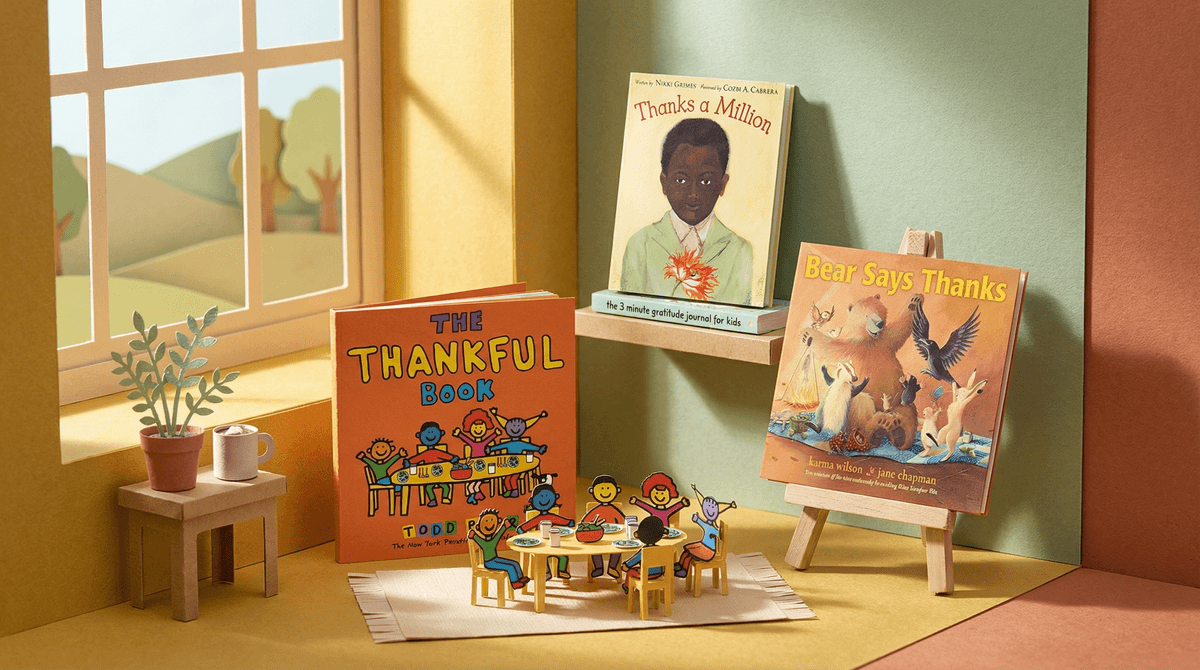
The Thankful Book by Todd Parr is straightforward without being boring. Parr's signature bright illustrations and simple text make gratitude feel accessible, not abstract. "I am thankful for music" next to a kid dancing. Done. No sermon required.
Bear Says Thanks by Karma Wilson wraps gratitude into a story about sharing and friendship. It's the kind of book that doesn't announce "THIS IS A LESSON ABOUT GRATITUDE" but kids absorb it anyway.
Gratitude Soup by Olivia Rosewood uses a cooking metaphor to talk about adding gratitude to your life. Kids love the interactive element of "what would you add to your gratitude soup?"
For Middle Grade (Ages 8-12)
Thanks a Million by Nikki Grimes is poetry that doesn't feel like homework. Grimes writes about everyday moments worth noticing—the first snow, a good meal, a friend who listens. It's gratitude without the Instagram-worthy sunset vibes.
The Gratitude Journal for Kids isn't technically a book you read, but it's worth mentioning. It's structured enough that kids actually use it, but flexible enough that it doesn't feel like another assignment. Five minutes before bed, three things they're grateful for. That's it.
For Teens (Ages 13+)
Real talk: most "gratitude books" marketed to teens are cringe. But The Gifts of Imperfection by Brené Brown approaches thankfulness through the lens of self-acceptance and vulnerability. Teens don't want to be told to be grateful—they need to understand why it matters for their actual lives.
Buying a gratitude book and putting it on the shelf does exactly nothing. Here's what works:
Read them during screen-free time. Seriously. If you read a gratitude book and then immediately hand over the iPad, you've just created cognitive dissonance. Make it part of bedtime routine, Sunday morning breakfast, or that weird dead time between school pickup and dinner.
Don't make it a lecture. After reading, just ask: "What are you grateful for today?" Not "what did we learn about gratitude?" Kids can smell a pop quiz from a mile away.
Model it yourself. Share what you're grateful for. Not the performative stuff ("I'm so grateful for my beautiful family!") but the real stuff ("I'm grateful the coffee was hot this morning because I am TIRED").
Connect it to their digital life. "You're grateful for your friends? Cool. How do you show them that—on Snapchat, in real life, both?" Make it relevant to their actual world.
Here's where this gets practical: gratitude practice can actually change how kids engage with screens. When you help kids notice and appreciate what they have, they become less susceptible to the manufactured want that drives so much screen time.
Try this: before buying another Robux card or game pass, ask your kid to name three things they're grateful for in the game they already have. Not as a punishment or a guilt trip, but as a genuine check-in. Learn more about how Robux is actually real money and why this matters.
Or when they're doom-scrolling TikTok, feeling bad about what they don't have: "What's something you saw today that you're actually grateful for?" It's a pattern interrupt that helps them engage more intentionally.
Let me save you some time and money:
Forced gratitude journals where you make kids write five things every single day will create resentment, not thankfulness. If they miss a day, who cares?
Gratitude as punishment. "You should be grateful for what you have!" shouted when they're begging for something is just... not it. That's shame, not gratitude.
Comparing their gratitude to others. "Kids in other countries would be grateful for what you have" is guilt, not gratitude. Different thing entirely.
Gratitude books aren't magic. Your kid won't read The Thankful Book and suddenly stop asking for V-Bucks. But they're a tool—one of many—for building a mindset that helps kids navigate a world designed to make them perpetually dissatisfied.
The goal isn't to raise kids who are grateful for everything all the time. That's toxic positivity. The goal is to raise kids who can notice what's good, who can appreciate what they have while still wanting to grow, and who aren't completely at the mercy of whatever algorithm is trying to sell them something.
Start with one book. Read it together. Talk about it without making it weird. See what happens.
Pick one book from the list above based on your kid's age. Order it today, or check if your library has it (being grateful for public libraries is very meta).
Create a simple routine. Five minutes before bed, after dinner, whenever. Consistency matters more than duration.
Explore alternatives to constant content consumption that might naturally create space for gratitude practice.
And if you want to dig deeper into how gratitude practice intersects with healthy screen habits, See how to build gratitude into your family's digital life.