

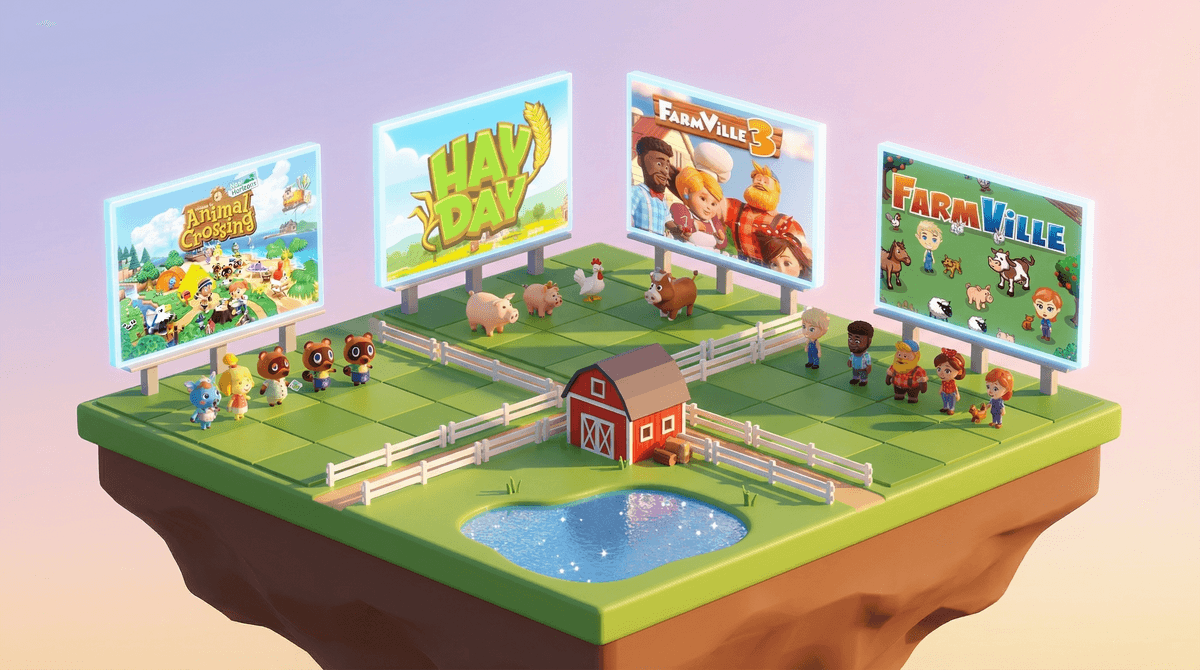
If you've been a parent (or honestly, just alive) for more than a decade, you probably remember Farmville. It was the Facebook game that launched a thousand "I need help with my crops!" notifications back in 2009. Created by Zynga, Farmville let players plant virtual crops, raise animals, and build elaborate farms—all while constantly nudging their Facebook friends to help out.
Here's the thing: while Farmville's heyday feels like ancient history in internet years, it's actually still around (now as Farmville 3), and more importantly, it basically wrote the playbook for how modern mobile and social games work. Every time your kid is playing a game with daily rewards, timed events, or in-app purchases, they're experiencing Farmville's legacy.
You might be thinking, "Why are we talking about a game from 2009?" Fair question! But understanding Farmville is like understanding the origin story of basically every game your kid plays today.
Farmville pioneered what we now call "social gaming mechanics":
The timer system - Plant strawberries that need harvesting in 4 hours, or corn that takes 3 days. Miss your window? Your crops wither. Sound familiar? That's the same mechanic in Hay Day, Animal Crossing, and dozens of other games kids play today.
The social obligation engine - Farmville was genius (or diabolical, depending on your perspective) at making you feel like you had to help your friends. They needed you to be their neighbor! To send them a cow! This is the ancestor of every "send lives" request in Candy Crush or collaborative building in Minecraft.
The "just one more thing" loop - There was always one more crop to plant, one more decoration to buy, one more level to reach. This is the psychological foundation of basically every mobile game with a progression system.
The reason I'm breaking down a 15-year-old game is because Farmville taught game developers exactly how to keep players engaged—and how to monetize that engagement. Understanding these mechanics helps you recognize them everywhere.
The Real Money Question
Farmville introduced "Farm Cash" (premium currency you bought with real money) alongside "Farm Coins" (what you earned playing). This two-currency system is now everywhere. Roblox has Robux. Fortnite has V-Bucks. Your kid's favorite mobile game probably has gems, crystals, or coins you can buy.
The trick? You could technically play Farmville for free, but paying money made everything faster, prettier, and more satisfying. Games today have perfected this model. Want to understand if Robux is actually "real money"?
The Notification Trap
Farmville was probably the first game that trained an entire generation to respond to notifications. "Your crops are ready!" "Your friend needs help!" These weren't just reminders—they were designed to create urgency and FOMO (fear of missing out).
Today's games are way more sophisticated. They know exactly when to ping your kid to maximize the chance they'll open the app. If you've ever wondered why your 10-year-old seems to always know when something is happening in their game, this is why.
Ages 5-7: Games like Hay Day or Township can actually be pretty appropriate at this age—they're colorful, non-violent, and teach basic planning. But you need to:
- Disable in-app purchases completely
- Turn off notifications
- Set clear time limits (these games are designed to be endless)
Ages 8-12: This is prime time for farming/building games like Stardew Valley (which is like Farmville but actually has an ending), Animal Crossing, or even Roblox farming games. At this age, these games can actually teach:
- Resource management
- Planning and delayed gratification
- Basic economics (seriously!)
But watch out for:
- Time-gated content creating anxiety about "missing out"
- Social pressure to spend real money to keep up with friends
- The games becoming a second job (if it's not fun anymore, it's a problem)
Teens: Honestly, most teens have moved past pure farming games, but they're playing games with all the same mechanics—Genshin Impact, Clash of Clans, etc. The conversation shifts to understanding how these games are designed to monetize their attention.
Instead of just saying "these games are manipulative" (even though... they kind of are?), try this approach:
Make the mechanics visible: "Hey, notice how this game always has something ready right when you get home from school? That's not an accident—they're tracking when you usually play."
Talk about real vs. virtual value: "If you spend $20 on Farm Cash, what do you actually get? Can you trade it? Sell it? What happens when the game shuts down?"
Discuss the opportunity cost: Not in a preachy way, but genuinely: "You've been playing this for an hour every day this week. Is it still fun, or does it feel like you have to?"
Farmville might seem like ancient history, but it's the grandmother of basically every casual game your kids play today. Understanding how it worked—and why it was so successful at keeping people engaged—gives you a framework for evaluating modern games.
The mechanics themselves aren't inherently bad. Lots of kids genuinely enjoy farming games and learn real skills from them. But knowing how these games are designed to maximize engagement and spending helps you set boundaries that actually make sense.
- Check out our guide to Stardew Valley—it's like Farmville but actually designed to respect your time
- Learn about the difference between platforms like Roblox and traditional games
- Curious about how to set up parental controls for in-app purchases?
- Take the Screenwise survey to see how your family's gaming habits compare to others in your community
Remember: You don't need to ban farming games or become an expert in every mechanic. You just need to be aware enough to have real conversations with your kids about what they're playing and why. And maybe, just maybe, you'll avoid getting 47 Farmville notifications like we all did in 2010.