

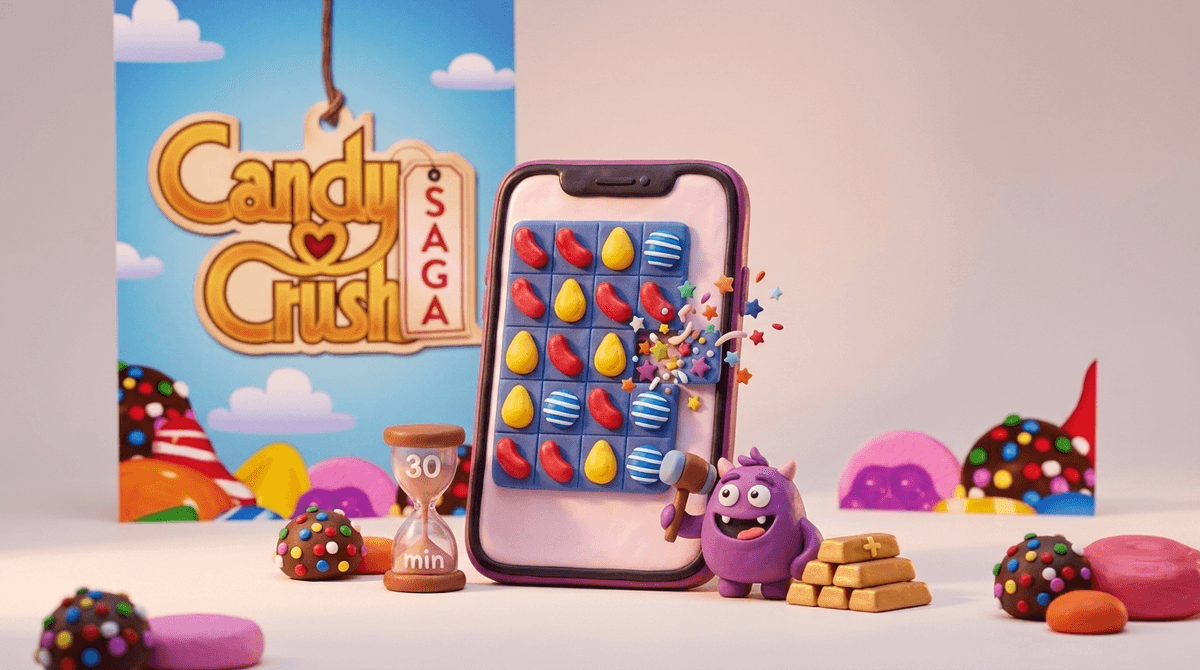
TL;DR: Candy Crush Saga is the ultimate "waiting room" game, but its "freemium" model is built on sophisticated psychological triggers like the "near-miss effect" and "variable ratio reinforcement." While it’s safe from a content and predator perspective (no social chat), it’s a masterclass in dark patterns in kids' games. If your kid is hooked, they aren't "bad at self-control"—they're up against a billion-dollar algorithm designed to keep them swiping.
Quick Links for the Time-Crunched Parent:
- The Game: Candy Crush Saga
- A Better Puzzle Alternative: Monument Valley
- For Actual Logic Skills: Baba Is You
- The "Old School" Fix: Tetris
At its surface, Candy Crush Saga is a simple match-three puzzle game. You swap colorful candies to make rows of three or more, they disappear with a satisfying "pop," and new candies fall from the top. It was originally a Facebook game (remember those?) but exploded on mobile because it fits perfectly into the 3-minute gaps of our lives—standing in line, sitting on the bus, or hiding in the bathroom for a "break" from the kids.
But don't let the bright colors and the deep-voiced narrator yelling "Divine!" fool you. This isn't just a digital version of Candyland. It is a highly engineered "freemium" machine. The game is free to download, but it’s designed to create "pain points" that can only be solved by waiting hours for lives to refill or by spending real money on "Gold Bars" and "Boosters."
If you’ve seen your kid staring at the screen with that glazed-over "zombie look," there’s a scientific reason for it. Candy Crush Saga utilizes something called The Juice. "Juice" refers to the excessive visual and auditory feedback for every action. You match three candies, and the screen explodes in sparkles, the phone vibrates, and a suave voice praises your genius. It’s a dopamine hit every five seconds.
For kids, it’s the ultimate "low stakes, high reward" environment. Unlike Minecraft where you have to build something or Fortnite where you might get "sniped" by a 12-year-old in Ohio, Candy Crush Saga is purely reactive. It’s digital fidgeting.
Ever noticed how often you or your kid fail a level when you only had one jelly left to clear? That’s not an accident. It’s the "near-miss effect." Research shows that a near-miss triggers almost the same amount of dopamine as a win, which compels the brain to try "just one more time."
This is where the monetization kicks in. When the game tells you that you’re out of moves but offers 5 more moves for a few Gold Bars, it’s catching you at your most vulnerable psychological moment. For a child whose prefrontal cortex (the part of the brain that handles impulse control) is still under construction, saying "no" to that pop-up is nearly impossible.

While Candy Crush Saga doesn't have the "loot box" controversy of Roblox, it is the king of the "Wait or Pay" model.
- Lives as a Currency: You get five lives. Lose them, and you’re locked out for 30 minutes per life. For a kid, 30 minutes is an eternity. This creates a false sense of scarcity.
- The Sunk Cost Fallacy: If a kid has spent 10 minutes on a hard level and is "almost" there, they feel like they've already invested too much to lose. They’ll beg for your App Store password to buy a "Lollipop Hammer."
- Social Pressure: If the game is linked to a social account, kids see their friends (or parents) progressing on a map. This creates a "keeping up with the Joneses" vibe that is surprisingly effective on younger players.
The good news? From a traditional safety standpoint, Candy Crush Saga is actually quite low-risk.
The real safety concern is the financial one. If your credit card is linked to their device without a "Password Required for Every Purchase" setting, you could easily find a $100 bill for "color bombs" at the end of the month.
Check out our guide on setting up iron-clad parental controls for in-app purchases
- Ages 4-7: They’ll love the colors, but they won't understand the strategy. They are also the most likely to accidentally click on ads or purchase buttons. Verdict: Play with them, or keep the device in Airplane Mode.
- Ages 8-12: This is the prime age for "obsessive swiping." They understand the game but lack the impulse control to walk away when the "Life Refill" timer is ticking. Verdict: Set a hard time limit and talk about why the game wants them to spend money.
- Teens: They usually find Candy Crush Saga a bit "cringe" or "for moms," unless it’s a viral trend. If they are playing it, it’s likely a stress-reliever.
If you want your kid to get the "puzzle fix" without the predatory gambling mechanics, check these out:
This is a stunningly beautiful game based on M.C. Escher-style impossible geometry. It’s a "pay once and play" game (no in-app purchase nagging). It’s meditative, artistic, and actually makes them think about spatial relationships.
If you want to turn their gaming time into a logic lesson, this is it. You have to change the rules of the game by pushing blocks around (e.g., "Wall Is Push" or "Lava Is Float"). It is genuinely challenging and teaches the fundamentals of coding logic.
The GOAT. Research has actually shown that playing Tetris can help reduce the impact of trauma and improve spatial awareness. It’s pure, skill-based, and doesn't require "gold bars" to win.
If they like the "collecting" aspect of Candy Crush, Animal Crossing offers a much more wholesome, long-term engagement model that rewards patience rather than instant-gratification-via-credit-card.
Instead of saying "Stop playing that mindless game," try opening a conversation about the design of the game.
- "Did you notice how the game gives you a huge 'Sweet!' when you make a match? Why do you think it does that?"
- "It looks like you're out of lives. The game wants us to pay $2 to keep playing right now. Do you think that’s a fair price for 5 minutes of gaming, or should we just go do something else until the timer resets?"
- "Why do you think the hard levels always seem to end when you're just one move away from winning?"
Teaching them to see the "strings" behind the puppet show is the best way to build long-term digital wellness.
Candy Crush Saga isn't "evil," but it is "sticky." It’s the digital equivalent of a bag of Skittles—fine in moderation, but it shouldn't be the only thing on the menu, and you definitely shouldn't be paying $50 for a "Golden Skittle."
If your family is struggling with screen time boundaries around these types of "endless" games, you aren't alone. These apps are literally designed to be harder to quit than a bad habit.
Next Steps:
- Audit your settings: Ensure "Ask to Buy" is turned on in your family sharing settings.
- Set a "Life Limit": Instead of a time limit, try a "life limit." When your 5 lives are gone, the iPad goes away. This teaches them to value their moves and accept the natural "stop" in the game.
- Explore the "Wise" list: Check out our best puzzle games for kids for options that build brains instead of just draining wallets.