

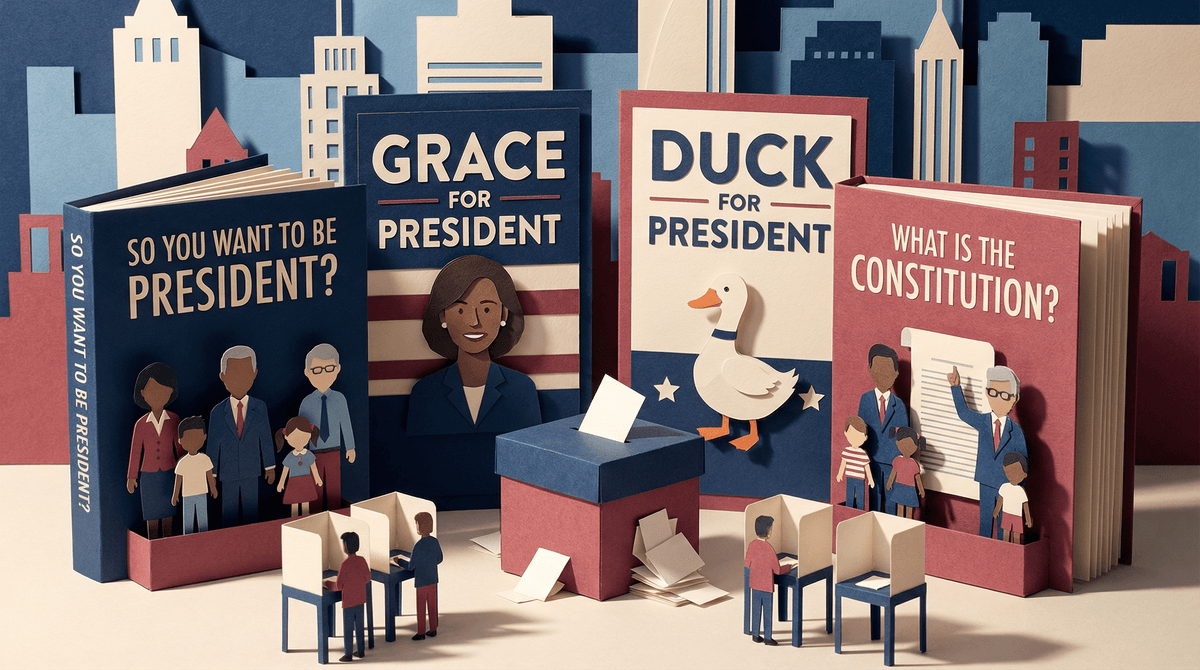
Election and voting books are exactly what they sound like—children's books that explain democracy, civic participation, elections, and how government works. They range from picture books about the voting process for kindergarteners to middle-grade novels that tackle political activism, to young adult books exploring the messy realities of campaigns and power.
But here's why they matter more now than ever: these books aren't just teaching kids how a bill becomes a law. They're building the critical thinking skills kids need to navigate an internet absolutely flooded with political misinformation.
Think about it. Your kid sees a TikTok claiming something wild about a candidate. They hear their friend repeat something their uncle posted on Facebook. They stumble into a YouTube rabbit hole of conspiracy theories. Election books—good ones, anyway—teach kids to ask questions like: Who's saying this? What's their evidence? What are they leaving out? Who benefits from this narrative?
That's not just civic literacy. That's digital survival skills.
We're raising kids in an information ecosystem that would make previous generations' heads spin. A 2023 study found that 59% of teens get their news primarily from social media, where algorithms prioritize engagement over accuracy and where a convincing deepfake can rack up millions of views before anyone fact-checks it.
Meanwhile, many schools have pulled back from robust civics education. Only nine states require a full year of civics or government for high school graduation. So kids are learning about democracy from... wherever. And "wherever" increasingly means influencers, memes, and whatever their algorithm decides to show them.
Quality election and voting books fill this gap. They provide a foundation of how things actually work—which makes it easier to spot when someone online is selling you nonsense.
Ages 4-7: The Basics
At this age, focus on books that explain voting as a concept and introduce the idea that people can have different opinions and still be kind to each other (revolutionary, I know).
- Grace for President by Kelly DiPucchio is the classic here—a girl runs for class president and learns about the electoral college
- Duck for President by Doreen Cronin is genuinely funny and sneaks in lessons about campaigns
- The Day the Crayons Quit isn't explicitly about voting, but it's perfect for teaching perspective-taking and negotiation
Ages 8-11: Getting Real
Middle elementary is when kids start noticing that adults have strong feelings about politics. They're also old enough to understand more nuance.
- So You Want to Be President? by Judith St. George gives the real, weird, human side of presidents
- What Is the Constitution? from the Who Was? series breaks down the actual document
- Undefeated: Jim Thorpe and the Carlisle Indian School Football Team by Steve Sheinkin isn't about voting but teaches kids that history is complicated and textbooks often lie by omission
Ages 12+: The Messy Truth
Teens can handle—and need—books that show democracy as it actually exists: imperfect, contested, sometimes failing, but still worth fighting for.
- All American Boys by Jason Reynolds and Brendan Kiely tackles police violence and activism
- The Hate U Give by Angie Thomas shows a teen finding her political voice
- 1919 The Year That Changed America by Martin W. Sandler reveals how many "current" issues have deep roots
These books work best as conversation starters, not lectures. Read them together if you can, or at least check in afterward. Ask: "What did you think about that?" "Does that seem fair to you?" "What would you do differently?"
Your own politics will come through—and that's okay. You don't need to be a perfectly neutral civics robot. Kids benefit from understanding their family's values. But also model curiosity about other perspectives and comfort with complexity. The goal isn't to create mini-yous, it's to raise humans who can think.
Connect books to real life. If you read a book about voting, take your kid to the polls with you. If you read about activism, find an age-appropriate way to participate in your community. Talk about how to evaluate sources when they encounter political content online.
Watch for the conversation to happen organically. Sometimes the best teaching moments come when your kid sees something confusing on YouTube and asks you about it. Having read quality election books gives them—and you—a framework for those conversations.
Here's where this gets really practical: kids with stronger civic literacy are better at spotting online manipulation.
When your kid understands how actual elections work, they're less likely to fall for viral posts claiming elections are rigged (in either direction). When they understand that democracy involves compromise and coalition-building, they're less susceptible to the all-or-nothing extremism that thrives on social media.
Books also give kids historical context. They learn that every generation thinks theirs is uniquely terrible, that democracy has always been messy, that progress happens slowly and then sometimes all at once. This context is genuinely protective against the doomscrolling and anxiety that political content can trigger online.
Plus, honestly? Reading a physical book is a break from screens. It's slower, more reflective, less algorithmically optimized to make you angry. In a media landscape designed to keep kids in a state of perpetual reaction, books offer space to actually think.
Election and voting books aren't just for election years, and they're not just about government. They're about teaching kids to think critically, evaluate sources, understand multiple perspectives, and participate in democracy—skills they need every single day online.
Start with one book at your kid's level. Read it together. Talk about it. Then watch for opportunities to connect what they learned to the digital world they're navigating.
Because the kids who can think critically about information—who can spot manipulation, evaluate evidence, and hold complexity—aren't just better citizens. They're better equipped for literally everything the internet is going to throw at them.
Not sure where to start? Find election book recommendations based on your kids' specific ages and interests.
Want more on media literacy? Check out our guide on teaching kids to spot misinformation online.
Wondering how to talk about politics with kids? We've got thoughts on that too.