

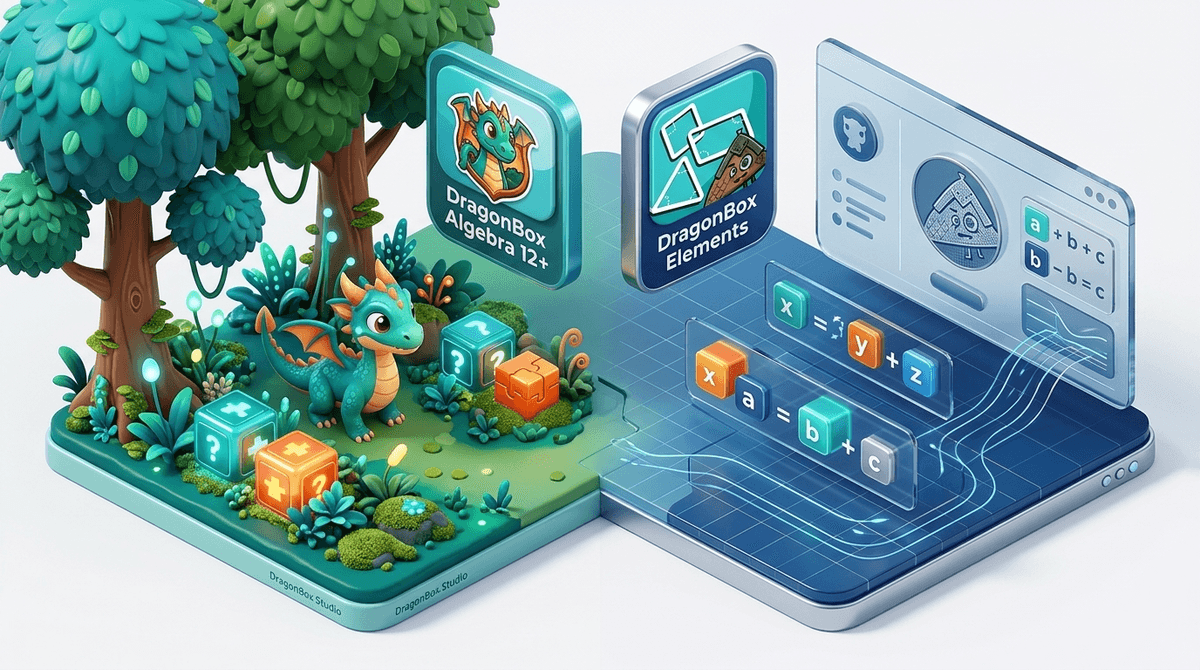
TL;DR: DragonBox Algebra 12+ is the rare educational app that actually lives up to the hype. It’s a puzzle game that "tricks" kids into mastering complex algebraic linear equations without the tears or the "when am I ever going to use this?" arguments. If your kid has finished DragonBox Algebra 5+ or is hitting a wall with middle school math, this is the $8 investment that might save your sanity.
If you’ve spent any time looking for "educational" games, you know the market is mostly "brain rot" disguised as learning. Usually, it’s a mediocre platformer where you have to solve a multiplication problem to jump over a pit. That’s not a learning game; that’s a bribe.
DragonBox Algebra 12+ is different. Developed by the folks at WeWantToKnow (now part of Kahoot!), it’s a sophisticated puzzle game where the core mechanics are the rules of algebra.
The game starts with a split screen and a few colorful icons. Your goal is to isolate a "glowing box" (the dragon box) on one side of the screen. To do that, you have to move other icons, cancel them out, and keep the two sides balanced. By the time the game starts swapping those cute icons for $x$, $y$, and $z$, your kid has already internalized the logic of isolating variables and balancing equations. They’re doing algebra; they just think they’re playing a game about growing a dragon.
We often assume kids hate math because it's "hard," but usually, they hate it because it feels arbitrary. Why do I have to move the 5? Why does it become negative?
DragonBox removes the "math anxiety" by turning these rules into physical interactions.
- The "Aha!" Factor: The game provides instant feedback. If you try to do something that isn't mathematically "legal," the game simply won't let you. It’s a low-stakes environment to fail and iterate.
- The Dragon Evolution: As you progress through the levels, your little dragon avatar grows and evolves. It sounds simple, but for a 10 or 12-year-old, that hit of dopamine is enough to keep them pushing through "Level 8: Parentheses" just to see what the dragon looks like next.
- No "Teacher Voice": There are no long-winded explanations or tutorials that feel like a lecture. It’s pure discovery.
When we look at the data for middle schoolers, we see a massive spike in usage for apps like TikTok and Discord. By the time kids hit 7th or 8th grade, "educational" apps often get deleted to make room for social tech.
DragonBox Algebra 12+ is one of the few apps that survives that purge because it feels like a "real" game. It’s a great "bridge" app for that 20-minute window between getting home and starting homework, or for long car rides where you want them off YouTube for a bit.
Comparing the DragonBox Universe
If you're looking at the app store and getting confused, here’s the breakdown:
- DragonBox Algebra 5+: Best for ages 6-9. It covers the basics of addition and subtraction logic.
- DragonBox Algebra 12+: The "big kid" version. It tackles parentheses, distributive property, factoring, and complex fractions. Don't let the "12+" scare you—a motivated 9-year-old who liked the first one can definitely do this.
- DragonBox Elements: This one is for Geometry. It turns Euclidean proofs into a game about capturing monsters. It's brilliant.
- DragonBox Big Numbers: Great for younger kids (ages 6-8) learning long addition and subtraction.
While the app says "12+," that’s more about the curriculum than the difficulty of the interface.
- Ages 9-11: This is actually the "sweet spot" for many kids. They are old enough to handle the logic but young enough that they haven't yet decided that "math is boring." If they finish this before they even start formal Algebra 1 in school, they will walk into that classroom feeling like they have a superpower.
- Ages 12-14: Perfect for kids currently struggling with algebra. It can help "unstick" concepts that aren't clicking in a traditional textbook format.
- Ages 15+: Might feel a bit "young" aesthetically, but if they are struggling with the foundations of equations, it’s still a solid tool.
This is the part where I get to be the "cool friend" and tell you there is literally nothing to worry about here.
- No Social Features: There’s no chat, no friends list, and no way for your kid to talk to strangers.
- No Microtransactions: You pay once (usually around $7.99) and you own the whole thing. There are no "Algebra Gems" to buy, no "Dragon Skins," and no "Premium Math Passes." It’s a refreshing break from the Roblox economy.
- Offline Play: It works without Wi-Fi. It’s a godsend for airplanes or "dead zones."
- Data Privacy: They aren't harvesting your kid's data to sell them sneakers later.
If you decide to download this, don't just hand the iPad over and walk away. The "sneaky" math works best when there’s a little bit of shared context.
- The "Switch" Moment: Around Level 3 or 4, the game starts introducing actual numbers and letters. Some kids might get a little intimidated when the "game" starts looking like "school." This is the perfect time to sit with them and say, "Wait, you just did that with the monsters, it’s the exact same thing."
- It’s Not a Full Curriculum: While it's amazing, it doesn't replace a math teacher. It teaches the mechanics of algebra, but it doesn't necessarily teach the "why" or the word-problem application. Think of it as a gym for their "math brain" rather than a full textbook.
- The Price Tag: Yes, it costs money. In an era where everything is "free-to-play," paying $8 for an app feels weird to some parents. But remember: if an app is free, you (or your kid's data) are the product. DragonBox is a premium tool, and it’s worth every penny.
Check out our guide on why 'free' apps often cost more in the long run
DragonBox Algebra 12+ is one of the few digital tools that actually delivers on the promise of "making learning fun." It’s not just "not bad"—it’s actually excellent. It takes one of the most stressful subjects in the middle school curriculum and turns it into a series of satisfying puzzles.
If your kid is currently saying things are "Ohio" (meaning weird or cringe) or spending too much time watching MrBeast challenges, swapping 15 minutes of that for 15 minutes of DragonBox is a massive win for their digital wellness.
- Check their current level: If they are in 4th grade or below, start with DragonBox Algebra 5+.
- Do a "Family Level": Sit down and try to solve the first 10 levels together. It’ll give you a sense of how their brain works.
- Compare notes: If your kid is also using Prodigy or IXL at school, see which one they prefer. Usually, DragonBox wins on the "fun" factor, while the others are better for specific homework help.
Learn more about how to balance educational apps with leisure time