

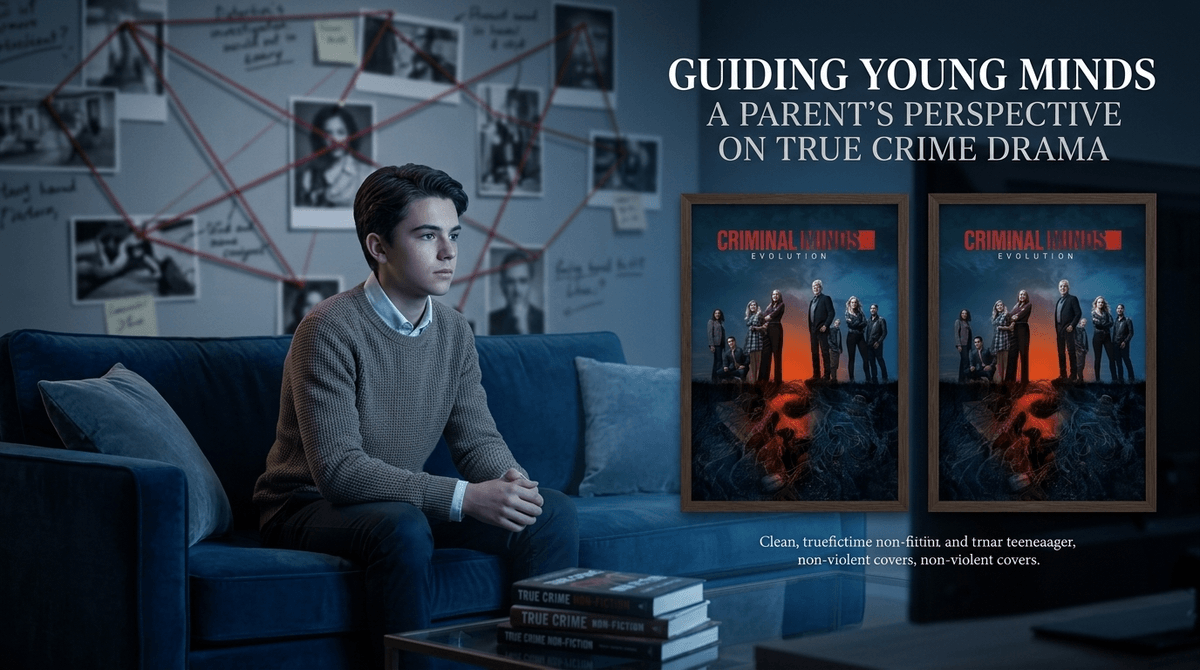
If you’ve walked into the living room to find your 14-year-old casually eating popcorn while a fictional serial killer is being profiled by the FBI, don’t panic—you haven’t raised a sociopath; you’ve just officially entered the Criminal Minds era of parenting. It’s the show that refuses to die, migrating from a "background noise" procedural on CBS to a full-blown viral obsession on TikTok and Netflix, and now a much darker, TV-MA iteration on streaming.
- The Vibe: High-stakes FBI profiling, "found family" team dynamics, and some genuinely nightmare-inducing villains.
- The Rating: The original series is TV-14, but the reboot, Criminal Minds: Evolution, is a hard TV-MA (more gore, way more swearing).
- Why they like it: Two words—Spencer Reid. Also, the "comfort watch" irony of using high-stress TV to decompress.
- What to watch instead (if it's too much): Psych for laughs, Monk for clean mystery, or A Good Girl's Guide to Murder for the YA detective itch.
See if Criminal Minds is okay for your middle schooler
Criminal Minds follows an elite group of FBI profilers in the Behavioral Analysis Unit (BAU). Unlike your standard Law & Order where they find the body and then the guy, the BAU focuses on why the guy did it. They look at "signatures," "unsubs" (unknown subjects), and psychological triggers to catch serial killers before they strike again.
The show ran for 15 seasons on network TV, which means there are over 300 episodes of content. In 2022, it was revived as Criminal Minds: Evolution on Paramount+. This is where things changed. Freed from the constraints of broadcast TV, the show leaned into "prestige" territory—meaning the crimes are more graphic, and the characters finally get to use the kind of language you’d actually use if you were hunting a serial killer.
It seems counterintuitive. Why would a generation that is arguably the most "wellness-conscious" ever want to spend their Friday nights watching the darkest corners of the human psyche?
The Spencer Reid Factor
If you check TikTok right now, you’ll see thousands of edits of Dr. Spencer Reid (played by Matthew Gray Gubler). He’s the resident genius—socially awkward, incredibly loyal, and perpetually in need of a hug. For teens, he’s the ultimate "comfort character." He represents the idea that being "weird" or "too smart" is actually a superpower.
The "Comfort Watch" Paradox
According to recent trends in digital wellness, many teens use procedurals as a form of "predictable stress." Because the format of Criminal Minds is so consistent (the jet, the profile, the takedown), it actually lowers anxiety for some viewers. They know the good guys will win, even if the journey there is scary. It’s the same reason some kids find horror movies relaxing—it’s a controlled environment to process fear.
Found Family
At its core, the show isn't about the killers; it's about the team. The chemistry between characters like Morgan and Garcia, or JJ and Prentiss, creates a "found family" dynamic that Gen Z and Gen Alpha are particularly drawn to. In an increasingly digital and sometimes lonely world, watching a group of people who would literally take a bullet for each other is deeply appealing.
While the show has some great themes about justice and teamwork, it isn't all sunshine and jet rides.
1. The Gore Factor: The original run is TV-14, but it pushes that rating to the absolute limit. We’re talking about human marionettes, people being fed to pigs—it’s dark. If your kid is sensitive to visual trauma, this is a hard pass.
2. Mean World Syndrome: Watching too much of this can lead to "Mean World Syndrome," a cognitive bias where people perceive the world to be more dangerous than it actually is. If your teen starts getting paranoid about every white van or refuses to go to the mall alone, it might be time to pivot to The Good Place.
3. The Evolution Shift: Make sure you know which version they are watching. Criminal Minds: Evolution is TV-MA. It features much more explicit violence and "F-bombs" in almost every scene. It’s intended for adults who grew up with the original show, not necessarily the 13-year-olds who found it on Netflix.
Learn more about the TV-MA rating and what it means for streaming
If your teen loves the mystery but you aren't ready for the trauma, or if they’ve finished all 16 seasons and need a new fix, here are our top picks:
For the "I want to be a detective" kid
- A Good Girl's Guide to Murder: This book series (and the show) is the perfect bridge. It’s smart, suspenseful, and deals with "unmasking" a killer without the extreme gore.
- Nancy Drew (The CW): A bit more supernatural, but keeps the "teen sleuth" energy high.
For the "I love the team dynamics" kid
- Brooklyn Nine-Nine: All the "found family" police vibes, but with 100% more jokes and 0% serial killers.
- The Mysterious Benedict Society: Great for younger teens who like the "genius kid" trope (like Spencer Reid) solving complex puzzles.
For the "I want to solve it myself" kid
- Among Us: It’s literally a game of profiling. Who is the "unsub"? Who is lying? It builds the same deductive reasoning skills.
- Chronicles of Crime: A fantastic board game that uses an app to let you "investigate" crime scenes in VR.
If your teen is already deep in a Criminal Minds binge, don't just pull the plug. Use it as a jumping-off point for some real-world discussions:
- Mental Health vs. Villainy: Talk about how the show often portrays mental illness. Does the show make it seem like every person with a trauma history becomes a "monster"? (Spoiler: It often does, and that's a great myth to deconstruct).
- Digital Footprints: Many "unsubs" find their victims through social media. This is a perfect time to review privacy settings on Instagram or TikTok.
- The Reality of the FBI: Real-life profiling is a lot of paperwork and data analysis, not just "magic" intuition. You can look up the FBI's actual BAU website to see how it differs from Hollywood.
Q: Is Criminal Minds okay for a 12-year-old? It depends on the 12-year-old, but generally, it’s a stretch. The themes of sexual violence and torture—even when not explicitly shown—are very heavy for middle schoolers.
Q: Why is Criminal Minds: Evolution rated TV-MA? The reboot moved to Paramount+ and includes significant profanity (F-words) and more lingering, graphic shots of crime scenes that wouldn't have been allowed on CBS.
Q: Who is Spencer Reid and why is he everywhere? He is the "genius" character on the show. Teens love him because he’s neurodivergent-coded, vulnerable, and has a very specific "indie-boy" aesthetic that is currently trending.
Q: Is the show based on true stories? While some episodes are "ripped from the headlines" (loosely based on people like Ted Bundy or the BTK killer), the vast majority of the plots are completely fictional and highly dramatized.
Criminal Minds is the "comfort food" of the true crime world. It’s not "brain rot" in the sense that it requires zero thinking—it actually encourages a lot of deductive reasoning and empathy for victims. However, the sheer volume of violence can be desensitizing.
If your teen is watching, watch an episode with them. See how they react to the "scary" parts. If they’re focusing on the friendship between the agents, they’re probably fine. If they’re starting to think there’s a killer behind every bush, it’s time to switch to Stardew Valley for a weekend palette cleanser.
Check out our full guide on the best mystery shows for teens