

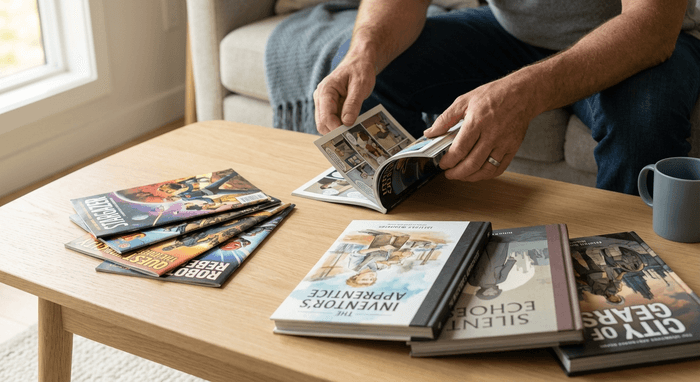
TL;DR: If you’re worried that your kid is "cheating" by reading books with pictures, take a breath. Visual storytelling is real literacy that builds complex inference skills. Whether they’re into the weekly "floppy" comic books, thick graphic novels, or scrolling through Webtoon on their phone, they are reading.
Top Recommendations to Get Started:
- Ages 6-9: Dog Man or InvestiGators
- Ages 8-12: Smile by Raina Telgemeier or Wings of Fire (Graphic Novel)
- Ages 12+: Heartstopper or American Born Chinese
We’ve all been there. You’re at the Scholastic Book Fair or browsing a local shop, and your kid bypasses the 300-page prose novel for a chunky book full of word bubbles and action panels. There’s a nagging voice in the back of your head—maybe one left over from your own childhood—asking, Is this actually good for their brain?
The short answer: Yes.
The long answer: Graphic novels and comic books require "multimodal literacy." A reader has to decode the text, interpret the facial expressions of the characters, understand the pacing of the panels, and bridge the "gutters" (the white space between panels) to figure out what happened in the moments the author didn't draw. For a kid who struggles with focus or has dyslexia, visual storytelling provides the context clues they need to stay engaged rather than getting frustrated and quitting.
In fact, our community data shows that by 4th grade, nearly 65% of students identify a graphic novel as their favorite thing to read. Forcing a "traditional" book on a kid who loves visual media is a great way to make them hate reading altogether.
Learn more about visual literacy and brain development
If you're confused by the terminology your kid (or the person at the comic shop) is using, here’s the breakdown:
Comic Books ("Floppies")
These are the thin, stapled magazines you find in those long white boxes. They usually come out once a month and tell one small piece of a much larger story. They’re called "floppies" because, well, they’re flimsy.
- The Vibe: Collectible, ephemeral, and often part of a massive "universe" like Marvel or DC.
- The Trap: It’s a subscription model for your wallet. If they like Spider-Man, they’ll want the new issue every month.
Trade Paperbacks ("Trades")
When a comic book series finishes a 5 or 6-issue story arc, the publisher glues them together into a single book with a spine.
- The Vibe: Much better for the bookshelf. If your kid says they want "Volume 1" of The Unbeatable Squirrel Girl, they're looking for a trade.
Graphic Novels
Technically, these are standalone stories written and published as a single, thick book. They aren't serialized first. Think of them as a "movie" versus a "TV show."
- The Vibe: High literary merit. These are the books winning Newbery Medals and National Book Awards. Examples include New Kid by Jerry Craft or El Deafo.
If your kid is over the age of 11, they’ve likely moved past the physical book aisle and into the digital "infinite scroll."
This is the YouTube of comics. It’s an app where creators post vertical-scrolling comics. It is massive with Gen Z and Gen Alpha. It’s free to use (mostly), but it’s the Wild West. While there are amazing stories like Lore Olympus, there is also plenty of "brain rot" and adult content that is only a swipe away.
These are Japanese comics, usually read right-to-left. If your kid is obsessed with Demon Slayer or Naruto, they are reading manga.
- Note: Manga has very specific age ratings. "Shonen" is for boys/teens, "Shojo" is for girls/teens, and "Seinen" is for adults. Do not assume that just because it’s a "comic" it’s for kids. Some manga is more graphic than an R-rated movie.
Ages 6-9: The Gateway Drugs
At this age, it’s all about humor and slapstick. They want to laugh, and they want to feel like they can finish a "thick" book quickly.
- It’s crude, the spelling is intentionally bad (because it's "written" by kids), and parents often hate it. But it is the single most effective tool for turning non-readers into readers.
- Great for kids who like heist movies and anti-heroes. It’s funny, fast-paced, and has a great movie adaptation too.
Ages 8-12: The Emotional Middle Grade
This is the sweet spot for graphic novels. Kids are dealing with friendship drama, puberty, and school stress.
- This is the "Harry Potter" of graphic novels for this generation. It’s an autobiographical story about getting braces and navigating middle school. It’s essential reading.
- A brilliant modernization of the classic series. It keeps the heart of the original but makes it feel relevant to 2025.
- If your kid wants fantasy and high stakes, this is the series. The art is cinematic and stunning.
Ages 13+: The YA Deep Dives
- A very sweet, wholesome LGBTQ+ romance. It’s a massive hit and much better than the Netflix show, though the show is also quite good.
- A genre-bending story about a shapeshifter. It’s funny, heartbreaking, and deals with some heavy themes about authority and identity.
Check out our full guide on graphic novels for reluctant readers
While the "Real Reading" debate is mostly settled (it's real reading, period), there are actual things to worry about:
- Violence and Gore: Western comics (Marvel/DC) can get surprisingly dark. A "Batman" comic from the 1960s is not the same as a "Batman" comic from 2024. Always check the rating on the cover (T for Teen, M for Mature).
- The "Infinite Scroll" Addiction: Apps like Webtoon are designed with the same dopamine loops as TikTok. It’s very easy for a kid to spend four hours "reading" while actually just scrolling through endless panels.
- Monetization: Digital comic apps often use "Coins" or "Fast Pass" systems. It’s the same "draining the bank account" logic as Roblox. They'll get to a cliffhanger and need to pay $0.99 to see the next chapter immediately.
Get instructions for setting up parental controls on Webtoon
Instead of asking "When are you going to read a real book?" try these conversation starters:
- "The art in this panel is incredible—how do you think the character is feeling right here without them saying a word?"
- "I noticed you're reading Wings of Fire as a graphic novel. How is it different from the prose version?"
- "Who is your favorite artist? I like the way they use color to show the mood."
Graphic novels and comic books are not a "lesser" form of media. They are a bridge. For some kids, they are the bridge to prose. For others, they are the bridge to a career in animation, design, or storytelling.
If your kid has their nose in a book—even if that book has more illustrations than adjectives—you’re winning. Let them read the "brain rot" (looking at you, Skibidi Toilet fan comics), but also point them toward the masterpieces.
Next Steps:
- Visit a Local Comic Shop: Let them pick out one "floppy" and one "graphic novel."
- Check the Digital Settings: If they use Marvel Unlimited or Webtoon, check the age filters.
- Read one yourself: Pick up Smile or American Born Chinese. You might be surprised at how much you actually enjoy it.