

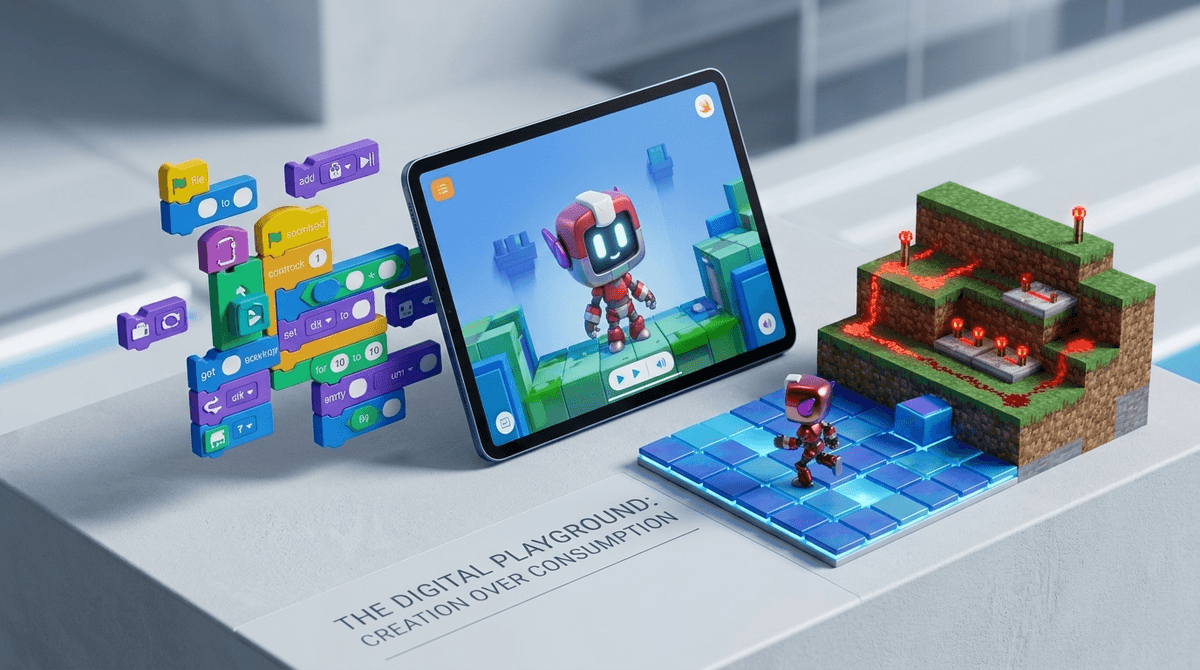
TL;DR: The Short List If you want to skip the "edutainment" apps that are basically just digital sticker books and get straight to the tools that actually build logic and syntax, here are the heavy hitters:
- Best for Ages 5-7: Lightbot (Logic without the reading requirement)
- Best for Ages 8-12: Scratch (The gold standard for block-based coding)
- Best for Gamified Learning: CodeCombat (Real Python/JavaScript in a dungeon crawler)
- Best for Apple Users: Swift Playgrounds (Professional Swift code on an iPad)
- Best for "Secret" Learning: Minecraft (Redstone is basically electrical engineering)
We’ve all seen the ads: "Your kid will be the next Mark Zuckerberg by playing this candy-matching game!" Most apps labeled as "coding for kids" are actually just logic puzzles. While logic is great, there’s a massive gap between dragging an arrow to move a fuzzy character and actually understanding how to structure a loop or debug a script.
The goal isn't necessarily to turn every kid into a software engineer. It's about computational thinking. Can they break a big problem into small steps? Can they spot a pattern? Can they handle the frustration of a program not working without throwing the tablet across the room?
If an app does all the work for them, they aren't learning to code; they’re just playing a game with a "coding" skin. Here are the tools that actually move the needle.
Lightbot is the "no-BS" entry point. There is zero text. Your kid just has to get a little robot to light up certain tiles. It sounds simple, but within twenty minutes, they are accidentally learning about functions and recursion. It’s the purest way to teach the "if this, then that" mindset without the frustration of typing.
Developed by the Lifelong Kindergarten Group at the MIT Media Lab, Scratch is the undisputed king of block-based coding. Instead of typing code (where a single misplaced semicolon ruins everything), kids snap blocks together like LEGOs.
- Why it works: It allows for total creativity. They aren't solving someone else's puzzle; they are building their own YouTube-style animations or games.
- The Caveat: The Scratch community is a social network. While it’s heavily moderated, it’s the first place many kids encounter "comments" from strangers.
If Scratch feels a bit too "open-ended" and your kid needs more direction, Tynker is the answer. It’s more structured, with specific paths for Minecraft modding and game design. It eventually bridges the gap from blocks to real Python code, which is a huge win for keeping them engaged as they get older.
If you have an iPad or a Mac, this is arguably the best-designed coding app ever made. Swift Playgrounds teaches Swift—the actual language used to build every app on your iPhone. It starts with a 3D world where you control a character named Byte, but you aren't dragging blocks; you are choosing real commands from a list. By the time they finish the advanced levels, they are actually building functional apps. It’s professional, sleek, and zero fluff.
Most kids would rather play a game than take a class. CodeCombat realizes this. It’s a dungeon-crawler RPG where your character’s "attacks" and "movements" are written in Python or JavaScript.
If they want to defeat the ogre, they have to write a while-true loop. It’s addictive, and the transition from "I'm playing a game" to "I'm writing 50 lines of Python" is almost seamless.
We can't talk about coding without talking about the Roblox elephant in the room. While most kids just spend Robux on digital hats, the ones who open Roblox Studio on a PC or Mac are learning Luau (a version of Lua). This is "industrial-strength" learning. If your kid wants to make a simulator that actually works, they have to learn variables, events, and functions. It is a steep learning curve, but the payoff—having thousands of other kids play their game—is a massive dopamine hit that keeps them learning.
Check out our guide on whether Roblox is actually educational
- Ages 5-7: Stick to "unplugged" coding or Lightbot. Focus on the concept that "computers are dumb and only do exactly what you tell them."
- Ages 8-11: This is the Scratch sweet spot. Don't worry about "real" languages yet. The logic is what matters. If they can build a complex game in Scratch, they can learn Python in a weekend later on.
- Ages 12+: If they’re still interested, move them to Swift Playgrounds or CodeCombat. This is where they start to see that coding is a tool to build real things, not just a school subject.
Coding apps are generally the "Green Veggies" of the digital world. They are low-risk, high-reward. However, two things to watch:
- Forums and Galleries: Platforms like Scratch and Roblox allow kids to share their work. This means they can see comments from others. It’s usually supportive ("How did you do that script?!"), but it’s still a social entry point.
- The "Expert" Trap: Some kids get frustrated because their game doesn't look like Fortnite. Remind them that Fortnite was built by hundreds of adults with millions of dollars, not one kid in a bedroom.
You don't need to know how to code to help them. In fact, it's better if you don't. When they get stuck (and they will), don't find the answer for them. Ask them to "Rubber Duck" it—this is a real programmer technique where you explain your code line-by-line to a rubber duck (or a parent) until you realize where you messed up.
Also, be aware of the "Brain Rot" vs. "Building" distinction. If your kid is on YouTube watching someone else code, that’s passive. If they are in Scratch breaking things, that’s active. We want active.
Learn more about the difference between passive and active screen time
Coding isn't a magic spell that makes kids geniuses, but it is one of the few digital activities that moves them from being consumers to creators.
Start with Lightbot for the logic, move to Scratch for the creativity, and if they have the itch to build something "real," point them toward Swift Playgrounds or Roblox Studio.
Even if they never write a line of code for a living, the ability to look at a complex problem and say, "I can break this down," is a superpower they’ll use forever.