

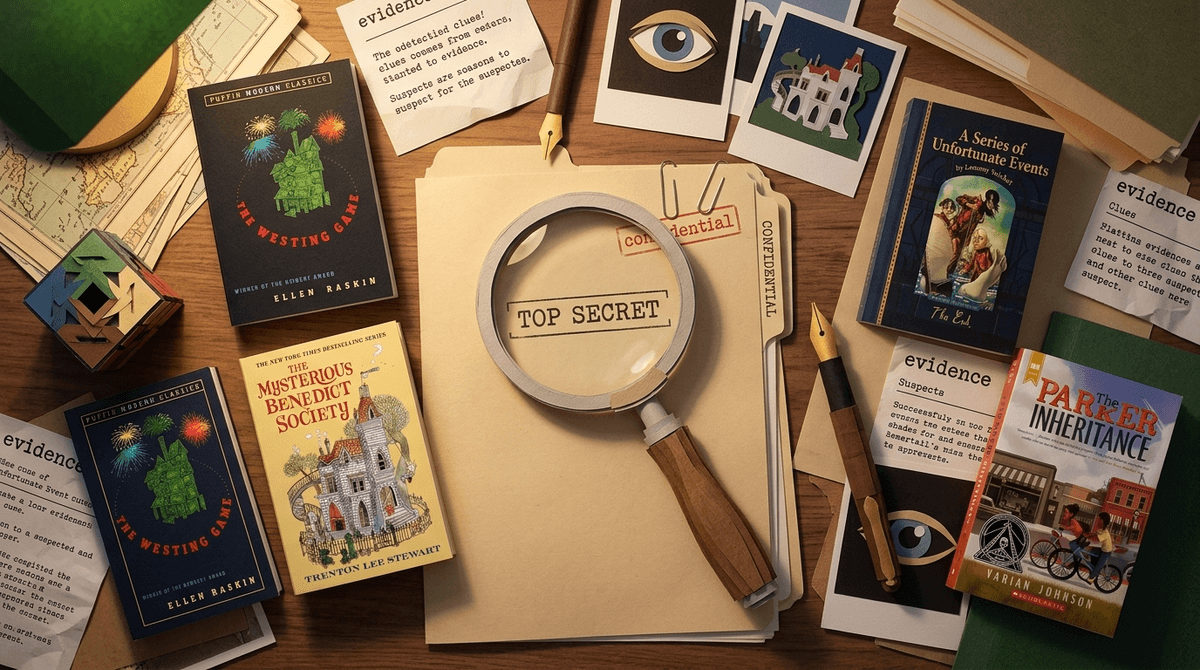
TL;DR: If you want to raise a kid who doesn't fall for every "free Robux" scam or clickbait "Skibidi" thumbnail, you have to train their "BS detector" early. These chapter books aren't just stories; they’re logic puzzles that teach kids how to spot patterns, question motives, and solve problems using evidence.
Top Recommendations:
- The OG Logic Builder: The Westing Game
- For the Puzzle Obsessed: The Mysterious Benedict Society
- Gamified Reading: Escape from Mr. Lemoncello's Library
- For Social Logic: The Parker Inheritance
- The Modern Classic: Greenglass House
We talk a lot about "media literacy" like it’s this high-level college course, but in 2026, it’s basically a survival skill. Between AI-generated deepfakes, YouTube thumbnails designed to hijack a child's dopamine, and the general "Ohio" energy of the internet (where everything is weird, chaotic, and context-free), our kids' brains are being pelted with information 24/7.
If we want them to navigate the digital world without getting scammed or "brain-rotted," we need to build their analytical grit. And honestly? The best way to do that isn't a lecture or a screen-time lock—it's a really good mystery novel.
When a kid reads a book that requires them to track clues, question an unreliable narrator, or solve a cipher alongside the protagonist, they are doing the heavy lifting of critical thinking. They’re learning that things aren’t always what they seem, that people have hidden motives, and that evidence matters.
Here are the chapter books that actually build those "detective" muscles.
Before we get into the list, let’s be real about why this matters for your family's digital life.
Think about Among Us. To win, a kid has to use deductive reasoning. They have to think: "If Blue was in Electrical, but the body was in MedBay, Blue couldn't have done it... unless they used a vent." That is pure logic.
Now, apply that to a TikTok trend or a sketchy Roblox link. A kid with high critical thinking skills is much more likely to pause and ask, "Wait, why would this person give me 10,000 Robux for free? What's the catch?"
Reading logic-driven stories builds the "pre-frontal cortex" muscles they need to make those calls. It moves them from being passive consumers of content to active investigators of their world.
Learn more about how to talk to your kids about online scams
Ages 8-12 If you haven't read this since you were a kid, it's time for a reread. It is the gold standard of "fair play" mysteries. Sixteen heirs are gathered for the reading of a will, and they have to solve a massive puzzle to win the inheritance. Why it builds grit: It’s complicated. It doesn't talk down to kids. It forces them to keep track of a large cast of characters and realize that everyone—even the "nice" characters—is hiding something. It’s the ultimate antidote to the "fast-food" content they get on YouTube Shorts.
Ages 9-13 This book is basically a love letter to gifted, weird kids who think outside the box. A group of children are recruited via a series of bizarre tests (logic puzzles, ethical dilemmas) to go undercover at an institute that is literally using "brain rot" (subliminal messages) to take over the world. Why it matters: It explicitly teaches that intelligence isn't just about knowing facts—it's about how you use your mind under pressure. Plus, the villain's plot is a fantastic metaphor for how digital media can manipulate our thoughts.
Ages 8-12 Think of this as Charlie and the Chocolate Factory but with a high-tech library and a lot of boardgame logic. The kids are locked in a futuristic library and have to find their way out using literary clues and puzzles. Why it works: It bridges the gap between gaming and reading. If your kid loves Minecraft or escape rooms, this is their gateway drug to chapter books. It makes "thinking" feel like a sport.
Ages 7-10 Look, these are old. Some of the "clues" are dated (like knowing how a manual typewriter works), but the format is still genius. Each chapter is a mini-mystery where the solution is hidden in the text, and the answer is in the back of the book. No-BS Review: Some of the solutions are a bit "gotcha!" and might frustrate a literal-minded kid. But as a tool for teaching kids to pay attention to the details of what they read, it’s still unbeatable.
Ages 10-14 This is a modern masterpiece. It combines a "Westing Game" style puzzle with deep, real-world history about social justice and racial tension in the American South. Why it builds critical thinking: It asks kids to solve two mysteries at once: the historical one and the present-day one. It teaches them that to understand the present, you have to be a detective about the past. It’s sophisticated, challenging, and incredibly rewarding.
Ages 8-12 While not a traditional "whodunnit," this series is a masterclass in media literacy. The narrator constantly breaks the fourth wall, defines complex vocabulary, and points out the absurdity and incompetence of the adult world. Why it’s essential: It teaches kids to be skeptical. It shows them that just because someone is in a position of authority (like Count Olaf in a bad disguise) doesn't mean they are telling the truth. That’s a 10/10 skill for the internet.
When picking these books, keep in mind your child's "frustration threshold." Critical thinking books are meant to be a challenge, but if they're too hard, the kid will just go back to watching MrBeast (no shade, but it's a different brain state).
- Grades 2-3: Start with "early chapter" mysteries like Nate the Great. They are short, the logic is linear, and they build confidence.
- Grades 4-6: This is the sweet spot for The Mysterious Benedict Society and Greenglass House. They can handle subplots and red herrings.
- Grades 7+: Move into YA mysteries like A Good Girl's Guide to Murder. These involve more complex social engineering and digital forensics (searching social media for clues), which is very relatable for teens.
Check out our guide on the best mystery books for middle schoolers
If you want to actually build these skills, you can't just hand them the book and walk away. You have to engage with the "detective" side of their brain.
- The "Stop and Predict" Method: When you're reading together (or even if they're reading solo and you're just chatting at dinner), ask: "Who do you think did it? What's your evidence?" If they say "I just have a feeling," push them. "What did the character say that makes you think that?"
- Highlight the Red Herrings: Talk about how authors try to trick us. Ask: "Why did the author want us to think it was the butler? How did they distract us?" This is the direct precursor to understanding how "clickbait" works on YouTube.
- Gamify the Logic: If they love a book, find the boardgame equivalent. Playing Clue or Codenames reinforces the same deductive reasoning they’re finding in the chapters.
We can't protect our kids from every confusing or misleading thing they’ll encounter online. The "Skibidi" era of the internet is loud, fast, and often nonsensical. But we can give them the tools to process it.
A kid who has spent hours trying to figure out the secret of The Westing Game is a kid who knows how to slow down, look at the facts, and spot a fake from a mile away. That’s not just being a good student; that’s being Screenwise.
- Take the Survey: Curious how your kid's reading habits stack up against their digital habits? Take our family tech survey.
- Build a Library: Grab one of the books above and commit to reading the first three chapters out loud together.
- Ask the Bot: Find a mystery book for kids who love Among Us