

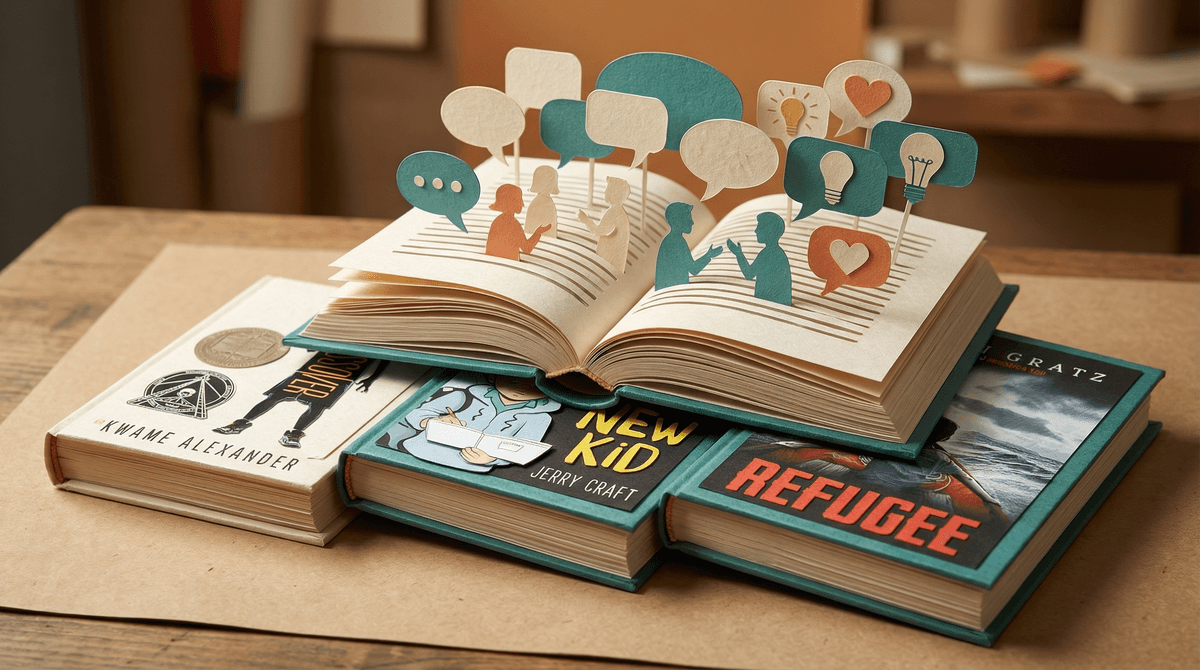
Books Worth Discussing: Turning Page-Turners into Conversations
You know that feeling when your kid finishes a book and you ask "Did you like it?" and they say "Yeah" and that's... it? Meanwhile, that book tackled friendship betrayal, or had a character dealing with divorce, or explored what it means to be brave when you're scared, and you just got a "yeah."
Here's the thing: books are one of the best tools we have for talking about hard stuff with our kids. They're safer than direct confrontation ("So, I noticed you excluded Emma at recess..."), more engaging than abstract lectures about values, and they give kids a way to process big feelings through characters who aren't them.
But it requires actually, you know, talking about the books. Not in a book report way. In a real conversation way.
Kids are navigating increasingly complex social and emotional terrain. They're dealing with social media pressure (even if they're not on it yet, their friends are). They're watching world events unfold in real-time. They're forming their identities in a world that's simultaneously more connected and more divided than ever.
And here's what's wild: they're often more willing to talk about hard topics through the lens of a story than through direct questioning. A kid who shuts down when you ask about their day might have a lot to say about why Auggie from Wonder by R.J. Palacio didn't tell his parents about being bullied.
Books create emotional distance that paradoxically allows for emotional closeness. Your kid can talk about Percy Jackson's relationship with his mom without talking about their relationship with you—but they're still processing those same feelings about loyalty, protection, and growing up.
Not every book needs to be a deep dive. Sometimes Diary of a Wimpy Kid is just funny and that's perfect. But books worth discussing usually have:
Characters making real choices with consequences. Not just "the hero defeats the villain," but "the hero has to choose between two friends" or "the character lies to protect someone and it backfires."
Situations that mirror real life. Even in fantasy settings. Harry Potter isn't just about magic—it's about chosen family, standing up to authority when authority is wrong, and how prejudice gets normalized.
Emotional complexity. Good guys who mess up. "Bad guys" who have reasons for their behavior. Situations where there's no clear right answer.
Themes that connect to your kid's life. A book about a kid changing schools hits different when your kid is about to change schools. The Hate U Give lands differently depending on your family's experiences with race and justice.
Ages 6-8: Start with questions about feelings and choices.
- "How do you think Frog felt when Toad said that?"
- "What would you have done?"
- "Was that fair?"
Books like Charlotte's Web or The One and Only Ivan work beautifully here—they deal with real themes (death, captivity, friendship) in age-appropriate ways.
Ages 8-11: Go deeper into motivation and consequences.
- "Why do you think they made that choice?"
- "What else could they have done?"
- "Have you ever felt like that?"
This is prime time for books like Wonder, Fish in a Tree, or New Kid—stories that tackle identity, difference, and social dynamics head-on.
Ages 11-14: Welcome to the gray areas.
- "Was that character right or wrong? Both?"
- "How would this story be different from another character's perspective?"
- "What would you do in that situation, knowing what you know about yourself?"
The Giver, Refugee, and Stamped are excellent for this age—they don't have easy answers, which is exactly the point.
Don't make it feel like homework. The fastest way to kill a good book discussion is to make your kid feel like they're being quizzed. These conversations happen best in the car, at bedtime, while making dinner—not sitting at the table with a list of questions.
Read what they're reading. I know, I know—you have seventeen books on your own nightstand. But you cannot have a real conversation about a book you haven't read. You don't have to read everything, but pick the ones that seem important or that your kid is really into.
Share your own reactions. "I was so mad when she did that" or "I didn't see that coming" makes it a conversation, not an interrogation. Model that it's okay to have strong feelings about stories.
Use the book to talk about the thing you actually want to talk about. Your kid's friend group is fracturing? Perfect time to discuss how the characters in Smile navigate changing friendships. Your kid is struggling with self-esteem? Insignificant Events in the Life of a Cactus opens that door.
Respect their interpretations. Even when they're different from yours. Especially when they're different from yours. If your kid sympathizes with a character you found frustrating, that's information about how your kid sees the world.
On identity and fitting in:
- The Crossover (family, brotherhood, growing apart)
- Front Desk (immigration, economic struggle, resourcefulness)
- Ghost (trauma, mentorship, second chances)
On social justice and fairness:
- As Brave As You (family, masculinity, what courage means)
- Roll of Thunder, Hear My Cry (racism, dignity, standing up)
- A Long Walk to Water (survival, privilege, perseverance)
On friendship and loyalty:
- Bridge to Terabithia (friendship, loss, imagination)
- El Deafo (disability, real friendship vs. pity friendship)
- Merci Suárez Changes Gears (family, class differences, authenticity)
The best conversations about values, choices, and navigating a complicated world don't usually start with "We need to talk about..." They start with "So what did you think about when she..."
Books give you a shared language and a safe space to explore hard topics. They let your kid practice thinking through complex situations without real-world stakes. And they create connection—you and your kid, on the same team, figuring out the story together.
You don't need to turn every book into a philosophy seminar. But when you find a book that resonates, that touches on something your kid is dealing with or something you want them to think about—lean into it. Ask questions. Share your thoughts. Listen to theirs.
Because ultimately, these conversations aren't really about the books at all. They're about helping your kid develop their moral compass, their empathy, their critical thinking. The books are just the excuse to have the conversation.
Start small. Pick one book your kid is currently reading or just finished. Ask one genuine question about it. Not "did you like it" but "what surprised you" or "which character would you want as a friend?"
Create a family book club. Doesn't have to be formal. Just everyone reads the same book and you talk about it over pizza. Even better if kids get to pick some of the books.
Use Screenwise to find books that match what your kid needs right now. Struggling with anxiety? There are books for that. Dealing with friendship drama? Books for that too. Explore books worth discussing based on what your family is navigating .
.
The conversations are worth it. I promise.