

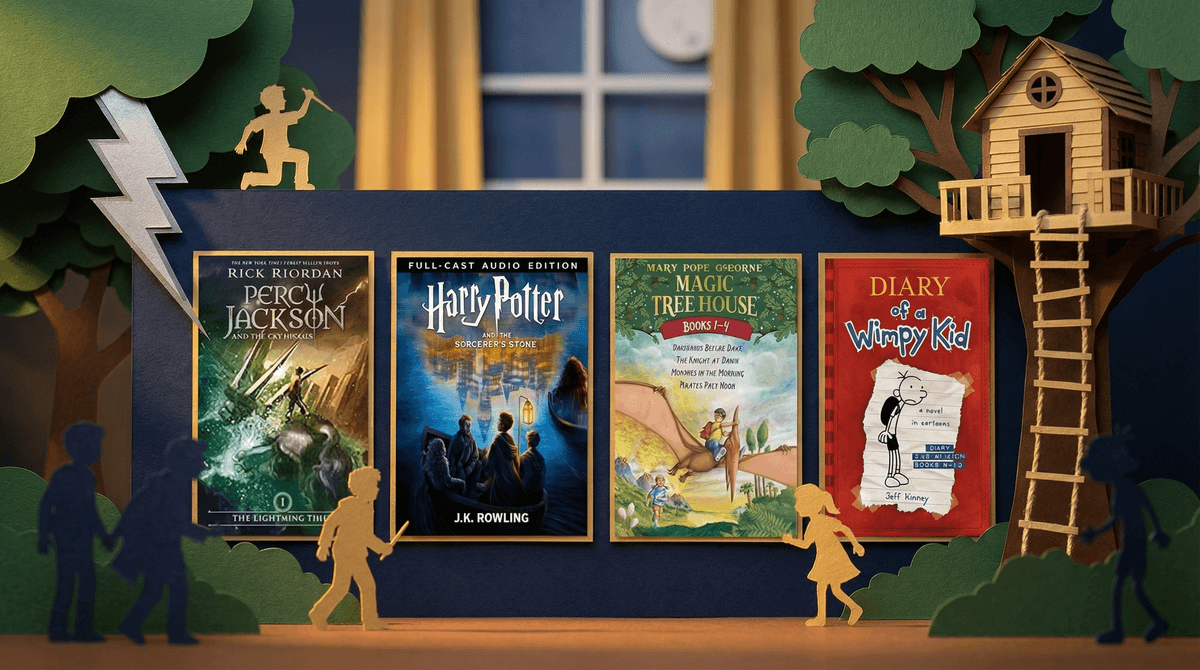
Look, in a world where we're constantly battling screens for our kids' attention, book series are basically the secret weapon hiding in plain sight. They're collections of books featuring the same characters, worlds, or themes that keep kids coming back for more. Think of them as the literary equivalent of binge-watching — but actually good for developing brains.
The magic of a book series is simple: once a kid connects with the characters and world, they don't want to stop. They've already done the hard work of getting invested, and now they just want MORE. It's like when your kid finally agrees to try a new food and actually likes it — you're going to serve that thing on repeat for a while.
Here's the thing: starting a new book requires mental energy. New characters, new settings, new rules of the world. It's work. But with a series? Your kid already knows Percy Jackson is going to be sarcastic and brave, already understands how Hogwarts operates, already gets the vibe of Wimpy Kid's world. They can just... read.
Series create comfort and anticipation simultaneously. Kids get the cozy feeling of reuniting with book-friends while still experiencing new adventures. It's predictable enough to feel safe, unpredictable enough to stay interesting.
And let's be real — for reluctant readers especially, series are game-changers. That "just one more chapter" feeling that keeps them reading past bedtime? That's what we're after. When a kid who "doesn't like reading" suddenly tears through seven books in a series, that's not magic — that's just good storytelling doing its job.
The biggest mistake parents make is buying an entire series upfront. I get it — the box sets are beautiful, they're on sale, and you're feeling optimistic. But here's your move: start with book one from the library.
Match Interest First, Reading Level Second
Forget the "recommended age" on the back cover for a minute. What's your kid actually into right now?
- Obsessed with Greek myths? Try Percy Jackson (ages 9-12) or The Kane Chronicles for Egyptian mythology fans.
- Can't stop talking about animals? Warriors (ages 8-12) has like 80 books about cat clans, and yes, kids read them all.
- Into mysteries? Nancy Drew still hits (ages 8-12), or try The 39 Clues for something more modern.
- Loves Minecraft? There are official Minecraft novels that are actually decent gateway books.
- Diary/journal format fans? Diary of a Wimpy Kid (ages 8-12) or Dork Diaries (ages 9-12) make reading feel less intimidating.
The Reading Level Reality Check
Yes, reading level matters, but not how you think. A kid who's "reading below grade level" but LOVES the book will learn more than a kid reading "appropriately challenging" books they hate.
For early/emerging readers (ages 6-8):
- Dog Man — graphic novels that are genuinely funny
- Junie B. Jones — short chapters, big personality
- Magic Tree House — 28 books of time-traveling adventures
For middle grade readers (ages 8-12):
- Harry Potter — the series that got a generation reading (note: books get darker/longer as they progress)
- Wings of Fire — dragon fantasy that's wildly popular right now
- The Baby-Sitters Club — nostalgic for parents, still relevant for kids
For strong/older readers (ages 10-14):
- The Hunger Games — if they can handle the violence
- A Series of Unfortunate Events — darkly funny with sophisticated vocabulary
- The Land of Stories — fairy tale mashups that are clever without being condescending
Some parents worry that graphic novels "don't count" as real reading. Let me be direct: that's nonsense. Dog Man, Amulet, Smile — these are legitimate books that require reading comprehension, visual literacy, and inference skills.
If graphic novel series are the gateway drug to reading, great. Your kid won't be reading graphic novels forever (though some adults still do, and that's fine too). They're building the habit of reading for pleasure, which is the whole point.
Series Can Get Expensive
Here's where that library card becomes your best friend. Most library systems now have apps like Libby where kids can check out ebooks and audiobooks instantly. No late fees, no lost books, no spending $15 per book.
If your kid truly loves a series, buy books 1-3 used or on sale. If they're still obsessed after that, then commit to the rest.
Not All Series Age Well
Some series start great for 8-year-olds but by book 5, the content has matured significantly. Harry Potter is the classic example — book 1 is whimsical, book 7 has war and death and trauma. Read ahead or check Common Sense Media if you're concerned.
The Series That Won't End
Some series have 40+ books (Warriors, Magic Tree House). This is actually great for reluctant readers — they never have to face the anxiety of "what do I read next?" But it can also become a crutch. If your kid has read 20 books in one series and refuses to try anything else, it might be time to gently expand horizons.
The Social Element
In many elementary and middle schools, certain book series become social currency. Kids bond over shared stories, trade books, discuss theories. This is genuinely valuable — it's creating a reading community. If your kid wants to read Wings of Fire because "everyone at school is reading it," that's a perfectly valid reason.
Book series are one of the best tools we have for creating lifelong readers. They remove friction, build confidence, and make reading feel like something kids want to do rather than something they have to do.
Start with your kid's interests, not their reading level. Use the library liberally. Don't dismiss graphic novels. And remember: a kid reading "below their level" is infinitely better than a kid not reading at all.
The goal isn't to have your kid reading Tolstoy by age 10. The goal is to help them discover that books can be as engaging, funny, and addictive as any screen — just in a way that builds their brain instead of fragmenting their attention.
This week: Ask your kid what they're interested in right now (not what they "should" read, but what actually sounds cool). Check out book one of a series that matches that interest from your library. Read it together if they're younger, or just make it available if they're older.
If they love it: Get books 2-3 and see if the momentum continues. If they devour those too, you've found your series.
If they don't: No big deal. Try something else. The right series is out there — it just might take a few tries to find it.
Want help finding the perfect series for your specific kid? Get book recommendations based on your child's interests and reading level .
.