

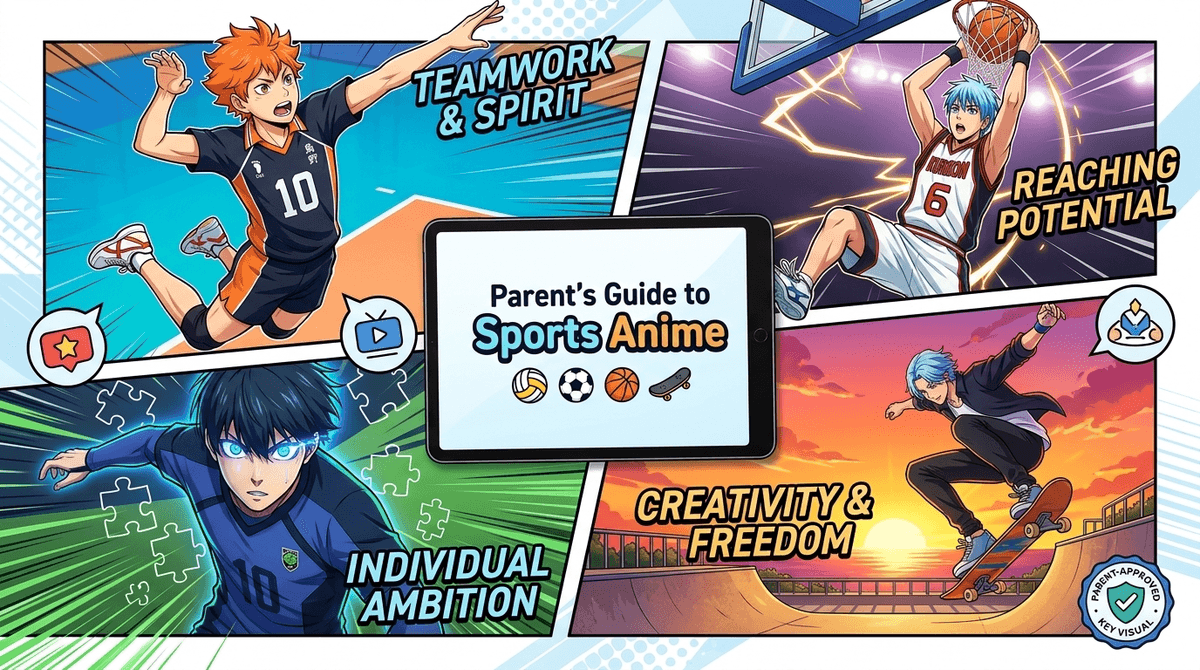
TL;DR: The Quick List
If you’re looking to swap out the mindless YouTube shorts for something with a plot, character development, and a dash of athletic inspiration, sports anime (known as spokon) is a fantastic pivot. Here are the top picks:
- The Gold Standard: Haikyu!! – Pure, unadulterated teamwork and resilience.
- The "Egoist" Choice: Blue Lock – Intense, competitive, and focuses on individual greatness over "friendship power."
- The Flashy One: Kuroko's Basketball – Basketball with basically "superpowers." High engagement for kids.
- The Underdog Story: Yowamushi Pedal – A nerdy kid discovers he’s a cycling prodigy.
- The Vibe: Sk8 the Infinity – Colorful, fast-paced skateboarding with a focus on find-your-joy.
Find sports anime for an 11-year-old who loves soccer
In the anime world, the sports genre is called spokon (a portmanteau of "sports" and "konjo," which means "guts" or "tenacity"). These aren't just cartoons about playing a game; they are high-stakes dramas where the "battlefield" happens to be a volleyball court or a soccer pitch.
For parents, sports anime is often a "safe harbor" in the vast sea of anime content. While mainstream hits like Demon Slayer or Jujutsu Kaisen involve literal life-and-death sword fights and monsters, sports anime channels that same "shonen" energy (aimed at young teens) into something relatable: practice, failure, teamwork, and the pursuit of a goal.
It’s the same reason we get sucked into the Olympics or a Game 7. The animation in modern shows is incredible—we’re talking cinematic camera angles during a dunk or a serve that make real-life sports look slow by comparison.
Beyond the visuals, these shows tap into the "power of friendship" trope that kids crave, but they also validate the struggle. Seeing a protagonist fail to make a team or lose a big game and then spend three episodes training to get better is a much healthier narrative than the "instant win" culture often found in Roblox simulators.
Best for: Ages 10+ If you watch one anime on this list, make it this one. It follows Shoyo Hinata, a short kid who wants to be a volleyball star despite his height. It is the most wholesome, high-energy, and genuinely moving show in the genre.
- The Lesson: It teaches that everyone has a role to play. Even the "bench warmers" get character arcs. It’s about the synergy of a team rather than one star carrying everyone.
- Parent Note: There is some mild "locker room" humor and the occasional "damn" or "hell," but it’s exceptionally clean compared to the rest of the genre.
Best for: Ages 12+ (due to intensity and attitude) This is the "anti-Haikyu." In Blue Lock, the Japanese football association decides that "teamwork" is why they keep losing the World Cup. They create a prison-like facility to train 300 strikers to be the ultimate "egoist."
- The Lesson: This is a conversation starter about individualism vs. teamwork. It’s about the drive to be the best and the "hunger" required to win.
- Parent Note: It’s aggressive. Characters are frequently told to "crush the dreams" of others. If your kid is already struggling with sportsmanship on their real-life soccer team, this might reinforce some "ball hog" tendencies.
Best for: Ages 10+ This is less a sports simulation and more of a superhero show where the medium is basketball. Players have "abilities"—one guy literally never misses a shot from anywhere on the court, another can "vanish."
- The Lesson: It’s about overcoming "talented" people through hard work and finding a partner who complements your skills.
- Parent Note: It’s very flashy and fast-paced. Great for kids who find traditional sports a bit slow.
Best for: Ages 12+ Set in Okinawa, this show revolves around an underground secret skateboarding race called "S." It’s vibrant, has an incredible soundtrack, and focuses on the pure joy of the sport rather than just winning trophies.
- The Lesson: It deals with the pressure parents put on kids to succeed and how that can kill the love for a hobby.
- Parent Note: There’s a flamboyant villain named Adam who can be a bit "extra" and might feel a little intense for younger kids, but the core friendship between the two leads is gold.
Best for: Ages 8+ Sakamichi Onoda is an otaku (anime nerd) who rides a clunky "mommy bike" to school every day. It turns out that riding 90km round-trip to buy anime merch gave him world-class leg strength.
- The Lesson: The ultimate underdog story. It’s about finding your "tribe" in the most unexpected places.
- Parent Note: This is one of the more "all-ages" friendly options. It's very earnest and lacks the "edginess" of the newer shows.
Most sports anime are rated TV-14, but don't let that scare you off. In the anime world, TV-14 often just means "there is some mild swearing and people get very sweaty and intense." Unlike Grand Theft Auto or South Park, the "maturity" here is usually just emotional intensity.
Language
Expect the standard "shonen" vocabulary: bastard, damn, hell, shut up. It’s rare to hear anything heavier, but the subtitles can sometimes be a bit more "colorful" than the dubbed versions.
Violence
It’s sports violence. Collisions on the field, nosebleeds from a stray ball, or the occasional scuffle between rivals. If your kid can handle a PG-13 Marvel movie, they can handle the physical stakes of Blue Lock.
Fanservice
This is the one to watch out for. Some anime (like Free! - Iwatobi Swim Club) lean heavily into "fanservice"—which in the context of sports anime usually means lingering shots of muscular, shirtless guys. It's generally harmless but can feel a bit "thirst-trappy" for a younger audience.
Check out our guide on understanding anime ratings and tropes
The "Ego" vs. "Team" Debate
The biggest shift in recent years is the move from the "teamwork makes the dream work" vibe of Haikyu!! to the "I am the best and I will destroy you" vibe of Blue Lock.
If your kid is watching Blue Lock, they are going to hear a lot about being an "egoist." In the show, this is framed as a positive—the refusal to settle for mediocrity. It’s worth having a dinner conversation about:
- Is it possible to be a great individual player and a great teammate?
- Why does the show think being "nice" is a weakness in sports?
The Streaming Landscape
Most of these are available on Crunchyroll, but a surprising amount have landed on Netflix and Hulu. If you’re worried about the ads or the "community" aspect of Crunchyroll, stick to Netflix where you have better parental controls.
Learn how to set up parental controls on Crunchyroll
If you see your kid getting obsessed with a specific series, use it as a bridge to real-world habits.
- The "Training Arc": When they’re frustrated with math or a piano piece, remind them of the "training arc." In anime, characters spend entire episodes doing the "boring stuff" to get to the "cool stuff."
- Handling Defeat: Sports anime handles losing better than almost any other medium. When a team loses in Haikyu!!, they cry, they eat a big meal, and they figure out what went wrong. It’s a great template for emotional regulation.
- Physical Activity: Don't be surprised if they suddenly want a volleyball or a high-end road bike. Use that momentum!
Sports anime is one of the "healthiest" sub-genres of digital media your kid can consume. It’s aspirational, it celebrates hard work, and it’s a far cry from the "brain rot" of mindless scrolling.
If you want the safest bet, start with Haikyu!!. If you have a middle schooler who likes things a bit more "edgy" and competitive, go with Blue Lock. Either way, you’re likely to find yourself leaning in to see if they make the final point, too.
- Audit their watchlist: See if they’ve already discovered these or if they’re stuck in the "isekai" (fantasy world) rabbit hole.
- Watch one episode together: The first episode of Haikyu!! is a masterclass in hook-based storytelling.
- Check the community: See what other parents in the Screenwise community are saying about Blue Lock and its influence on their kids' competitive drive.