

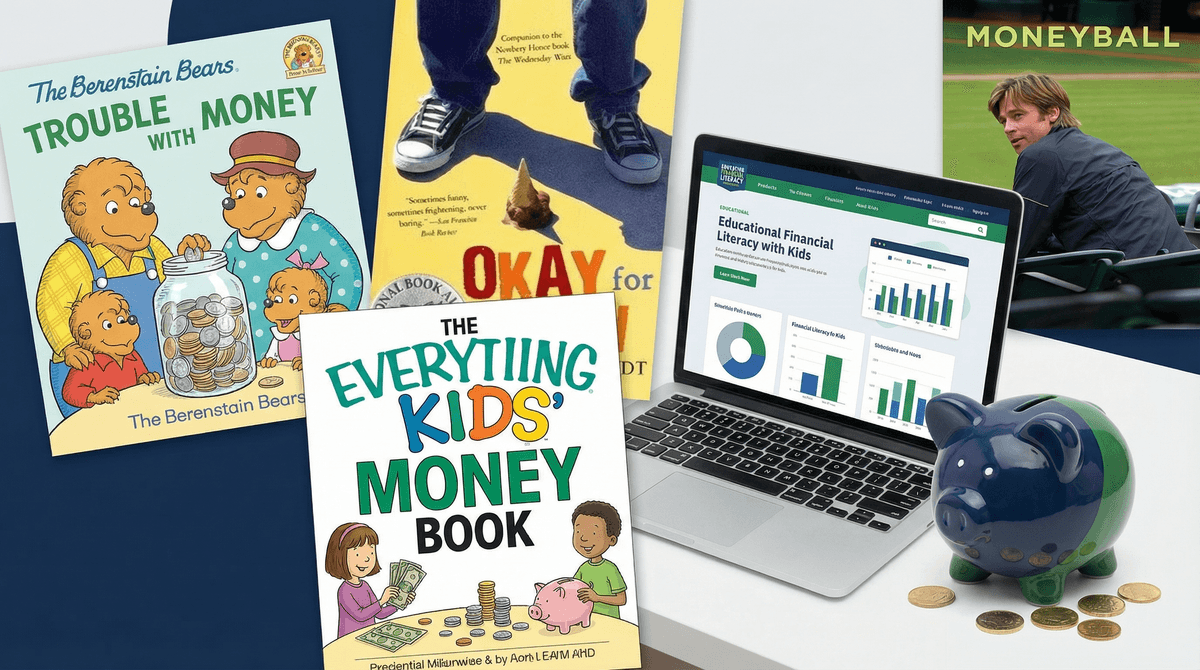
TL;DR: The Best Money-Teaching Media for Kids
Quick wins by age:
- Ages 5-8: The Berenstain Bears' Trouble with Money (book) + Thinking Money for Kids games (free online)
- Ages 9-12: Okay for Now by Gary D. Schmidt (book) + Moneyball (movie, PG-13)
- Ages 13+: Everything Kids Money (book) + interactive budgeting games
Financial literacy is one of those life skills that somehow never makes it into the school curriculum in any meaningful way, which means it falls squarely on us parents to figure out. And let's be honest—most of us are fumbling through our own relationship with money, let alone trying to teach it to our kids.
The good news? There's actually a solid lineup of books, movies, and interactive resources that can do the heavy lifting for you. The even better news? Many of them are free or library-available, and they're designed to make abstract money concepts feel concrete and manageable for kids.
Here's the reality: 42% of families in our community let their kids use YouTube solo, and a solid chunk of that viewing time is spent watching creators who are either flaunting wealth, promoting crypto schemes, or hawking merch. Kids are absorbing financial "lessons" whether we're teaching them or not—they're just getting them from Mr. Beast's latest giveaway or a Roblox influencer explaining how to "get rich" in-game.
Meanwhile, the average family in our data logs 4.2 hours of screen time daily. If even a fraction of that time went toward intentional financial literacy content, we'd be setting kids up with skills that actually compound over a lifetime.
Ages 9-12 | The pitch: A middle schooler takes on odd jobs, discovers a talent for bird illustration, and learns how hard work and mentorship build financial independence.
This one's a sleeper hit. It's not marketed as a "money book," but it's one of the best examples of showing (not telling) kids how earning works, how skills translate to income, and how small-scale entrepreneurship can grow. The protagonist isn't running a lemonade stand—he's navigating real work, real mentors, and real stakes. It's also just a genuinely beautiful story, so you're not force-feeding vegetables here.
Why it works: Kids see the protagonist's financial agency develop alongside his character growth. It's not preachy, it's not a worksheet—it's just a kid figuring out how to make his way in the world.
Ages 5-8 | The pitch: Classic picture book that introduces saving, sharing, and spending in a way that doesn't make your kindergartner's eyes glaze over.
This is part of the American Library Association's Thinking Money for Kids collection—a vetted, free, downloadable guide featuring 40 titles curated specifically for financial literacy. The Berenstain Bears version is a solid entry point because it's relatable, low-stakes, and gives you natural conversation starters about money decisions.
Bonus: The ALA guide comes with printable take-home sheets and discussion prompts, so you're not left wondering "okay, now what?" after you finish reading.
Ages 10-15 | The pitch: A workbook-style guide that breaks down allowances, saving goals, budgeting, and even intro investing concepts through kid-friendly language and activity prompts.
This is the book you hand to a tween who's starting to ask "why can't we just buy that?" or "how does a credit card work?" It's structured, it's actionable, and it doesn't assume kids are already fluent in financial jargon. Investopedia lists it as one of the top resources for a reason—it's comprehensive without being overwhelming.
Why it works: Kids can work through it semi-independently, which means you're not doing all the teaching. It's also flexible enough to adapt to your family's money philosophy (allowance vs. chore-based earning, etc.).
Ages 11+ | PG-13 | The pitch: Brad Pitt uses data-driven decision-making to build a winning baseball team on a shoestring budget.
This isn't a "kids' movie," but it's one of the best films about resource allocation, opportunity cost, and thinking creatively under financial constraints. If your tween is into sports, this is a natural entry point. If they're not, it still works as a story about problem-solving with limited resources—a concept that translates directly to personal finance.
Watch out for: Some mild language and adult themes, but nothing gratuitous. It's more "business meeting" than "action thriller."
The Federal Reserve Comic Book Series
Ages 8-12 | Free online | The pitch: Colorful, bite-sized stories that turn abstract monetary policy into something visual learners can actually grasp.
Yes, the Federal Reserve makes comics. No, they're not as boring as you'd think. These are especially useful for kids who struggle with text-heavy explanations but light up when they see concepts illustrated. You can download them for free, and they pair well with a book like Okay for Now to reinforce lessons about earning, saving, and decision-making.
The Thinking Money for Kids digital suite offers five free, web-based games that let kids practice financial concepts in simulated environments:
- Earning It – Explore different career paths and earning potential
- Balance My Budget – Manage a $300 budget across needs and wants
- Money Trail – Track $500 over time and see how decisions compound
- Let's Deal – Negotiation and trade-offs in a marketplace setting
- Pet Cents – Budgeting for pet care (huge hit with animal-loving kids)
Why these work: They're low-stakes, repeatable, and give kids immediate feedback. You can't "fail" in a way that costs real money, but the lessons stick because kids are actively making choices and seeing consequences.
Our take: Pair one of these games with a book (e.g., Okay for Now + Earning It) to give kids both a narrative hook and a hands-on rehearsal space. Research shows this combo approach improves retention of financial habits way more than lectures or one-off conversations.
| Age Range | Book | Movie/Show | Interactive Game |
|---|---|---|---|
| 5-8 years | The Berenstain Bears' Trouble with Money | – | Currency Catcher (coin values) |
| 9-12 years | Okay for Now | Moneyball | Earning It (career paths) |
| 13-15 years | Everything Kids Money | – | Balance My Budget |
| 16-18 years | Everything Kids Money (deeper chapters) | – | Money Trail |
Pro tip: Don't feel like you need to tackle all of these at once. Start with one book or one game and see what resonates. Financial literacy is a marathon, not a sprint.
You don't need to be a finance expert to teach this stuff. The whole point of these resources is that they do the explaining for you. Your job is to facilitate the conversation—ask questions like "What would you have done differently?" or "Why do you think that character made that choice?"
The Roblox question: If your kid is already deep into Roblox, you're probably wondering whether it's teaching entrepreneurship or just draining your bank account. Honest answer? It's both. Roblox can teach kids about in-game economies, supply and demand, and even basic coding/game design. But it can also teach them that Robux feels like fake money and that microtransactions are normal. Pairing Roblox time with one of these books or games gives kids the context to understand what's happening with their spending.
The YouTube reality: If your kid is watching finance content on YouTube (or just watching YouTubers who casually drop money references), it's worth having a conversation about what's real vs. what's performance. Mr. Beast's giveaways are entertaining, but they're not a financial education. Use these books and games to build a baseline so kids can critically evaluate what they're seeing online.
Financial literacy isn't something kids pick up by osmosis—it's something we have to actively teach. The good news is that there's a solid, vetted lineup of books, movies, and interactive resources that make it way less painful than you'd think.
Start with one book that fits your kid's age and interests. Add a game or movie if they're engaged. And remember: even small, consistent conversations about money add up over time. You're not aiming for perfection—you're aiming for progress.
Next step: Pick one resource from this list and try it this week. Browse more financial literacy resources or Get recommendations based on your kid's age and interests based on your kid's age and interests.