

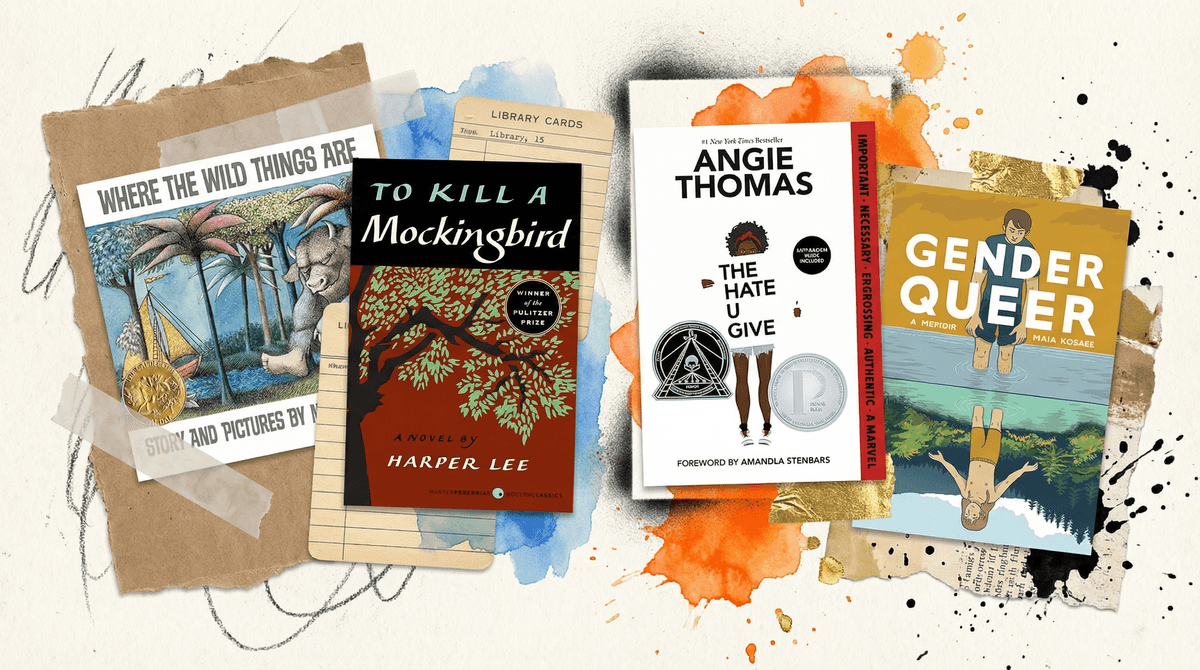
Let's get real: we're living in a moment where more books are being challenged and removed from school libraries than we've seen in decades. According to the American Library Association, over 4,000 unique book titles were targeted for censorship in 2023 alone. That's not a typo.
When we talk about "banned books," we're usually talking about books that have been challenged (someone formally requests removal) or actually removed from school libraries, classroom reading lists, or public libraries. Sometimes it's a single parent complaint. Sometimes it's an organized campaign. And sometimes it's administrators preemptively pulling books to avoid controversy.
The thing is, this isn't new. Books have been challenged forever—The Catcher in the Rye, To Kill a Mockingbird, even Where the Wild Things Are have all faced challenges. But what's different now is the scale, the coordination, and the types of books being targeted.
The most frequently challenged books today share some common themes:
- LGBTQ+ characters or themes (this is the big one right now)
- Discussion of racism and racial justice
- Sexual content (ranging from actual sex education to just acknowledging that teenagers think about sex)
- Profanity
- "Age-inappropriate" content (a genuinely subjective category)
Books like Gender Queer by Maia Kobabe, All Boys Aren't Blue by George M. Johnson, and The Bluest Eye by Toni Morrison have been among the most challenged in recent years. Even The Handmaid's Tale—a book warning about authoritarian control—is being banned in some places for being "too political."
Here's what's tricky: sometimes the concerns are legitimate questions about age-appropriateness. A book that's perfect for a 16-year-old might genuinely not be right for an 11-year-old. But often, the challenges aren't really about age—they're about whether kids should encounter certain ideas at all.
The "parental rights" framing can be misleading. You absolutely have the right to decide what YOUR kid reads. What you don't have is the right to decide what OTHER people's kids can access. That's the distinction that gets lost in these debates.
Most challenged books aren't on required reading lists. They're just available in the library. Nobody's forcing your kid to read This Book Is Gay—but another kid whose parents are fine with it should be able to check it out.
The books being challenged are often exactly what some kids need. A queer kid in a conservative town might find Heartstopper life-saving. A Black student might see themselves in The Hate U Give in a way they never have before. A kid dealing with sexual assault might find validation in Speak by Laurie Halse Anderson.
"Age-appropriate" is genuinely complicated. A book with mature themes isn't automatically inappropriate—it depends on the kid, the context, and how the material is handled. Some 12-year-olds are ready for The Perks of Being a Wallflower. Others aren't ready at 15. You know your kid.
Talk about it. If your kid's school is dealing with book challenges, use it as a conversation starter. What do they think? Why do they think people want to remove certain books? What would they want to read?
Trust your kid's teacher and librarian. School librarians are trained professionals who understand child development and literature. They're not trying to corrupt your children—they're trying to match kids with books that will help them grow.
Read the actual book before you panic. If you hear about a "controversial" book your teen is reading, maybe read it yourself before deciding it's harmful. You might be surprised. The excerpts being shared on social media are often the most inflammatory moments taken wildly out of context.
Remember that discomfort isn't harm. Books are supposed to challenge us sometimes. If your teen is reading something that makes them think hard about difficult topics—racism, sexuality, violence, injustice—that's often the point. Literature is supposed to help us understand perspectives different from our own.
Use opt-out, not ban. If there's a book on a reading list you genuinely don't want your child to read, most schools will offer an alternative. That's reasonable. Demanding it be removed for everyone is not.
Here's a rough framework, though every kid is different:
Elementary (K-5): Most challenges at this level involve books with LGBTQ+ characters or families, like And Tango Makes Three or I Am Jazz. These books are age-appropriate—they're just showing that different kinds of families exist.
Middle School (6-8): This is where you see challenges to books dealing with puberty, identity, bullying, and social issues. Books like Drama by Raina Telgemeier or New Kid by Jerry Craft are being challenged despite being perfect for this age group.
High School (9-12): Teens are reading books with mature themes because they're becoming adults who need to grapple with complex ideas. Books like The Absolutely True Diary of a Part-Time Indian or Fun Home by Alison Bechdel are challenged for content that's honestly less explicit than what these kids see on social media every day.
Here's the thing: you get to decide what your kids read. But that doesn't mean you get to decide what's available to everyone else's kids.
If you're worried about what your child is encountering in books, the solution isn't banning—it's conversation. Read with them. Ask questions. Help them process difficult material. That's parenting.
And if you're worried about your kid accessing "inappropriate" content? I promise you the books in the school library are not your biggest concern. They have the entire internet in their pocket. A thoughtfully written book with mature themes, vetted by professional educators, is probably one of the better ways they could be learning about difficult topics.
Support your local librarians. They're under incredible pressure right now and they're trying to serve all families, not just the loudest ones.
- Check out Banned Books Week
 and read a challenged book with your teen
 - Ask your school librarian about their book selection process
- If a book is challenged at your school, learn how to speak up effectively
- Browse age-appropriate books that tackle difficult topics
The goal isn't to shelter kids from every difficult idea—it's to help them become thoughtful, empathetic humans who can handle complexity. Books are one of the best tools we have for that.