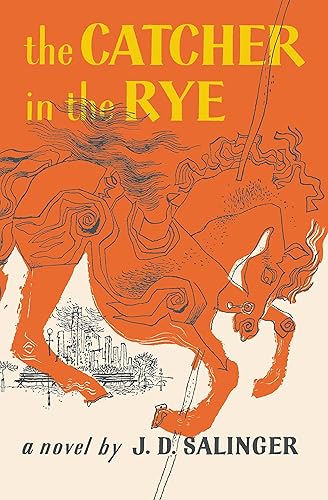
The Catcher in the Rye J. D. Salinger

The Catcher in the Rye J. D. Salinger

book

2001, Politics & Social Sciences, Politics & Government

WISE
52%

WISE Score

4.4

Amazon

The ultimate angsty teen novel—brilliant voice, brutal honesty, but prepare for profanity on every page and a protagonist who needs serious therapy.

Amazon4.4
Common Sense Media

Where to Read

Our reviews and ratings are 100% unbiased, but as an Amazon Associate, Screenwise earns an affiliate fee if you buy a book or game by clicking one of our links. We don't get any credit if you just Google it instead :)

Screenwise Verdict

Let's be real: this book is assigned in high schools across America, which means it's survived 70+ years of literary canonization for good reason. Salinger's voice is genuinely remarkable—Holden's narration feels immediate and authentic in ways that still resonate.

But is it actually enjoyable to read? That's debatable. It's slow. It's depressing. Holden wanders around 1940s New York complaining about everything and everyone while chain-smoking, drinking, and spiraling into what's clearly a mental health crisis. The profanity that shocked readers in 1951 is tame by today's standards, but it's constant. The prostitution subplot, the underage drinking, the suicidal ideation—it's all there.

For mature high schoolers, especially those who feel alienated or are processing their own grief, this can be powerful. It validates the feeling that the adult world is confusing and often hypocritical. But for kids who aren't in that headspace, or who prefer plot-driven stories, this will feel like homework (because it probably is).

The enrichment value is real—it's a cultural touchstone that offers insight into adolescent psychology and literary craft. But entertainment value? Limited. This earns its place in the canon, but don't expect most modern teens to voluntarily pick it up for fun.

Age Fit

This is firmly high school territory—14 and up, as Plugged In recommends. The mature content, dark themes, and literary style require emotional maturity. Younger teens may struggle with the slow pacing and dated references. It's a classic for a reason, but not every teen will connect with Holden's relentless cynicism.

WISE Breakdown
Wholesome
45

Holden Caulfield is a deeply troubled teenager processing grief and alienation. The book captures authentic adolescent angst but features constant profanity, underage drinking and smoking, encounters with prostitutes, and pervasive cynicism. While emotionally honest, it doesn't model healthy coping or kindness—Holden is isolated, judgmental, and spiraling. The tone is dark and depressive throughout.

Imaginative
72

Salinger's vernacular voice was groundbreaking in 1951 and remains distinctive. The stream-of-consciousness narrative style invites readers into Holden's unique perspective. However, the story is more introspective than action-driven—it's three days of wandering New York, not building or exploring new worlds. The imagination here is literary and psychological, not fantastical or creative in ways that inspire building or making.

Safe
55

This is a classic assigned in many high schools, but it contains mature content on nearly every page: frequent profanity, sexual references, prostitution, underage drinking and smoking, depression, and suicidal ideation. Parent reviews confirm 'dirty words on quite literally every page.' For a young reader encountering this unexpectedly, the relentless cynicism and mature themes could be jarring. It's not graphic or violent, but it's definitely not safe for younger kids.

Enriching
78

This is a canonical American novel that captures adolescent alienation with brutal honesty. It offers insight into grief, identity, authenticity versus 'phoniness,' and the painful transition to adulthood. For mature readers, it's a mirror for teenage feelings of disconnection and can spark meaningful discussions about mental health, loss, and belonging. The literary craftsmanship—that voice—is exceptional. But entertainment value? It's a slow, depressing character study.

Parent Info
✓

Why It Might Be Great

  • Salinger's voice is iconic—Holden's stream-of-consciousness narration feels authentic and immediate, capturing teenage alienation like few books before or since
  • Offers a raw, honest look at grief, depression, and the struggle to find authenticity in a world that feels fake
  • Literary landmark that has influenced generations of writers and remains assigned reading for good reason—it's a masterclass in character voice
  • Can validate feelings of disconnection and confusion that many teens experience, showing they're not alone in finding the world bewildering
  • Sparks important conversations about mental health, loss, and what it means to grow up
⚠

What to Watch For

  • Constant profanity—parent reviews confirm 'dirty words on quite literally every page,' which is accurate for 1950s standards and beyond
  • Mature content throughout: prostitution, underage drinking and smoking, sexual references, and discussions of sex
  • Dark mental health themes including depression, trauma from his brother's death, and suicidal ideation—Holden is clearly struggling and not getting help
  • Slow, meandering plot—this is three days of a kid wandering around New York feeling miserable, not an action-packed adventure
  • Cultural references from the 1940s-50s that feel extremely dated to modern readers

Conversation Starters

  • "Why do you think Holden calls everyone 'phony'? Is he being fair, or is he the phony one?"
  • "Holden is clearly grieving his brother Allie. How do you think that loss shapes everything he does in the book?"
  • "If Holden were a teenager today, how would his story be different? Would social media make things better or worse for him?"
  • "What do you think the title means? Why does Holden want to be 'the catcher in the rye'?"
  • "Holden needs help but doesn't get it. What would you say to a friend who was acting like him?"

Ask Anything

Get a personalized guide on any topic