

TL;DR
If you’re short on time, here are the top recommendations for kids who want a thrill without the trauma:
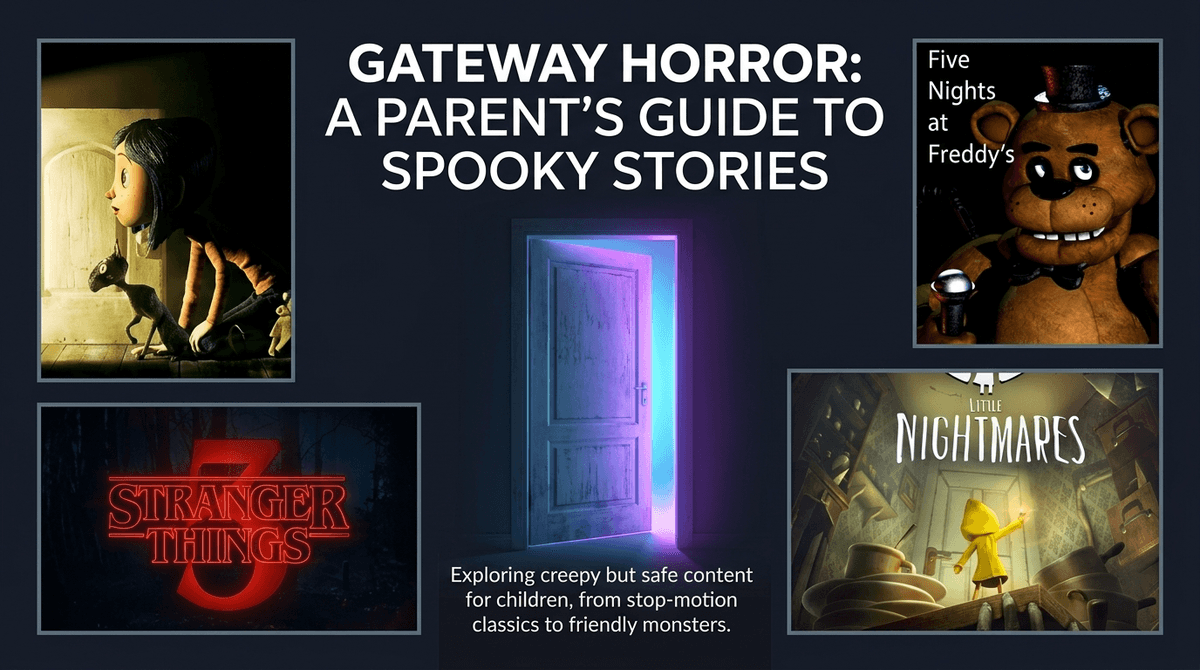
- Best for Tweens (Ages 8-12): Coraline, Little Nightmares, and the classic Goosebumps books.
- Best for Young Teens (Ages 13-15): Five Nights at Freddy's, Stranger Things, and The Backrooms.
- Best for Older Teens (Ages 16+): A Quiet Place or Talk to Me.
Get horror recommendations based on your kid's age
I was at a birthday party recently where a group of 10-year-olds was debating the "lore" of a character named Huggy Wuggy. If you haven't encountered him, he’s a giant blue plushie with rows of needle-sharp teeth. To an adult, he looks like a nightmare fueled by a bad trip to a toy store. To these kids, he’s basically Mickey Mouse with an edge.
We are living in the golden age of "Gateway Horror." Between the viral explosion of Mascot Horror (think killer Chuck E. Cheese vibes) and the rise of Analog Horror (creepy, low-fi YouTube videos), our kids are consuming scary content earlier and more frequently than we ever did.
But here’s the thing: horror isn’t necessarily "brain rot." When handled correctly, it’s a way for kids to practice bravery, process anxiety, and bond with friends over shared adrenaline. The trick is knowing the difference between a healthy "spooky vibe" and content that’s going to keep them (and you) awake until 3:00 AM.
If your kid is obsessed with Five Nights at Freddy's, they are into Mascot Horror. This genre takes childhood staples—toys, fast-food mascots, or daycare centers—and turns them into something predatory.
It’s huge because it’s "safe" scary. It usually relies on jump scares rather than psychological trauma or gore. The real hook isn't the fright; it's the lore. Kids spend hours on YouTube watching "theory" videos about why the animatronics are haunted. It’s basically a digital scavenger hunt for plot points.
This is the home of Huggy Wuggy. Set in an abandoned toy factory, it’s atmospheric and genuinely tense. It’s popular with the elementary and middle school crowd.
- The Verdict: It’s a bit jumpy, but mostly harmless. Just be aware that the merchandise is everywhere, making it feel more "kiddie" than the actual game is.
I’ll be honest: this game is kind of a mess. It’s a blatant attempt to capitalize on the Five Nights at Freddy's hype. It’s set in a creepy daycare, but the graphics are mediocre and the "scares" are predictable.
- The Verdict: If your kid wants to play it, let them. It’s more "weird" than actually terrifying, and they’ll probably get bored of it in a week.
You might have heard your kid mention "The Backrooms" or seen them watching videos that look like old, grainy VHS tapes from the 90s. This is Analog Horror.
It’s a style of storytelling that feels like "found footage." It’s less about monsters jumping out at you and more about a feeling of liminality—that eerie sensation of being in an empty office building or a deserted mall at night. It’s the digital equivalent of a campfire ghost story.
Based on an internet "creepypasta," this series features endless yellow rooms and humming fluorescent lights.
- The Verdict: This is actually high-quality storytelling. It’s unsettling and atmospheric, but generally lacks gore. It’s great for teens who prefer "vibes" over "slasher" films.
This one is a bit more intense. It deals with "alternates"—creatures that mimic humans.
- The Verdict: This can be genuinely disturbing for younger kids because it plays on the fear of people not being who they say they are. Save this for the 14+ crowd.
You’ve probably heard your kid call something "Only in Ohio" or mention Skibidi Toilet. While Skibidi Toilet isn't strictly horror, it falls into the "weird internet" category that feeds into horror culture.
Kids love this stuff because it’s theirs. It didn't come from a Hollywood studio; it came from the internet. It’s a secret language. When they watch Doors on Roblox, they aren't just playing a game; they are participating in a cultural moment.
Horror also provides a controlled risk. Their hearts race, their palms sweat, but they are sitting safely on their couch. It’s a biological "reset" button that can actually help some kids manage real-world anxiety by giving them a tangible thing to be "afraid" of and then overcome.
Here is how to navigate the "spooky" requests based on where your kid is at.
Ages 8+ This is the gold standard for "kid horror." It’s visually stunning, deeply creepy (the button eyes!), but ultimately a story about bravery and family. It’s a "safe" way to test the waters.
Ages 10+ A puzzle-platformer where you play as a tiny girl in a yellow raincoat navigating a world of grotesque adults. It’s dark and moody but has no dialogue and very little gore. It’s a masterpiece of atmosphere.
Ages 12+ Most kids are ready for this by middle school. It balances horror with "80s adventure" vibes. Note: it does get significantly darker and more violent in the later seasons (Season 4 is basically a Nightmare on Elm Street tribute).
Ages 9+ The Alvin Schwartz classics. The illustrations are arguably scarier than the stories. If your kid likes these, move them up to Fear Street by R.L. Stine.
Ages 9+ This is currently the "it" horror game on Roblox. It’s a rogue-like game where you walk through doors and try to avoid monsters with names like "Rush" and "Screech." It’s high-energy, fun to play with friends, and the scares are mostly sound-based.
How do you know if they're ready? It’s less about the age on the birth certificate and more about their emotional regulation.
- The "Lingerer" Test: Does your kid forget about the scary movie ten minutes after it’s over, or do they talk about it for three days? If they "linger" on the images, they might not be ready for psychological horror.
- Jump Scares vs. Dread: Most tweens handle jump scares (startling noises) better than "dread" (the feeling that something bad is going to happen). Mascot horror is 90% jump scares. Analog horror is 90% dread.
- The "Lore" Buffer: If your kid is obsessed with the story behind the monster, they are likely using their logical brain to process the fear. This is usually a good sign.
The biggest risk isn't the games themselves—it’s the YouTube ecosystem surrounding them.
A kid might play a relatively tame game like Piggy, but then go to YouTube and find "fan-made" animations that are much more violent or sexually suggestive. Content creators often use familiar characters (like Elsa or Huggy Wuggy) to bypass filters and deliver inappropriate content.
Pro-tip: If they are watching horror content on YouTube, try to keep it on the big screen in the living room rather than on a private tablet.
Learn how to set up YouTube parental controls for your tween
Instead of saying "Why do you like this trash?", try a more curious approach. It’ll get you a lot further.
- "What’s the 'lore' of this character?" (This is the fastest way to a kid's heart. They will talk for 20 minutes straight. Bring snacks.)
- "How did your body feel during that jump scare?" (Helps them build awareness of their physical response to fear.)
- "Is this 'fun' scary or 'I'm not going to sleep' scary?" (Teaches them to self-regulate and turn it off when it's too much.)
Horror is a rite of passage. Whether it’s Goosebumps or Five Nights at Freddy's, kids have always looked for ways to test their limits.
As long as the content isn't veering into extreme gore or nihilistic themes, it’s generally a healthy part of digital play. Your job isn't to ban the monsters—it's to be the "safe base" they return to after the lights come back on.
- Audit the "Mascots": Check if your kid is playing Poppy Playtime or Garten of Banban. Ask them to show you their favorite character.
- Watch Together: Pick a "gateway" movie like Beetlejuice or Wednesday for your next family movie night.
- Talk Lore: Ask them to explain the "Backrooms" to you. Even if it sounds like gibberish, listen for how they describe the "rules" of that world.