

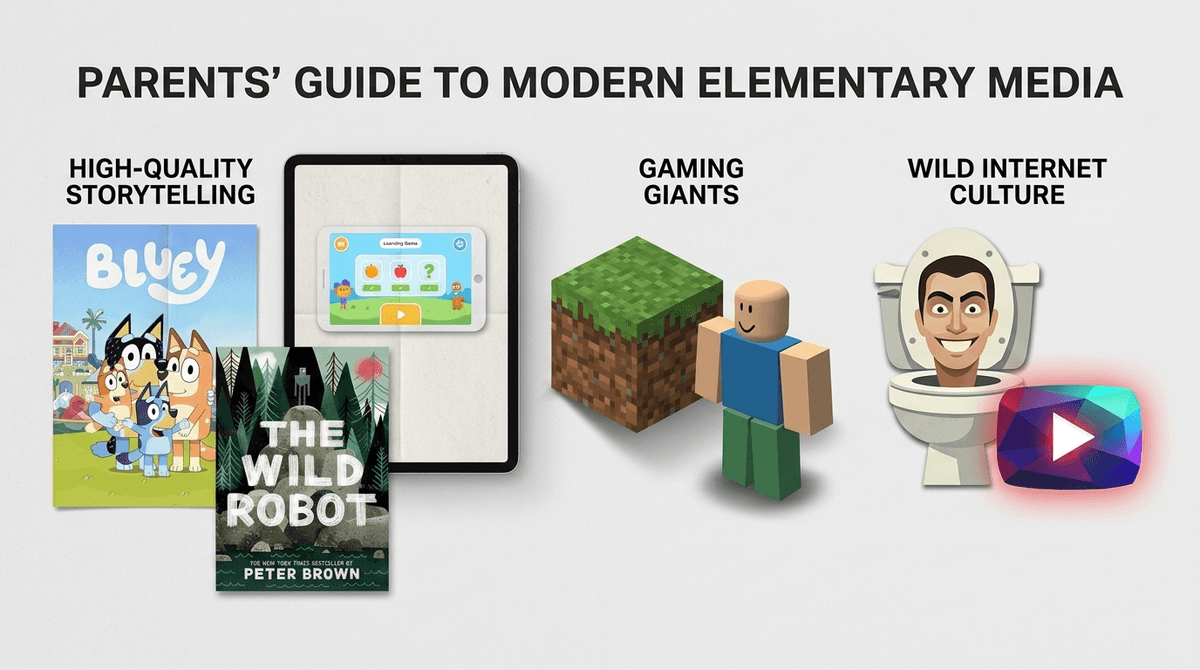
TL;DR: The Elementary Media Cheat Sheet
If you’re in the "I just want to know if I should delete this app" phase, here are the quick hits for the K-5 crowd:
- The "Gold Standard" Shows: Bluey, Hilda, and StoryBots.
- The Gaming Giants: Minecraft (Creative mode is the sweet spot) and Roblox (requires heavy parental controls).
- The Podcast Lifesavers: Wow in the World and Greeking Out.
- The "Brain Rot" Red Flags: Skibidi Toilet and aggressive "challenge" YouTubers like Luccas Neto or certain MrBeast clones.
- The "Safe" Social Entry: Messenger Kids (with strict supervision).
Get a media plan based on your kid's age
One day you’re peacefully watching a dog family in Brisbane learn life lessons about playing "Keepy Uppy," and the next, your seven-year-old is singing a song about a head popping out of a toilet while calling your kitchen "Ohio."
The jump from the curated, safe world of preschool media to the chaotic, meme-driven landscape of elementary school is the hardest transition in modern parenting. This is the age where "community influence" starts to outpace "parental preference." By second grade, about 60% of kids are regularly playing Roblox, and by fourth grade, nearly 80% have navigated away from YouTube Kids toward the main YouTube platform.
Navigating this doesn't mean you have to be the "No Fun Parent." It means becoming a savvy curator who knows the difference between a weird-but-harmless meme and content designed to hijack a child's dopamine receptors.
If you’ve heard the term "Brain Rot" lately, it’s usually used by Gen Z or Alpha to describe content that is hyper-stimulating, nonsensical, and visually chaotic. Think of it as the digital equivalent of eating nothing but Pixy Stix for dinner.
The poster child for this is Skibidi Toilet. It started as a series of shorts featuring heads coming out of toilets fighting camera-headed men. It’s weird, it’s loud, and it’s incredibly addictive for the 6-to-10-year-old brain. Is it "evil"? No. Is it high-quality storytelling? Also no.
The concern isn't necessarily the weirdness; it’s the pacing. Content labeled as brain rot often features cuts every 1.5 seconds, loud sound effects, and constant flashing colors. This trains the developing brain to expect a constant stream of high-intensity input, making real-life activities—or even a slower-paced show like Bluey—feel boring by comparison.
Learn more about the effects of hyper-stimulating content on focus
Kids in elementary school are obsessed with "insider" knowledge. Using slang like "Ohio" (meaning weird or cringey) or "Rizz" (charisma) makes them feel like they belong to a digital tribe.
They also love the autonomy of the "choose your own adventure" style of the modern internet. In Roblox, they aren't just playing a game; they are participating in a social ecosystem. They can "work" a job at a pizza place, build a house, or trade virtual pets. It feels like practicing for adulthood, even if the "currency" is just Robux you bought them for their birthday.
You can steer the ship without crashing it. Here are the best-in-class options for the elementary years, categorized by how they engage your kid.
If you want to bridge the gap between screens and books, this is it. It’s a masterpiece of modern children's literature that touches on AI, nature, and what it means to be a family. It’s also a Wild Robot movie now, making it a great "read the book then see the movie" incentive.
Think of this as the perfect "bridge" show. It has the whimsy of a younger show but the stakes and world-building of something for older kids. It follows a blue-haired girl navigating a world of giants, trolls, and spirits. It’s visually stunning and emotionally intelligent.
While Roblox is a social free-for-all, Minecraft (especially in Creative mode) is essentially digital LEGOs. It encourages spatial reasoning, planning, and persistence. If they want to play with friends, help them set up a private "Realms" server so they aren't interacting with strangers.
For car rides, this is the goat (Greatest of All Time). Guy Raz and Mindy Thomas explain science in a way that is genuinely funny for adults and captivating for kids. It’s the antidote to the "passive" screen time of YouTube.
If your kid loves games, move them from consumer to creator. Scratch is a block-based coding language developed by MIT. It’s free, it’s safe, and it teaches the logic behind the games they love.
Check out our full list of educational websites for 8-10 year olds
We need to talk about Roblox. It’s not just a game; it’s a platform where anyone can make a game. This means for every great "Obby" (obstacle course), there’s a game that might have inappropriate themes or aggressive monetization.
The Screenwise No-BS Take: Roblox is fine if you are involved. If you hand it over and walk away, your kid will eventually find something you don't like or spend $50 on "Adopt Me" pets.
Safety Checklist:
- Turn off Chat: Unless they are playing with real-life friends you know, the chat function is the biggest risk.
- Set Spend Limits: Use the parental pin to lock down the ability to buy Robux.
- Check the "Recently Played": This tells you exactly what kind of sub-games they are gravitating toward.
On YouTube, the biggest risk isn't "stranger danger"—it's the algorithm. A kid starts watching a video about Minecraft and, four clicks later, they are watching a "creepy pasta" horror story or a highly commercialized toy unboxing video designed to trigger a "must-buy" response.
When your kid says something is "Sigma" or "Skibidi," don't roll your eyes. Ask them what it means.
"Hey, I saw that toilet video everyone is talking about. It’s pretty weird, right? Why do you think it’s so popular at school?"
By showing interest instead of immediate judgment, you keep the door open. When you eventually have to say, "Hey, we’re taking a break from Roblox because I noticed you're getting really frustrated when you lose," they are more likely to listen because you've shown you actually understand the game.
Elementary school is the training ground for digital citizenship. You are moving from the "Manager" phase (where you pick everything they see) to the "Consultant" phase (where you help them navigate their own choices).
The goal isn't to keep them in a Bluey bubble forever. It’s to give them a balanced "media diet." A little brain rot is fine—we all watched weird stuff as kids—as long as it’s balanced with high-quality stories, creative play, and plenty of offline time.
- Audit the Apps: Look at your kid's tablet today. If you see TikTok or Snapchat, those are generally "over-leveled" for elementary kids. Consider swapping them for Messenger Kids.
- Set a "Green Time" Rule: For every 30 minutes of "Brain Rot" (YouTube/Roblox), they need 30 minutes of "Green Time" (outside, reading, or creative play).
- Take the Screenwise Survey: Understanding how your kid's usage compares to other families in your community can help you set realistic boundaries without feeling like the "meanest parent on the block."