

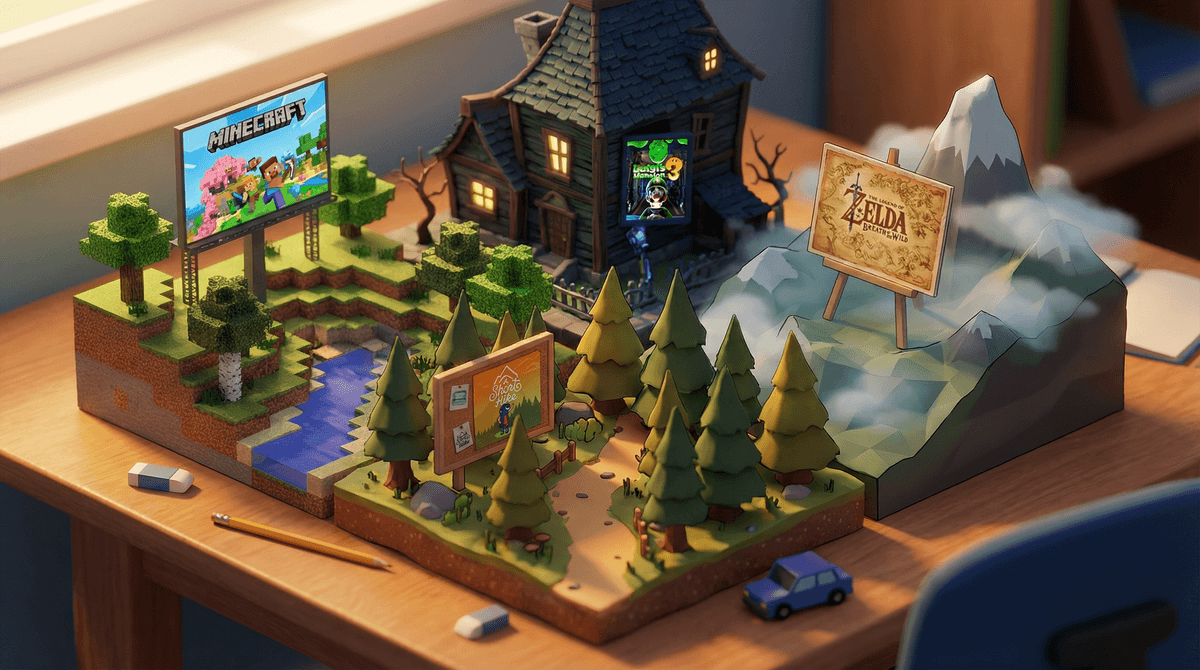
Adventure games are basically the digital version of "choose your own adventure" books, but with way better graphics and actual consequences. They're games where exploration, puzzle-solving, and story matter more than reflexes or combat skills. Think The Legend of Zelda, Minecraft in survival mode, or Pokémon—games where kids navigate worlds, make choices, collect items, and work toward goals that aren't just "shoot everything that moves."
The genre is massive and honestly kind of vague. Some adventure games lean heavily into story (like A Short Hike), others are more about exploration and crafting (hello, Terraria), and some blend action with puzzles (Luigi's Mansion). What unites them is that sense of going somewhere, discovering something, and figuring things out.
Adventure games hit a sweet spot in child development that's honestly pretty brilliant. They satisfy the same urges that make kids want to build forts, explore the woods, or turn the basement into a secret lair—but in a structured, endlessly replayable format.
Autonomy and agency. Kids get to make real choices. Which path do I take? Do I fight this boss now or explore more first? Should I trade my diamonds for emeralds? These aren't life-or-death decisions, but they feel meaningful, and that sense of control is intoxicating for kids who spend most of their day being told what to do.
Problem-solving that feels like play. Adventure games are packed with puzzles, but they rarely feel like homework. Figuring out how to cross a lava pit or unlock a temple door engages the same cognitive skills as math problems—pattern recognition, logic, trial and error—but with immediate, satisfying feedback.
Exploration without real-world risk. Kids are hardwired to explore, but modern childhood doesn't always allow for much of it. Adventure games let them scratch that itch safely. They can get lost, make mistakes, fall off cliffs, and respawn. It's low-stakes learning.
Stories they control. Unlike movies or books, adventure games put kids in the story. They're not watching Link save Hyrule—they are Link. That level of immersion is powerful, especially for kids who are starting to think about their own identities and capabilities.
Not all adventure games are created equal, and what works for a 6-year-old is going to bore (or overwhelm) a 12-year-old. Here's a rough breakdown:
Ages 5-7: Gentle Exploration
At this age, kids need games with clear goals, forgiving mechanics, and minimal reading. Think:
- Animal Crossing: New Horizons – Open-ended, cozy, no fail state
- Lego games (any of them) – Co-op friendly, humorous, easy to pick up
- Kirby and the Forgotten Land – Adorable, forgiving, great for beginners
These games let kids explore without punishing them for mistakes. They're building confidence and learning how games work.
Ages 8-10: Expanding Worlds
This is the sweet spot for adventure games. Kids can handle more complex mechanics, longer playtimes, and actual challenges. Popular picks:
- Minecraft (survival mode) – Creativity meets problem-solving
- Pokémon games – Strategy, collection, exploration
- Stardew Valley – Farming sim with surprising depth
- Zelda: Breath of the Wild – Gold standard for open-world adventure (though combat can be tricky)
At this age, kids start to appreciate games with actual stakes and consequences. They want to feel challenged, not coddled.
Ages 11-13: Complex Narratives
Preteens can handle darker themes, moral ambiguity, and games that demand patience. They're ready for:
- Hollow Knight – Beautiful, challenging, atmospheric (but tough—expect frustration)
- Subnautica – Underwater exploration with light survival horror
- Genshin Impact – Gorgeous open world (but watch for gacha mechanics)
- The Outer Wilds – Mind-bending space exploration (not to be confused with The Outer Worlds)
These games respect kids' intelligence and don't talk down to them. They're legitimately good games that adults play too.
Time sink potential. Adventure games are designed to keep you playing. They're full of "just one more quest" hooks. Unlike a 20-minute Fortnite match, a Zelda session can easily stretch to 3 hours without the kid realizing it. Set timers, use console parental controls, and be realistic about how much time these games demand.
Grinding and repetition. Some adventure games require repetitive tasks to progress (looking at you, Pokémon). This can teach persistence, or it can feel like a chore. Pay attention to whether your kid is enjoying the grind or just going through the motions.
In-game purchases. Most classic adventure games are one-and-done purchases, but newer titles (Genshin Impact, Roblox adventure games) often include microtransactions. Learn how to lock down payment methods before handing over the controller.
Online features. Games like Minecraft and Roblox have multiplayer modes that can expose kids to strangers. Know whether your kid is playing solo or online, and set up appropriate safeguards.
Scary content. Adventure games can get dark. Subnautica has legitimately terrifying sea creatures. Hollow Knight has a melancholy, lonely vibe. Check ratings and watch gameplay videos if you're unsure.
Adventure games are, generally speaking, some of the best screen time your kid can have. They encourage exploration, problem-solving, persistence, and creativity. They're also just really fun, which matters.
The key is matching the game to your kid's age, temperament, and frustration tolerance. A kid who loves structure might thrive with Pokémon's clear goals, while a creative kid might lose themselves in Minecraft for hours. A kid who gets easily frustrated might rage-quit Hollow Knight but love the gentler pace of Animal Crossing.
Start with games that have strong parent reviews (check our media pages for ratings and community feedback), watch your kid play for a bit, and ask questions. "What's your goal right now?" "What happens if you lose?" "Who are you playing with?" You'll learn a lot, and your kid will appreciate that you're actually interested.
Not sure where to start? Try this guide to Minecraft for beginners—it's the gateway drug for most kids.
Want more cozy, low-stress options? Check out our guide to cozy games.
Worried about multiplayer safety? Learn how to set up parental controls on major gaming platforms.
And if your kid is already deep into adventure games and you're just trying to keep up, that's fine too. You're doing great. At least they're not watching Skibidi Toilet compilations for 4 hours straight.