A middle school teacher watched her students stop taking risks
Jessica Lahey taught English, Latin and writing to middle schoolers for years, and wrote about it in The Atlantic and in the New York Times column "The Parent-Teacher Conference." She kept seeing the same thing in her classroom: bright kids so afraid of a bad grade that they stopped trying anything hard. She saw it at home too. By her own account she was still tying her son's shoes when he was 9. The Gift of Failure is her case that kids learn competence by getting things wrong while the stakes are small, and that loving parents often take that chance away.
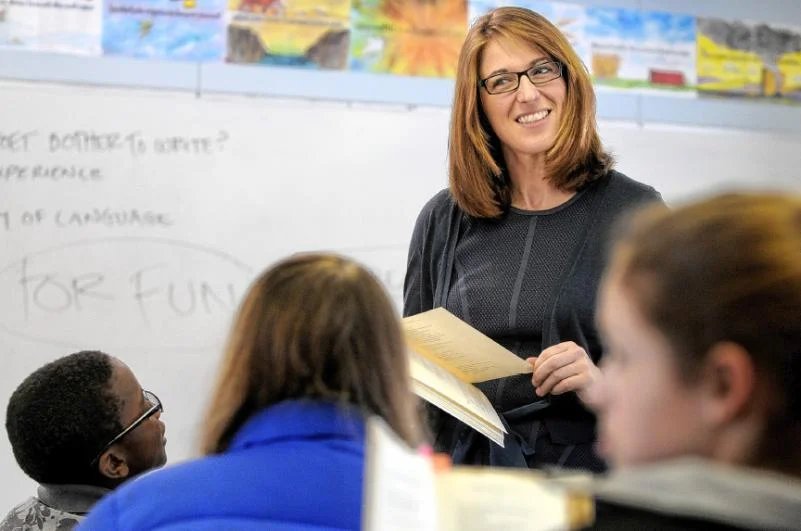 Lahey in her classroom. Photo by Jennifer Hauck, Valley News, via jessicalahey.com.
"Autonomy-supportive" means clear expectations, then hands off
Lahey is careful to say what she is not arguing for. Stepping back is not neglect and it is not permissive. Parents set clear expectations, stay close, and offer guidance when a kid is frustrated, then let the kid do the work and live with the result. She draws on motivation research (why rewards and praise for being "smart" backfire, and why praise for effort works better) and turns it into specifics:
- Chores start early and stay real, even when a 4-year-old does them badly.
- Homework belongs to the child. Don't drive the forgotten paper to school.
- Friendships and sports get their own chapters. At games, she says, act more like a grandparent.
- Teachers are partners, and a parent's job is to support the school, not to argue every grade.
There are chapters for the middle school and high school years, which is where her own classroom experience shows most.
 Jessica Lahey. Photo by Sharona Jacobs, from jessicalahey.com.
The book's sharpest critics say it overgeneralizes
Kirkus called it "an important, thoughtfully balanced book." The Independent's reviewer was harsher, finding the school-as-fear-factory picture overdrawn and the advice "well-intentioned but superficial" for families who aren't overparenting to begin with. One school principal reviewing it for MiddleWeb pushed back on Lahey's view that adults overreact to bullying. That last point is worth acting on: let kids handle ordinary friction and small social failures, but treat real bullying as an adult problem and step in.
Hear her make the case
A short talk from Lahey on the book's central idea:
Read it with
How to Raise an Adult and The Self-Driven Child make the same argument from a college dean's and a neuropsychologist's side. Lahey's second book, The Addiction Inoculation, builds on this one for the teen years. For a younger kid who melts down at mistakes, see helping kids embrace failure as a learning opportunity.


