It talks to kids as rebels, not as patients
The adult book is written to worried parents. This one is written to the kid. Haidt and Price never blame the reader for using a phone; Kirkus noted that the authors "never blame the users of technology." Instead they point at the companies, the "tech wizards," and invite kids to be rebels who use technology as a tool and refuse to let it use them.
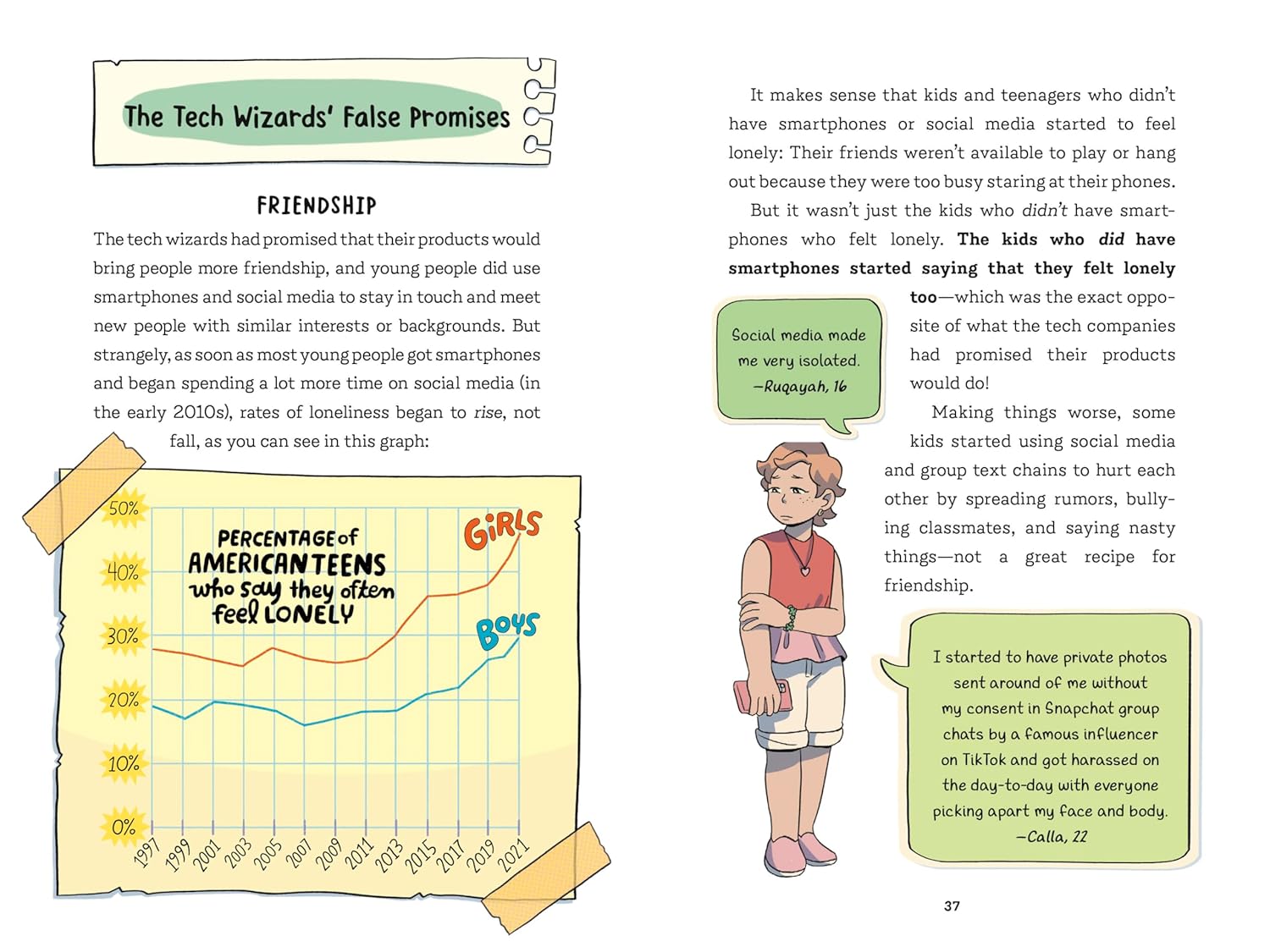 Secrets of the Technology Wizards, from the book. Image from the publisher's Amazon page.
The math pages make the point better than a lecture
Some of the strongest pages hand kids the numbers and let them draw the conclusion. A screen-time calculator shows that one hour a day adds up to 15 full days a year, and four hours a day comes to two months. A "Try This" box asks kids to do the same math with a parent or older sibling.
 The screen-time calculator. Image from the publisher's Amazon page.
Comics carry the story between the facts
Cynthia Yuan Cheng's comic chapters follow a group of kids through group chats and a school science fair, so the arguments arrive inside a story. Between them are speech-bubble quotes from teens and people in their 20s, and "Meet a Rebel" interviews, including 23-year-old Gabriela Nguyen, who founded the Appstinence movement.
 A comic chapter by Cynthia Yuan Cheng. Image from the publisher's Amazon page.
The heavy material from the adult book is gone
Common Sense Media rates it for 9 and up and notes that the adult book's long discussion of pornography is not here; the kids' edition covers how to spot "creepy" strangers online and where to get help. The labels are where reviewers hesitated. Kirkus found the "rebel" and "tech wizard" framing a little hyperbolic. Some kids love it; others will roll their eyes. Read a chapter together and see which kind you have.
A book for the year before the phone
The book works best before a kid has a smartphone, when the choices are still open. If your 12-year-old already has one, it can still start a good conversation, but go in expecting some pushback, and pair it with a real-world privilege so it does not read as a lecture.
Hear the authors
Haidt and Price talked about the book and its message for kids on The View:
Price went deeper with Screenagers on raising kids who are wiser tech users, including what to look for in a first phone or watch:
For the grown-ups
The Anxious Generation is the full argument for parents. Price's How to Break Up With Your Phone is the plan for parents who want to model the same habits.