

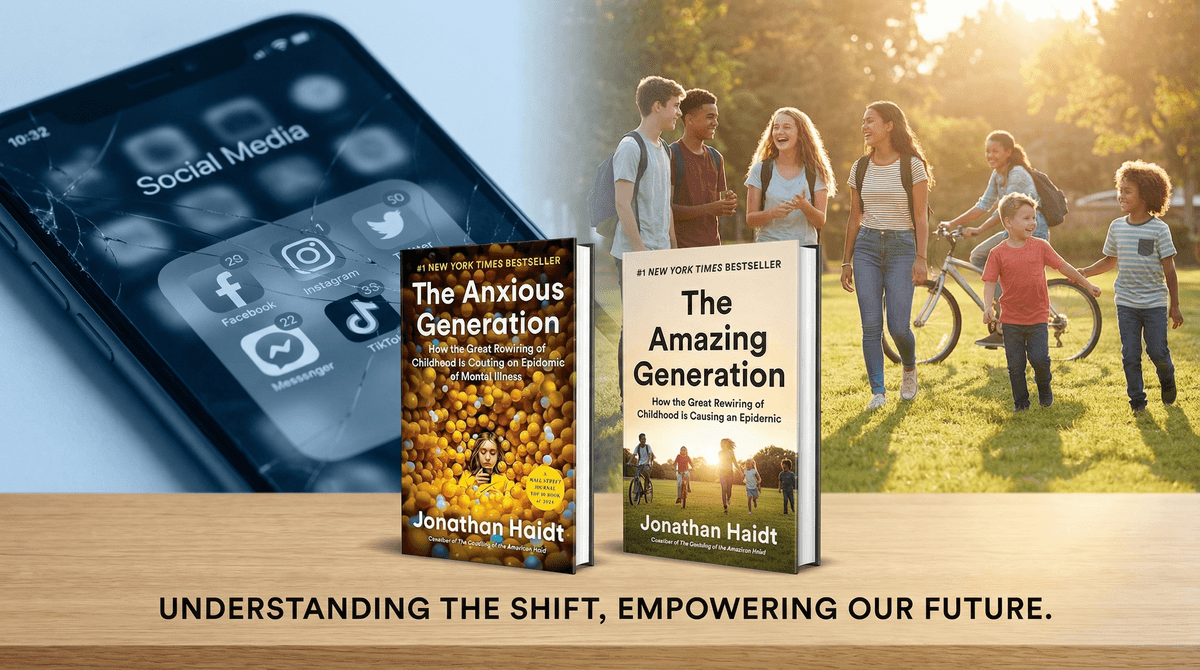
The Amazing Generation: Jonathan Haidt's New Playbook for Kids
TL;DR: Jonathan Haidt just released a kid-focused companion to The Anxious Generation called The Amazing Generation, and it's basically the empowerment manual we've been waiting for. Instead of lecturing parents (again), this one speaks directly to kids about reclaiming their real-world independence, building resilience, and breaking free from phone-based childhoods. If you've been wondering how to actually implement the ideas from The Anxious Generation with your own kids, this is your playbook.
The Amazing Generation is Jonathan Haidt's follow-up to his 2024 bestseller The Anxious Generation, but with a crucial twist: it's written for kids and teens themselves, not their parents.
Screenwise Parents
See allWhere The Anxious Generation made the case to adults about why phone-based childhoods are creating a mental health crisis, The Amazing Generation hands the reins to young people and says: "You have the power to change this. Here's how."
The book is organized around practical, actionable strategies for kids to:
- Understand what screens are actually doing to their brains
- Build real-world skills and independence
- Create meaningful friendships offline
- Push back against the cultural pressure to be constantly online
- Advocate for themselves (and their generation) to reclaim childhood
According to Anxious Generation, the book is designed to be read by kids as young as 8 or 9 (with parent support) all the way through high school, with age-appropriate sections and activities throughout.
Here's what makes this different from every other "put down your phone" lecture: it's not a lecture. It's a roadmap.
Haidt's research showed that Gen Z and Gen Alpha are experiencing unprecedented levels of anxiety, depression, and loneliness—and that the shift to phone-based childhoods (starting around 2010-2012) correlates directly with these outcomes. But telling kids "screens are bad" without giving them alternatives or agency? That doesn't work.
The Amazing Generation flips the script. It treats kids as capable, intelligent people who deserve to understand what's happening to them—and who have the power to do something about it.
The timing is perfect. Our community data shows that 68% of families don't give their kids smartphones yet, but the average kid is still getting 4.2 hours of screen time daily. We're in this weird middle ground where parents are hesitant about phones but haven't figured out what to replace them with. This book gives kids (and parents) the language and tools to navigate that tension.
Real-World Independence Challenges
One of the core themes is helping kids rebuild the "free-play childhood" that's been lost. The book includes specific challenges and milestones for different ages:
- Walking to school or a friend's house independently
- Navigating public transportation
- Spending time outdoors without adult supervision
- Taking on age-appropriate responsibilities in the community
Sound familiar? Our data shows only 15% of families let their kids walk to school independently, and 70% don't allow unsupervised outings at all. Haidt argues (and the research backs this up) that this lack of independence is just as harmful as too much screen time.
The book doesn't just say "go outside more"—it gives kids specific scripts for talking to their parents about earning more freedom, and it gives parents a framework for saying yes.
The Science, Made Kid-Friendly
Haidt breaks down the neuroscience of dopamine, social comparison, and addiction in ways that actually make sense to kids. There are sections on:
- Why infinite scroll is designed to be addictive (and how to recognize it)
- What happens to your brain when you're constantly context-switching
- Why social media makes you feel worse even when you think it's making you feel better
- The difference between "real" socializing and "performative" socializing
This isn't fear-mongering—it's education. Kids deserve to understand how these platforms work.
Building a Phone-Free Social Life
Here's the hard part: even if your kid is on board with spending less time on screens, what happens when all their friends are on Snapchat, TikTok, and Discord?
The Amazing Generation tackles this head-on with strategies for:
- Finding and connecting with other kids who want more real-world time
- Organizing phone-free hangouts and activities
- Dealing with FOMO (and reframing it)
- Being the "weird" kid who doesn't have a smartphone (and making it cool)
The book includes examples of schools and communities that have successfully implemented phone-free policies, showing kids that they're not alone in wanting this shift.
Ages 8-10: Read this together with your kid. The concepts are accessible, but younger kids will benefit from discussing them with you. Focus on the independence-building activities and the sections about outdoor play.
Ages 11-13: This is the sweet spot. Kids this age are old enough to understand the science but young enough that they haven't fully bought into phone culture yet. Let them read independently, then talk about it together.
Ages 14-17: Hand them the book and get out of the way. Teens need to feel like this is their choice, not another thing their parents are forcing on them. That said, leave the door open for conversation—many teens will want to talk about what they're reading, especially if it validates feelings they've already had about social media.
This Isn't Anti-Technology
Haidt isn't saying "never use screens" or "smartphones are evil." He's saying that phone-based childhoods—where kids' primary social and recreational lives happen through screens—are developmentally harmful. There's a huge difference.
The book encourages kids to use technology intentionally: for creative projects, learning, staying in touch with long-distance friends, etc. But it pushes back against the idea that kids need to be reachable 24/7 or that social media is a necessary part of growing up.
You Might Need To Change, Too
If you hand your kid this book and then spend the entire evening scrolling Instagram, that's... not great. The Amazing Generation works best when families make changes together.
Our data shows that 30% of families are already experimenting with more independence for their kids, and 22% have chosen to give their kids smartphones (with varying levels of restrictions). There's no one right answer, but consistency matters. If you're asking your kid to put down their phone, be ready to examine your own habits.
The Community Piece Is Key
One of Haidt's big arguments—both in The Anxious Generation and in this book—is that individual families can't solve this alone. We need collective action: schools implementing phone-free policies, communities creating safe spaces for unsupervised play, parents coordinating so kids aren't the only ones without smartphones.
The Amazing Generation includes resources for kids who want to start these conversations in their schools and communities. It's empowering, but it also requires adult support. Be ready to back your kid up if they want to advocate for change.
Read it yourself first. Even though it's written for kids, you'll get a lot out of it—and you'll be better equipped to support your kid through the process.
Create space for conversation. Don't quiz your kid or turn this into homework. Just ask open-ended questions: "What did you think about the chapter on dopamine?" or "Do you feel like you have enough independence?"
Start small. Don't expect your kid to read this book and immediately delete all their social media accounts. Pick one or two ideas to try together: a phone-free family dinner, a weekend hike, letting them walk to the library alone.
Connect with other families. Check out Wait Until 8th or similar initiatives in your community. Having a cohort of families making similar changes makes everything easier.
Use Screenwise's list maker if you need help navigating specific situations. See age-appropriate independence milestones or how to talk to your kid about social media.
The Amazing Generation is the book I wish existed when my friends' kids started asking for smartphones. It's not preachy, it's not fear-based, and it doesn't pretend that opting out of phone culture is easy. But it does give kids (and parents) a roadmap for building something better.
If you've read The Anxious Generation and thought "okay, but how?"—this is your answer. And if you haven't read The Anxious Generation yet, honestly, start with this one and read it with your kid. You'll both get more out of it.
The goal isn't to raise kids who are scared of technology. It's to raise kids who are amazing—confident, independent, resilient, and connected to the real world. And that starts with giving them the tools to reclaim their childhood.
- Grab a copy of The Amazing Generation and read it with your kid
- Check out The Anxious Generation for the parent-focused research and context
- Explore books about digital wellness for kids
- Learn about building real-world independence
- Take the Screenwise survey to see how your family's digital habits compare to your community