A cognitive scientist says the love of reading matters more than the skill
Daniel Willingham is a psychology professor at the University of Virginia, where he has taught since 1992, and the author of Why Don't Students Like School? He wrote this book as a parent who wanted his own kids to love books, and he is upfront that his reason is personal. "For me it's a family value," he told NPR. "I gain experiences I wouldn't gain any other way by virtue of being a reader."
 Daniel Willingham. Photo from Learning and the Brain.
He splits reading into three parts: decoding (turning letters into sounds), comprehension (making sense of what the words say) and motivation. Most kids become good decoders. Comprehension and motivation are where families make the difference, and the book is organized by age so you can go straight to yours: birth through preschool, kindergarten through second grade, and third grade and beyond, with a section on the reluctant older reader. Each chapter ends with a short summary.
Kids understand what they read when they already know about the world
The most useful idea in the book is about knowledge. A child can sound out every word in a paragraph about the ocean and still not understand it if they know nothing about tides and fish. Willingham argues that good readers need knowledge "a million miles wide and an inch deep," and that the best way to build it is to read aloud from nonfiction, answer a kid's endless questions, and talk with them about the world. He also points out that readers need to know about 98 percent of the words in a text to understand it comfortably.
He applies the same idea to how you talk at home. A parent who mostly gives commands teaches a child that language is for getting what you want. A parent who asks a lot of questions teaches that language is for finding things out.
Paying kids to read can teach them that reading is a chore
Willingham is wary of reading rewards, minutes logs and charts. Paying a kid to read, he told NPR, tells them "this is not something that I expect to be pleasurable for you." A reward can raise reading for a while, then reading drops when the reward stops. He does not rule rewards out for a kid who will not read any other way, but he puts them last.
What he puts first:
- Make your family a family of readers. Kids pick up what their parents value from what is on the walls, what the house rules are and who the grown-ups admire.
- Read aloud in warm, cozy moments, long after kids can read on their own.
- Put books where kids get bored. The car is his favorite example.
- Make the easy entertainment a little less easy, so a book is the most appealing thing in reach.
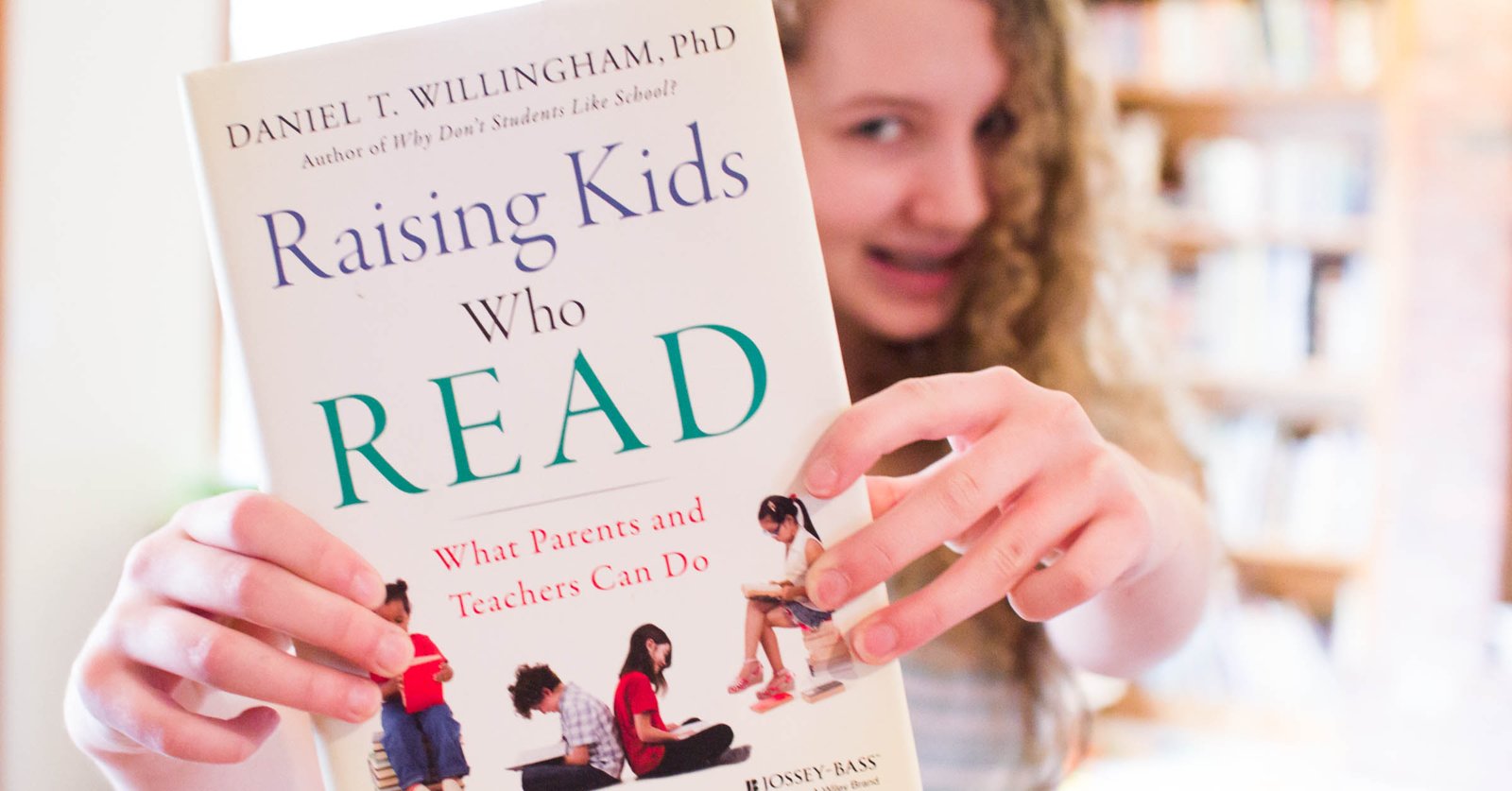 The book in hand. Photo from the Read-Aloud Revival.
Screens make kids impatient with boredom, not unable to focus
Willingham does not buy the claim that devices have shrunk kids' attention spans; he notes that measured attention span has not dropped in 50 years. His version is more useful to a parent: "The consequence of long-term experience with digital technologies is not an inability to sustain attention. It's impatience with boredom." A kid who can always get instant, effortless fun on a screen learns to expect it, and a book, which asks for a little effort at the start, loses. That is why he wants parents to make reading the most appealing option in the room rather than a duty.
The reviewers' complaint is about who picks it up
The reviews were warm. The Washington Independent Review of Books called it "a practical manual for instilling a love of books in children." The criticism that comes up most is that the parents who buy a book like this already read to their kids. Some readers who had read a lot on the topic found the practical advice familiar. The literacy researcher Timothy Shanahan disagreed with Willingham's claim that schools spend too long teaching comprehension strategies. Read it for the framework and the knowledge chapters; those are what set it apart.
Watch him explain it
Willingham talked through the book with Sarah Mackenzie on the Read-Aloud Revival podcast:
His short video on why building knowledge is how schools teach reading:
Read it with
For the read-aloud side, The Read-Aloud Family is the practical how-to with book lists by age, and The Enchanted Hour makes the case for reading aloud to kids of every age. For what screens do to the reading brain itself, Reader, Come Home is the deeper dive. If your kid is in the early grades, see how to build reading confidence in elementary school.


