Computers will always beat kids at remembering facts
Hirsh-Pasek likes a line about Rip Van Winkle. If he woke up today, she told NPR, there is one institution he would recognize: the school, with kids "still sitting in rows, still listening to the font of wisdom at the front of the classroom." Schools still reward recalling facts, and computers will always be better at that than people. What they will not be better at, the authors argue, is working with others, solving new problems and being part of a community. Becoming Brilliant is their proposal for measuring those things instead.
 Kathy Hirsh-Pasek (left) and Roberta Michnick Golinkoff. Photos from the Brookings Institution.
The 6Cs stack on each other
- Collaboration. Getting along with others, from not kicking someone off the swing to working on a team. Everything else rests on it.
- Communication. Speaking, writing, reading and listening.
- Content. Knowing things, which depends on being able to understand language and read.
- Critical thinking. Sorting through masses of information, which you cannot do without content.
- Creative innovation. Making something new, which takes knowing something well first.
- Confidence. The willingness to take smart risks and fail. "There isn't an entrepreneur or a scientific pioneer who hasn't had failures," Golinkoff said.
For each C, the authors lay out four levels. A preschooler who plays next to another child is at level one of collaboration; a kid who can disagree with a teammate and still finish the project is near the top.
Small moments are where the Cs grow
The book's practical advice is about everyday questions. When a child asks why traffic lights are red, yellow and green, a parent can shut it down, explain it, or turn it back and help the child reason it out. Nobody gets that right every time; the point is noticing how many of those moments there are.
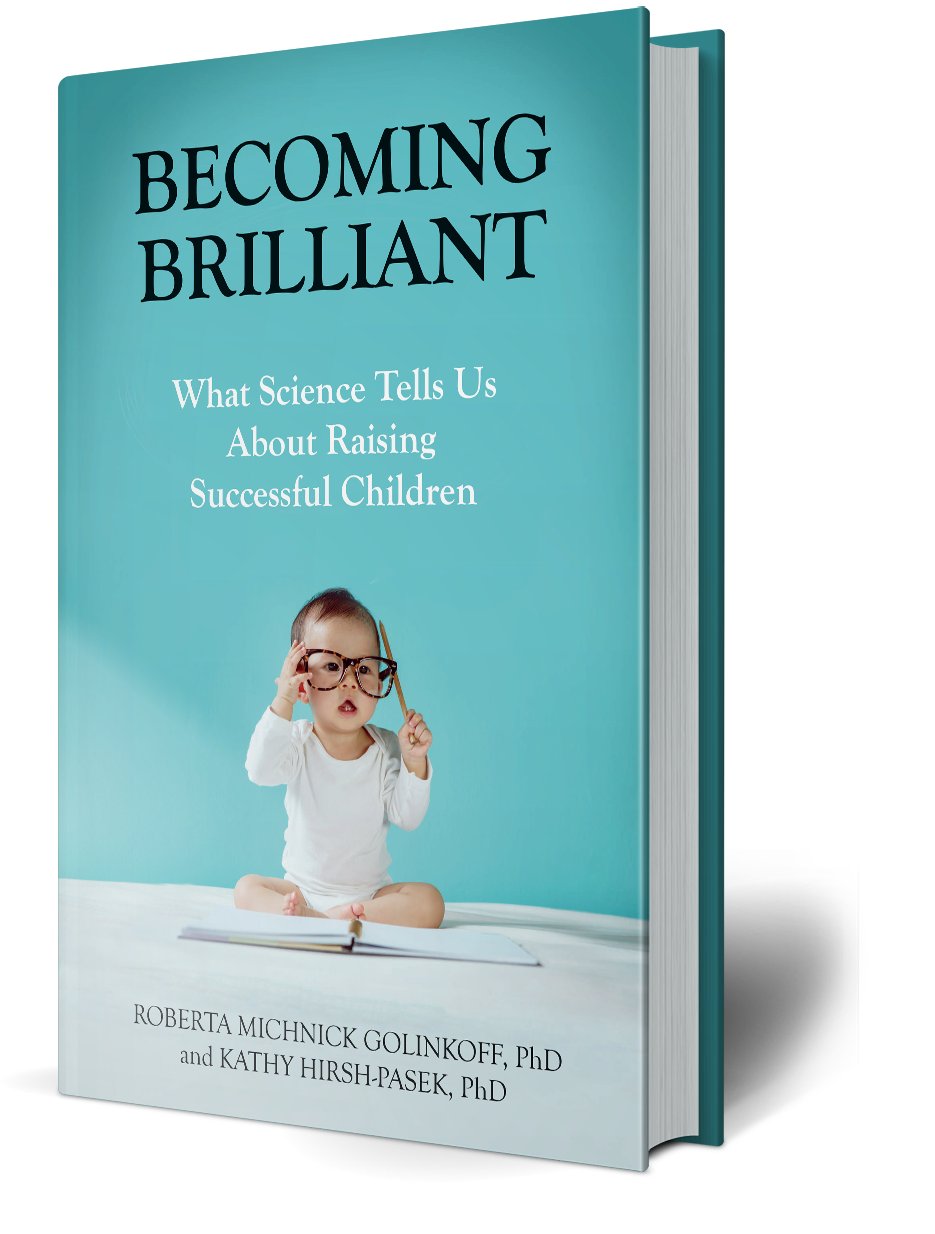 Becoming Brilliant, published by the American Psychological Association. Image from becoming-brilliant.com.
Watch them
Golinkoff and Hirsh-Pasek on how play became a four-letter word in early education:
Hirsh-Pasek on rethinking how we educate children, for the Simms/Mann Institute:
Read it with
The authors' earlier book, Einstein Never Used Flash Cards, covers the baby and preschool years. Mitchel Resnick's Lifelong Kindergarten shows what creative innovation looks like when kids build with code.


