

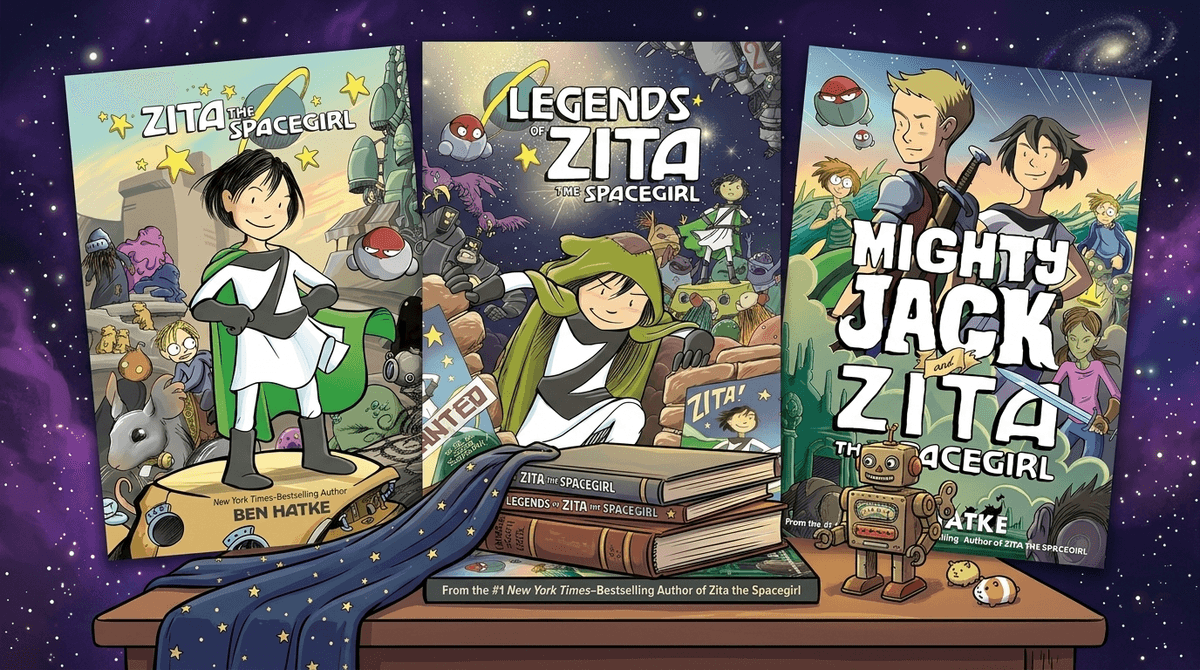
TL;DR: Zita the Spacegirl is a three-book graphic novel masterpiece by Ben Hatke that follows a normal girl who becomes an intergalactic hero after trying to save her friend. It’s the perfect "gateway drug" to reading for kids who are currently obsessed with Roblox or YouTube because it moves fast, looks amazing, and doesn't feel like "homework."
Quick Links for the Obsessed:
- The Original Trilogy: Zita the Spacegirl, Legends of Zita the Spacegirl, and The Return of Zita the Spacegirl.
- The Crossover: Mighty Jack and Zita the Spacegirl.
- If they loved Zita, try: Amulet or Lightfall.
If you’ve seen a colorful book with a girl in a brown cape and a giant star on her shirt floating around your house, you’re looking at Zita the Spacegirl.
The story starts with a classic "don't touch that" moment. Zita and her friend Joseph find a mysterious red button in a meteor crater. Joseph, being a typical kid, pushes it and gets pulled into a portal by a giant mechanical tentacle. Zita—who is arguably the bravest character in middle-grade fiction—jumps in after him.
She lands on a dying planet filled with script-writing robots, giant hamsters, and a shifty con man named Piper. Over the course of three books, she evolves from a scared kid who just wants to go home into a galactic legend.

There’s a reason this series has a permanent spot on the "Most Popular" shelf at the school library.
- The Pacing: Graphic novels are the ultimate "screen-free" alternative because they mimic the visual stimulation of a show or a game. Ben Hatke’s art is cinematic; the action sequences actually feel like they’re moving.
- The "Accidental Hero" Vibe: Zita isn't a superhero with powers. she’s just a girl with a cape and a lot of nerve. Kids relate to her because she’s figuring it out as she goes, much like they are when they're navigating a new server in Minecraft.
- The World-Building: It’s weird. In a good way. There are creatures like One-Zero (a robot who is basically a walking anxiety attack) and Mouse (a giant, rideable pill-bug creature). It captures that same sense of discovery kids get from Star Wars.
We talk a lot about "brain rot"—that mindless scrolling through TikTok or watching endless "Skibidi Toilet" memes on YouTube. Graphic novels like Zita the Spacegirl are the antidote.
Reading a graphic novel requires "multimodal literacy." Your kid is decoding text while simultaneously interpreting visual cues, facial expressions, and spatial relationships on the page. It’s high-level cognitive work disguised as pure fun. If you’re trying to transition your kid away from a "one more level" obsession with Brawl Stars, handing them a copy of Zita is a strategic move. It offers the same hit of dopamine and adventure without the blue light and the in-app purchases.
Check out our guide on using graphic novels to reduce screen time
While every kid is different, here’s how the community generally sees the Zita series:
Grades K-2 (Ages 5-7)
They will love the pictures and the "cool" factor. If they are emerging readers, you’ll probably be reading it with them. It’s a great "lap book." There is some peril—Joseph is in danger, and there are some "scary" monsters—but nothing that’s going to cause a 3:00 AM nightmare.
Grades 3-5 (Ages 8-11)
The Sweet Spot. This is the target audience. They can read it independently in one or two sittings. They’ll pick up on the deeper themes of sacrifice and the fact that Zita’s fame actually becomes a burden for her in the second book, Legends of Zita the Spacegirl.
Grades 6+ (Ages 12+)
Middle schoolers might find it a bit "young," but many still appreciate the art and the nostalgia. If they’ve outgrown Zita, it’s time to move them toward Bone by Jeff Smith or Nimona.
There are zero "red flags" here. No inappropriate language, no sexual content, and the violence is very "cartoon-action" (think Pokemon style).
However, there is real emotional weight. Zita has to make some genuinely tough choices. In the first book, she makes a sacrifice that means she can't go home right away. It’s a heavy moment that teaches kids about the cost of doing the right thing.
If your family is big on loyalty and friendship, Zita is your girl. She never gives up on Joseph, even when it would be much easier to just save herself.
The "Mighty Jack" Connection
Ben Hatke also wrote a series called Mighty Jack, which is a modern retelling of Jack and the Beanstalk. Eventually, the two worlds collide in Mighty Jack and Zita the Spacegirl. If your kid finishes the Zita trilogy and starts acting like their life is over, just hand them Mighty Jack and tell them a crossover is coming. It buys you at least another week of quiet reading time.
If you want to engage with your kid about the book (and prove you aren't just the person who pays for the Netflix subscription), try these conversation starters:
- "If you found a giant red button in the woods, would you push it? (Be honest, I probably would too.)"
- "Zita becomes famous in the second book, but she doesn't seem very happy about it. Why do you think that is?"
- "Which robot would you want as a sidekick: One-Zero or the giant Strong-Strong?"
- "Do you think Piper is a good guy who does bad things, or a bad guy who does good things?"
Zita the Spacegirl is a 10/10, no-notes recommendation. It’s wholesome without being boring, adventurous without being overly violent, and it features a female protagonist who is defined by her courage and loyalty rather than her appearance or a romantic subplot.
In an age where we are constantly fighting for our kids' attention against algorithms designed by neuroscientists to keep them hooked on YouTube Shorts, Ben Hatke has created something that can actually compete.
- Grab the box set: It’s cheaper and they will want all three immediately.
- Check out the author: Ben Hatke has other great books like Little Robot for younger siblings.
- Explore the genre: If Zita is a hit, look into our guide on The Best Graphic Novels for Middle Grade Readers.
- Community Context: In the Screenwise community, about 45% of parents with kids in 3rd-5th grade report that graphic novels are their child's primary "pleasure reading" choice. You aren't alone in the "my kid only reads comics" struggle—and honestly, it's not a struggle. It's a win.