

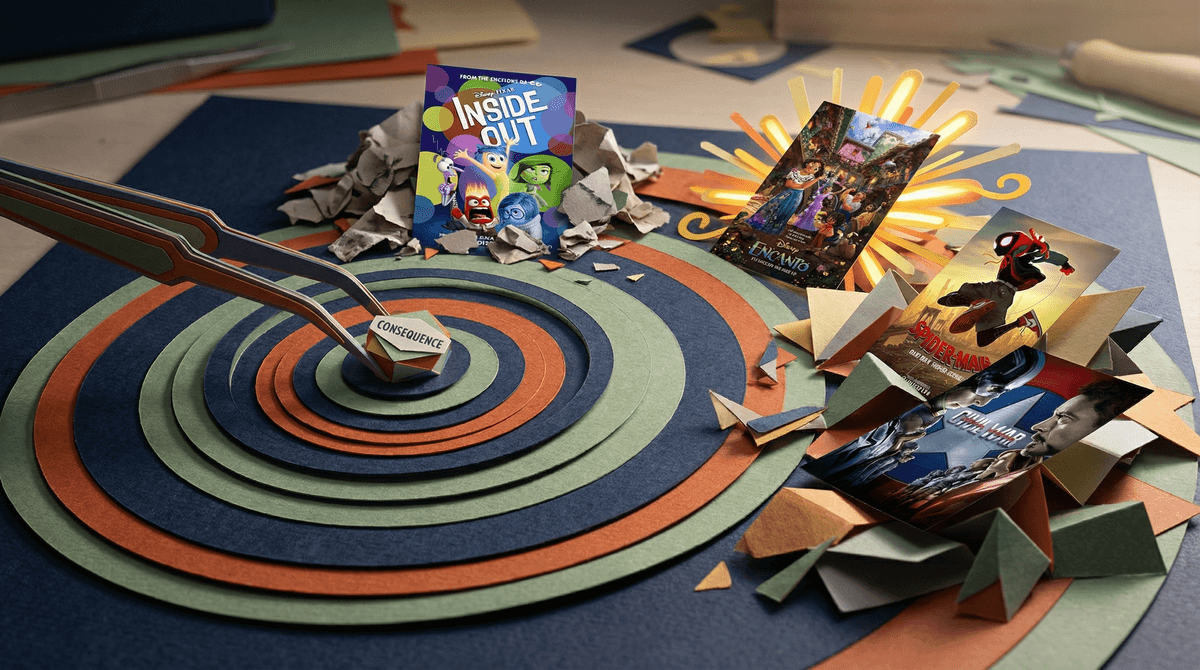
You know that moment when the hero blows up a building full of bad guys, cracks a joke, and then rides off into the sunset? Or when a character makes a terrible choice and somehow everything works out perfectly by the end credits? Yeah, we need to talk about that.
Consequences in movies aren't just about whether the villain gets caught or the hero wins. It's about whether the story actually shows the real fallout of actions—the emotional weight, the collateral damage, the messy aftermath that doesn't get tied up with a neat bow.
And here's why this matters for your kids: Movies are teaching tools whether we like it or not. They're showing our kids how the world works, how actions connect to outcomes, and what happens when you make big (or small) choices. When movies skip over consequences or treat them like inconvenient plot points, kids miss out on crucial lessons about cause and effect, empathy, and accountability.
Think about the last action movie you watched. How many nameless henchmen got taken out? Did anyone stop to think about their families? Probably not, because they're "just the bad guys." But here's what research tells us: kids who regularly consume media that glosses over consequences have a harder time connecting actions to outcomes in real life.
This isn't about being a killjoy or banning action movies (please, I'm not a monster). It's about helping kids develop what researchers call "moral imagination"—the ability to think through the ripple effects of decisions before making them.
When movies show real consequences, kids learn:
- Empathy: Actions affect real people with real feelings
- Critical thinking: Choices have trade-offs and aren't always clear-cut
- Accountability: You can't just joke your way out of everything
- Emotional intelligence: Processing guilt, regret, and responsibility is part of being human
The Marvel Cinematic Universe is actually a fascinating case study here. Early on, movies like Iron Man and Captain America: Civil War wrestled with consequences—Tony Stark's PTSD, the collateral damage debate. But as the franchise expanded, a lot of that weight got lost in quippy one-liners and CGI explosions. Is the MCU teaching kids the right lessons?
Let's get real about what's on their screens right now:
Ages 6-9 are watching a lot of Sonic the Hedgehog, Encanto, and The Bad Guys. Good news: many of these actually do show consequences. Encanto doesn't shy away from generational trauma. The Bad Guys shows redemption as a process, not a switch you flip.
Ages 10-13 are deep into the MCU, Star Wars, and increasingly, more mature content on streaming platforms. This is where things get dicey. A lot of these franchises have gotten so big that individual character consequences get lost in the spectacle.
Ages 14+ are watching everything from John Wick to Euphoria (yes, really, and we should talk about that). Some of this content does show consequences—sometimes brutally—but without context and conversation, kids might just see the shock value without processing the meaning.
Not all movies need to be heavy moral lessons, but it helps to think about a spectrum:
High consequence movies show the weight of choices:
- Inside Out and Inside Out 2 - emotions have real impacts
- Spider-Man: Into the Spider-Verse - "with great power..." actually means something here
- The Hunger Games - war has lasting trauma (though even this gets Hollywood-ized)
Low consequence movies treat actions as plot devices:
- Most Fast & Furious movies - physics and human life are suggestions
- A lot of comedy where cruelty = humor with no fallout
- Revenge fantasies where violence solves everything cleanly
Neither is inherently bad, but kids need help understanding the difference between "fun escapism" and "this is how the world works."
During the movie: You don't need to be that parent who pauses every five minutes, but a well-timed "whoa, that was a lot of destruction" can plant a seed.
After the movie:
- "What do you think happened to all those people in the building?"
- "If that happened in real life, how do you think [character] would actually feel?"
- "What would the consequences be if someone did that at your school?"
The comparison game: Watch movies that handle consequences differently and talk about it. How to Train Your Dragon vs. a typical action movie. One shows lasting physical consequences (Hiccup loses his leg), the other has characters walk away from explosions without a scratch.
Ages 6-9: Look for movies where characters face emotional consequences and learn from mistakes. Turning Red, Coco, and Zootopia are great at this. The consequences are age-appropriate but real.
Ages 10-13: This is when you can start having more nuanced conversations about violence, moral complexity, and unintended consequences. The Hunger Games is actually solid here—Katniss deals with PTSD, not just victory.
Ages 14+: They can handle (and need) movies that don't tie everything up neatly. Everything Everywhere All at Once shows how choices ripple across realities. But also: they're probably watching stuff that's way more consequence-free than you realize, so check in about what they're actually consuming.
Movies that show real consequences aren't just "better" from some high-minded moral standpoint—they're literally helping your kids build better brains. They're learning to think through "if I do this, then what?" They're developing empathy. They're understanding that actions matter.
Does this mean only watching documentaries and prestige dramas? Hell no. Paddington 2 is one of the best movies about consequences ever made, and it's about a talking bear. It's not about being serious—it's about being real.
-
Audit the rotation: What are your kids watching on repeat? Does any of it show characters dealing with the aftermath of their choices?
-
Add some balance: If it's all consequence-free action, throw in some movies where choices matter. Check out alternatives to typical blockbusters.
-
Make it a conversation: You don't need to turn movie night into philosophy class, but asking "what would really happen if..." opens up the discussion naturally.
-
Model it yourself: When you mess up in front of your kids, show them what real accountability looks like. That's worth more than any movie.
The goal isn't to ruin fun movies—it's to help kids see the difference between fantasy and reality, and to build the mental muscles they need to make good choices when it actually matters.