

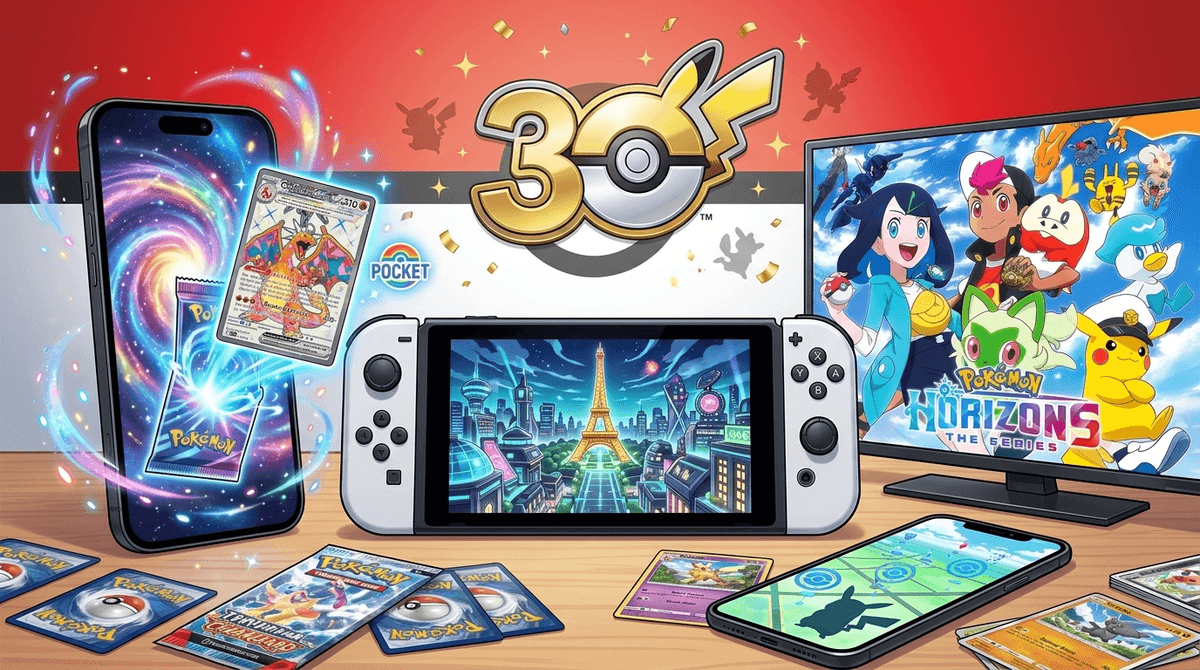
TL;DR: Pokémon is hitting its 30th anniversary in 2026, and the hype is at an all-time high. Between the release of Pokémon Legends: Z-A on the new Nintendo hardware and the massive success of the Pokémon TCG Pocket mobile app, your kid is likely asking for "packs" (digital or physical) daily. It’s a great way to build strategic thinking, but the monetization in the new mobile apps is basically "Baby's First Gambling." Set hard limits on IAPs (In-App Purchases) now before the anniversary events kick into high gear.
If you feel like you’ve been hearing about Pikachu since the 90s, you aren't hallucinating. We are officially entering the 30th anniversary of Pokémon, and the marketing machine is working harder than a Machamp on double-shot espresso.
Back in the day, "catching 'em all" meant trading Game Boy links in the back of a minivan. In 2026, it means navigating a complex ecosystem of console games, mobile "gacha" mechanics, and a trading card market that sometimes feels like the New York Stock Exchange.
Whether your kid is just starting their journey in the Paldea region or they’re a seasoned competitive battler, here is the state of the Poké-union and how to handle the inevitable "Can I have $10 for Poké-Gold?" requests.
It’s no longer just a game; it’s a lifestyle brand. Currently, about 45% of kids aged 6-12 interact with Pokémon in at least two different formats (usually the cards and the video games).
The big shift this year is the "Mega Evolution" revival. If your kid is screaming about a "Mega Lucario" or "Mega Charizard Z," they’re talking about a mechanic from ten years ago that has been brought back for the 30th-anniversary flagship title, Pokémon Legends: Z-A.
But the real "Ohio" (weird/cringe) part for parents isn't the monsters—it's the money. The franchise has leaned heavily into "pocket-sized" experiences that are designed to be opened daily, creating a habit-loop that can be hard for kids to break.
This is the biggest hurdle for intentional parents right now. It’s a mobile app where you open two "free" digital packs of cards a day. It sounds innocent, but the animations—the crinkle of the foil, the slow reveal of a "Rare Art" card—are designed by experts to trigger dopamine hits.
- The Vibe: High-speed collecting.
- The Risk: It is incredibly easy to spend $20 in five minutes to get "just one more pack."
- Age Recommendation: 9+ (due to the simulated gambling nature of pack opening).
This is the "prestige" game on the Nintendo Switch (and the newer Switch 2). Unlike the older games where you just walk from town to town, this is an open-world adventure set entirely within Lumiose City. It’s single-player focused, which is great for parents who want to avoid the toxicity of online multiplayer.
- The Vibe: Exploration, mystery, and "Mega Evolutions."
- The Benefit: It requires actual reading comprehension and strategic planning.
- Age Recommendation: 7+ (requires solid reading skills).
Ash Ketchum is officially retired. The new show follows Liko and Roy. It’s a bit more serialized and "prestige" than the original 90s cartoon. It’s actually... dare I say... good? It deals with themes of belonging and finding your purpose without being too "brain rot" adjacent.
- Where to watch: Netflix.
- Age Recommendation: All ages.
Believe it or not, this is still huge. In 2026, it’s the primary way kids socialize in person. If you see a group of middle schoolers standing awkwardly around a fountain in a park, they are doing a "Raid."
- The Benefit: They are actually outside walking.
- The Risk: Stranger danger (though minimal if supervised) and "sponsored locations" trying to get them to buy fast food.

The biggest struggle with Pokémon in 2026 is the financial friction. We’ve moved past the era where you just bought a $40 cartridge and were done.
- Digital Cards: In Pokémon TCG Pocket, the "Premium Pass" is a monthly subscription. If your kid is "obsessed," they will want this. It’s better to treat this like a Netflix sub than a series of one-off purchases.
- Physical Cards: The Pokémon TCG (Board Game) is still a massive playground currency. Be aware that "fake" cards are everywhere. If your kid trades a real "Shiny" for a fake "Gold" card they found at a flea market, there will be tears.
- The Switch 2 Factor: With the new console out, the 30th-anniversary games look better than ever, but they also cost more ($70 is the new standard).
Learn more about how to set up Nintendo Switch parental controls
Ages 5-7: The "Pikachu is Cute" Phase
At this age, it’s mostly about the Pokémon Horizons show and maybe some plushies. If they play games, stick to Pokémon Let's Go Pikachu. It’s simplified and doesn't have the complex "held item" strategies that frustrate younger kids.
Ages 8-12: The "Competitive" Phase
This is when they start caring about "IVs," "EVs," and "Meta-decks." They will want to watch YouTube to learn how to play better. I recommend YouTube Kids filtered for Pokémon content, as some adult "Poké-tubers" can get surprisingly salty and use language you might not want echoed at the dinner table.
Ages 13+: The "Collector" Phase
For teens, Pokémon often becomes about the "flex." They want the rarest cards to show off on Discord or Instagram. This is a good time to talk about the scarcity economy and why a piece of cardboard isn't actually worth $500 just because a guy on the internet said so.
We need to have a real conversation about the Pokémon TCG Pocket app. It uses a mechanic called "Gacha" (named after Japanese toy vending machines).
The game gives you just enough "free" currency to feel like you're winning, then hits you with a "pity timer"—meaning if you just open five more packs, you’re guaranteed a rare card. This is high-level psychological engineering. If your kid has an impulsive personality, this app is probably not for them.
How to talk about it: "I see that you really want that Mewtwo card. The game is designed to make you feel like you need to spend money to get it. Let's look at the 'pull rates' (the actual math) together so you can see why it’s a bad investment."
Check out our guide on explaining loot boxes and gacha to kids
I’ve heard parents argue that trading Pokémon Cards teaches kids about value, negotiation, and market trends.
The No-BS Take: Sometimes, sure. If your kid is checking "TCGPlayer" prices and negotiating trades at the local card shop, they are learning basic market economics.
However, more often than not, it’s just teaching them consumerism. If the goal is always "The Next Pack" rather than "The Next Win," they aren't learning entrepreneurship; they’re learning how to be a customer. Encourage them to actually play the game, not just collect the cards. Playing the game involves math, logic, and reading. Collecting just involves a debit card.
Pokémon is one of the "safest" franchises in terms of content. There’s no gore, no "Ohio" level weirdness in the writing, and the themes of friendship and persistence are genuinely solid.
The danger in 2026 is entirely financial and habit-forming.
Next Steps:
- Audit the Apps: Check if your kid has Pokémon TCG Pocket or Pokémon GO. Turn off "One-Click Purchases" in your App Store settings immediately.
- Focus on the "Prestige" Games: If they want a Pokémon fix, steer them toward the console games like Pokémon Legends: Z-A or Pokémon Scarlet/Violet. These have a fixed cost and offer hundreds of hours of gameplay without asking for a credit card every ten minutes.
- Use the 30th Anniversary as a Bridge: If you played the original Red/Blue version, play the new ones with them. It’s one of the few pieces of "digital culture" where you actually have more "lore knowledge" than they do. Use that street cred.