

TL;DR: The YouTube Survival Guide
If you’ve ever watched your toddler go from a sweet human being to a possessed demon the second you turn off the iPad, you aren't alone. YouTube is designed like a digital slot machine, and toddler brains don't have the "brakes" to handle it yet. To protect their developing focus, prioritize "Slow Media" over high-speed "Brain Rot."
Quick Links for Better Screen Time:
- The Gold Standard: Bluey
- Speech & Interaction: Ms. Rachel (Songs for Littles)
- The "Chill" Option: Trash Truck
- Nature & Calm: Puffin Rock
- Emotional Intelligence: Daniel Tiger's Neighborhood
Think of YouTube as a giant, unregulated experiment in human attention. For adults, the algorithm is a distraction. For toddlers (ages 1-4), it’s a neurological tidal wave.
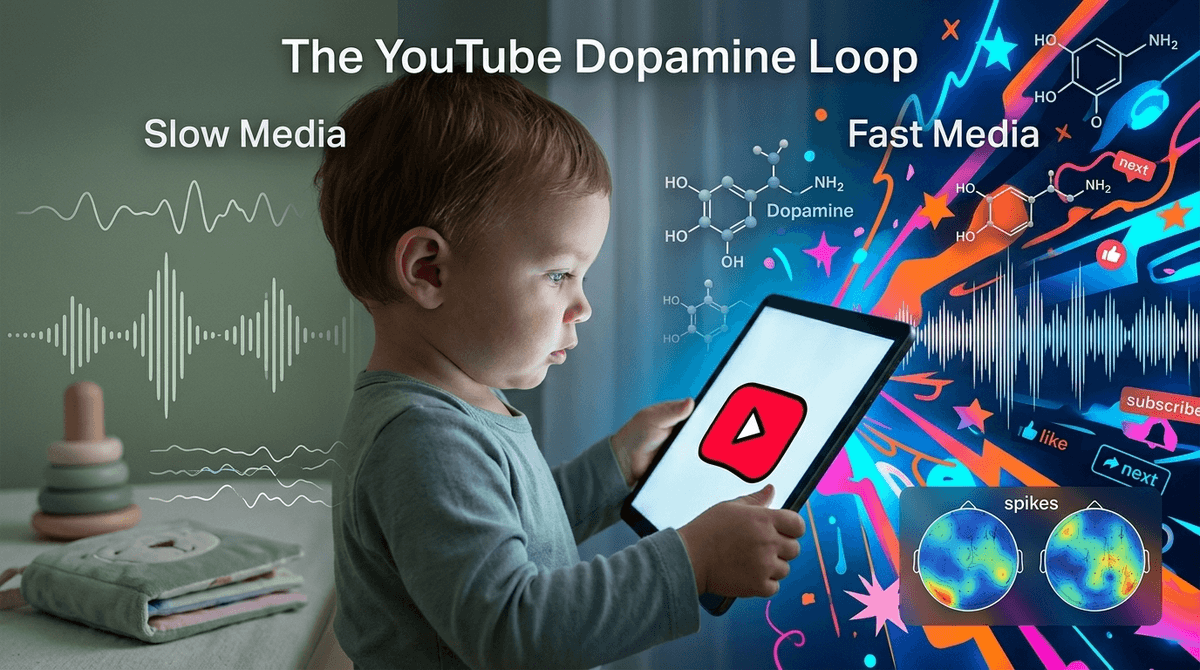
When a toddler watches a high-intensity show like Cocomelon or those weird, neon-colored "unboxing" videos, their brain is flooded with dopamine. This is the "feel-good" neurotransmitter associated with reward and novelty.
YouTube’s features—Autoplay, Recommended Videos, and Shorts—are designed to keep that dopamine flowing. Every time a new, bright, loud video starts, the brain gets a fresh hit. The problem? Toddlers have zero impulse control. Their prefrontal cortex (the part of the brain that says "okay, that's enough") won't be fully cooked for another twenty years. They are physically incapable of turning it off themselves without a struggle.

Have you noticed how modern kids' shows look different than the ones we grew up with? Shows like Little Bear or Mr. Rogers' Neighborhood had long camera takes and slow movements.
On the flip side, a lot of YouTube Kids content features a camera cut every 1 to 3 seconds. This constant visual jumping forces the brain into a state of hyper-arousal.
When the brain is overstimulated by these fast edits, it can lead to "low registration." This is that "zombie" look where your child is staring at the screen, mouth open, and doesn't hear you when you call their name three times. Their brain has literally tuned out the physical world because it’s struggling to process the firehose of digital information.
The meltdown that happens when the screen goes black isn't just "bad behavior." It’s a physiological crash.
Imagine you’re at a party, the music is pumping, and you’re having the time of your life. Suddenly, someone cuts the power, turns on the fluorescent lights, and tells you to go do your taxes. That’s what it feels like for a toddler to go from the high-dopamine environment of YouTube to the "boring" real world where toys don't move on their own and Mommy wants them to eat broccoli.
The transition is too sharp. Their nervous system is over-taxed, and the only way they know how to signal that "low battery" state is by screaming.
Not all screen time is created equal. If you need 20 minutes to cook dinner or take a shower (and let's be real, we all do), choose content that respects your child's nervous system.
There is a reason parents are obsessed with this show. The colors are muted, the music is orchestral and calm, and the stories focus on imaginative play. It’s "Slow Media" that actually entertains.
While it's on YouTube, Ms. Rachel uses techniques backed by speech therapists. She speaks slowly, uses "parentese," and leaves pauses for your child to respond. It's interactive rather than passive.
This is a masterclass in gentle storytelling. The pacing is slow, the characters are kind, and it doesn't rely on "jump scares" or frantic edits to keep a toddler's attention.
Narrated by Chris O'Dowd, this show is basically a nature documentary for toddlers. It’s visually beautiful and incredibly soothing.
The spiritual successor to Mr. Rogers. It explicitly teaches emotional regulation—the exact skill they need to handle the "YouTube Dopamine Loop" in the first place.
Even on YouTube Kids, "brain rot" is a real concern. There is a massive amount of "AI-generated" content—videos with weirdly distorted versions of Mickey Mouse or Spider-Man that are designed solely to trigger the algorithm.
What to watch out for:
- Unboxing Videos: These trigger a "want" response and can lead to more consumerism-driven tantrums.
- Surprise Egg Videos: High dopamine, low educational value.
- Blippi: While popular, Blippi is very high-energy and fast-paced. Some kids handle it fine; others get completely "wired" after an episode.
We live in a world where 80% of children under 4 are using mobile devices. You aren't "failing" if your toddler watches YouTube. But you are the "Chief Technology Officer" of your home.
Practical Steps:
- Turn off Autoplay. This is the single most important thing you can do. It forces a manual choice between videos rather than a never-ending stream.
- Cast to the TV. Tablets are more addictive because they are "personal" and close to the face. Watching on a TV creates physical distance and makes it a shared experience.
- The "Two-Minute Warning" doesn't work. Toddlers have no concept of time. Instead, use "visual cues." Say, "When this episode of Bluey is over, we are going to play with blocks."
- Co-watch when possible. If you’re there, you can talk about what’s happening. "Look, the Puffin is sad because he lost his snack." This turns a passive experience into an active, social one.
YouTube isn't inherently "evil," but it is built for engagement, not for healthy toddler development. When we understand that the meltdowns and the "zombie stare" are just a biological reaction to a high-dopamine environment, we can stop feeling guilty and start making better choices.
Focus on quality over quantity and slow over fast. Your toddler’s brain (and your own sanity) will thank you.