

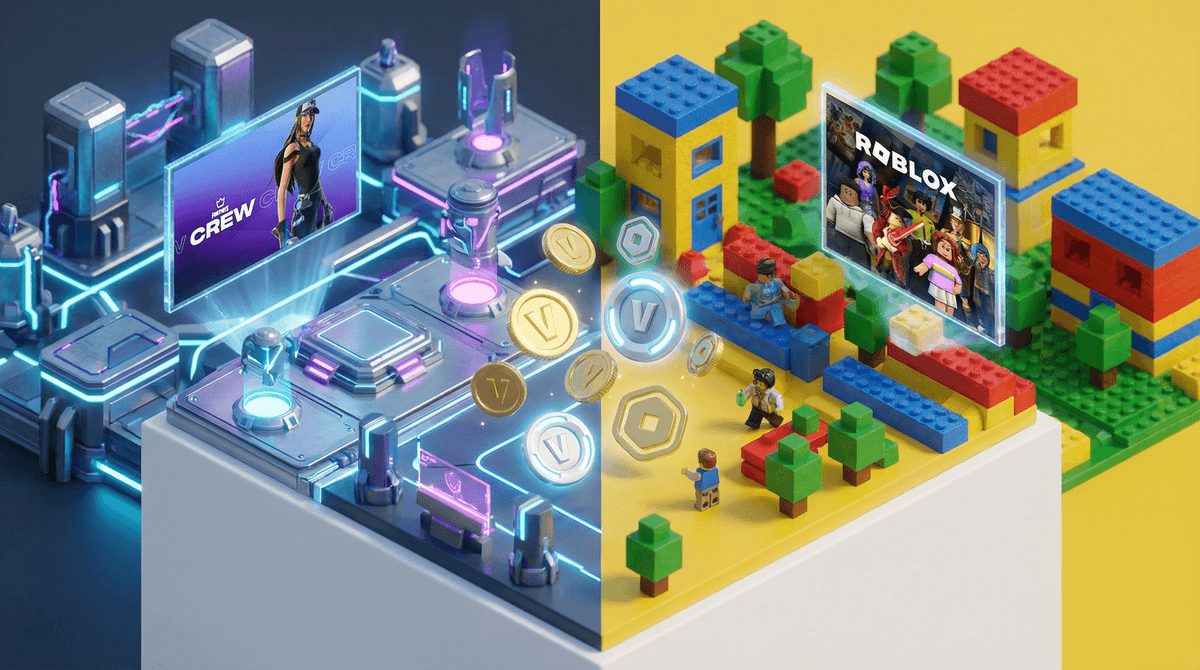
Let's cut to the chase: V-Bucks and Robux are both virtual currencies that let kids buy stuff in games—but they work in completely different ecosystems, and understanding that difference is actually pretty important for your wallet and your sanity.
V-Bucks are the currency for Fortnite. That's it. You buy V-Bucks, you spend them in Fortnite on skins, emotes, and Battle Passes. They're locked to one game made by one company (Epic Games).
Robux are the currency for Roblox—but here's where it gets interesting. Roblox isn't really a game. It's a platform with millions of user-created games inside it. Robux can be spent across any of these games, and here's the kicker: kids can actually create things in Roblox and earn Robux back. Some teens are making real money from their Roblox creations (though let's be clear, most aren't).
So the TL;DR: V-Bucks = one game, cosmetic stuff only. Robux = entire platform, can unlock game features AND cosmetics, and has a creator economy built in.
The begging is real, and it's relentless. Here's what's driving it:
For V-Bucks: Fortnite's entire business model is built on FOMO (fear of missing out). New skins drop constantly, often tied to popular franchises like Marvel or Star Wars. The Item Shop rotates daily. Battle Passes are seasonal. Your kid sees their friends with the latest skin and suddenly they NEED it or they'll literally die (their words, not mine). The social pressure is intense—skins are status symbols in the Fortnite world.
For Robux: The ask is often framed as "I need Robux to play this game" or "I need Robux to make my avatar look cool." And sometimes that's true—many Roblox games have premium features or game passes that require Robux. But also, Roblox has created a culture where your avatar IS your identity, and a default avatar screams "I'm broke" to other kids. It's the digital equivalent of showing up to school in hand-me-downs (which, to be clear, is totally fine—but middle schoolers are brutal).
Both currencies tap into the same psychological levers: social belonging, self-expression, and the dopamine hit of getting something new and shiny.
This is where parents get frustrated, because you're not buying a thing you can hold. You're buying digital goods that exist only inside these games. When the game eventually dies (and all games do), that money is gone.
V-Bucks pricing:
- $7.99 = 1,000 V-Bucks
- $19.99 = 2,800 V-Bucks
- $31.99 = 5,000 V-Bucks
Most skins cost 800-2,000 V-Bucks. A Battle Pass (which unlocks challenges and rewards for a season) costs 950 V-Bucks and is actually the best value if your kid plays regularly.
Robux pricing:
- $4.99 = 400 Robux
- $9.99 = 800 Robux
- $19.99 = 1,700 Robux
- $49.99 = 4,500 Robux
Or you can get a Roblox Premium subscription ($4.99-$19.99/month) that gives you a monthly Robux allowance plus other perks.
Here's what makes Robux more complicated: the spending is spread across thousands of games. Your kid might spend 100 Robux here, 50 there, 200 on an avatar item—it adds up fast and feels less visible than dropping 2,000 V-Bucks on one Fortnite skin.
Let's talk about what actually matters:
1. Neither currency is regulated like real money, but they ARE real money.
When your kid asks for $20 in V-Bucks, they're asking for $20. Full stop. The conversion to fake currency is a psychological trick that makes spending feel less real. This is by design .
.
2. Roblox has a creator economy that sounds educational but can be exploitative.
Yes, some kids learn game design and make money. But the vast majority spend Robux on other people's creations and never earn a dime back. And some of the "tycoon" games on Roblox are literally just teaching kids to grind for virtual currency—not exactly entrepreneurship.
3. Both platforms make it VERY easy to spend without friction.
Once a credit card is linked, kids can spend with a few taps. There are parental controls (and you should absolutely use them), but the default setting is "spend away."
4. The social pressure is real and it's not going away.
Your kid isn't lying when they say "everyone has this." In many friend groups, that's true. Whether you give in to that pressure is your call, but don't dismiss the social dynamics at play.
Ages 8-10: If they're playing these games, consider a small monthly allowance of V-Bucks or Robux (like $10/month). This teaches budgeting within a system they care about. Use parental controls to require approval for purchases. Talk about the difference between "need" and "want."
Ages 11-13: This is peak FOMO age. Consider letting them earn V-Bucks/Robux through chores or trade screen time for currency. Set clear limits ("You get $20/month, period"). Have honest conversations about marketing tactics and why games use virtual currency.
Ages 14+: They're old enough to understand the economics. If they want more currency, they can earn real money and buy it themselves. Some families tie this to financial literacy lessons—"If you save $50 in real money, I'll match your next V-Bucks purchase."
Here's what actually works:
Set up parental controls immediately. Both Fortnite and Roblox have decent parental control options. Require purchase approval. Set spending limits. Do this before the first meltdown over a denied purchase.
Create a budget together. Sit down with your kid and say "Here's what we're willing to spend on games each month: $X. You can spend it on V-Bucks, Robux, or other games. You choose." This shifts the conversation from "Can I have?" to "How should I spend my budget?"
Talk about the psychology. Kids are smart. Explain that these games are designed to make them want to spend money. Talk about FOMO, artificial scarcity, and social pressure. It won't eliminate the begging, but it plants seeds.
Consider gift cards. For birthdays or holidays, V-Bucks or Robux gift cards are actually great gifts. It gives kids autonomy, teaches budgeting, and saves you from the constant "Can I have..." requests.
Don't link your credit card directly if you can avoid it. Use gift cards or prepaid cards instead. This creates natural friction and prevents accidental (or "accidental") overspending.
V-Bucks and Robux are not the enemy. They're just the current version of what kids have always wanted: stuff that helps them fit in and express themselves. In the 90s it was Pokémon cards. In the 2000s it was Webkinz. Now it's digital skins and avatar items.
The real issue isn't the virtual currency—it's teaching kids to navigate a world designed to extract money from them at every turn. Use this as an opportunity to teach financial literacy, delayed gratification, and critical thinking about marketing.
And look, if you decide your family's boundary is "We don't spend real money on virtual items," that's totally valid. But know that your kid will be the one with the default skin, and that has social consequences in their world. Whether those consequences matter is up to you.
- Set up Roblox parental controls if your kid plays Roblox
- Set up Fortnite parental controls if your kid plays Fortnite
- Learn more about whether Roblox is actually teaching entrepreneurship or just draining your wallet
- Have a real conversation with your kid about wants vs. needs using V-Bucks or Robux as the example
- Create a monthly gaming budget together and stick to it