

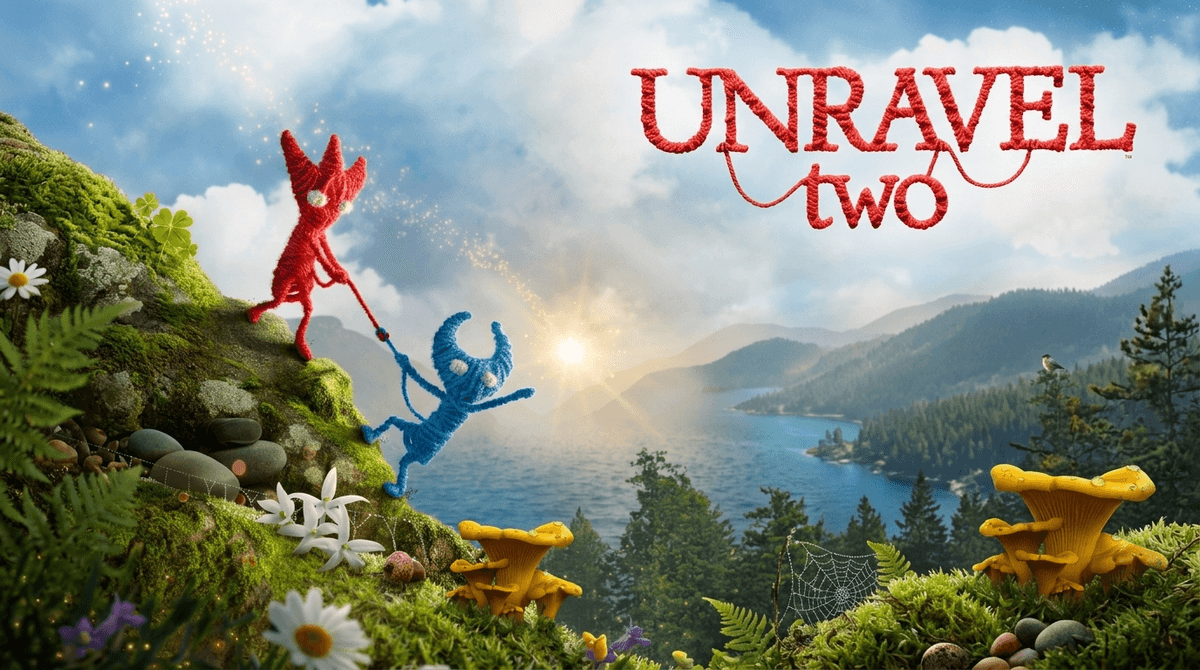
TL;DR: Unravel Two is the rare "peace treaty" video game. Instead of competing, two players are literally tied together by a thread of yarn, forcing them to communicate, swing each other across gaps, and solve puzzles as a unit. It’s stunningly beautiful, low-stress, and the perfect antidote to the high-octane chaos of Fortnite.
Quick Links for the Busy Parent:
- The Game: Unravel Two
- Similar Vibe: It Takes Two
- For Younger Kids: Pikmin 4
- Guide: How to encourage collaborative gaming
Unravel Two is a physics-based puzzle-platformer where you control "Yarnys"—tiny, adorable creatures made of red and blue yarn. While the first game was a solo adventure, the sequel was built from the ground up for two-player local co-op.
The hook is literal: the two characters are joined at the waist by a single strand of yarn. If one player jumps off a cliff, the other has to anchor them. If you need to reach a high ledge, one player stays down to act as a counterweight while the other climbs. You aren't just playing in the same room; you are physically tethered to your partner’s success.
The backdrop is a gorgeous, photorealistic world that looks like the Swedish countryside. While the "story" is told through blurry, metaphorical silhouettes of human memories in the background, the real story is what’s happening on your couch between the two people holding the controllers.
We talk a lot about "brain rot" content—those YouTube Shorts or Skibidi Toilet videos that offer high-frequency sensory input with zero cognitive load. Unravel Two is the exact opposite.
It requires spatial reasoning, problem-solving, and, most importantly, interpersonal regulation.
In most games, if a sibling messes up, the other sibling gets annoyed because it "ruined their score." In Unravel Two, if a sibling messes up, the game literally stops until the other sibling helps them up. It reframes the "gamer" mindset from "I need to win" to "We need to get through this forest without falling into the water."
Learn more about why collaborative games are better for sibling harmony
The "Buddy System" isn't just a marketing tagline here; it’s the core mechanic. About 20% of 3rd graders and nearly 40% of middle schoolers report that gaming is their primary way of socializing with friends, but that socialization is often competitive or toxic (think Call of Duty or even the "prestige" culture in Roblox).
Unravel Two teaches three specific skills:
- Trust: You have to trust that your partner won’t let go of the yarn while you’re swinging over a pit of fire (or, you know, a very scary puddle).
- Communication: You can’t just "do your own thing." You have to say, "Okay, you stay there, I’m going to swing, and then you pull me up."
- Resilience: Some of the puzzles are genuinely tricky. Because there’s no "Game Over" screen that sends you back to the very beginning, it encourages kids to try, fail, and iterate together.
If your kids are used to the dopamine-drenched world of [Brawl Stars](https://screenwiseapp.com/media/brawl-stars-app, this might feel "slow" at first. That’s a feature, not a bug. It’s a "cozy game" that still has stakes.
- Compared to Mario Kart 8 Deluxe: There is no losing in Unravel. There is only "not there yet."
- Compared to Minecraft: While Minecraft is great for creativity, it can be lonely or overwhelming. Unravel is a guided, shared experience with a clear beginning, middle, and end.
- Compared to Roblox: There are no microtransactions. No "limited edition" skins to beg for. No "bank account draining" entrepreneurship simulators. You buy the game, you own the yarn.
Recommended Ages: 7+ (with a partner)
While the game is rated E for Everyone, the puzzles require a level of logic and fine motor skills that might frustrate a 5-year-old.
- Ages 5-7: They can play, but they should probably play with a parent or a very patient older sibling. The "Carry" mechanic is a lifesaver here—one player can actually hop onto the other's back, merging the two Yarnys into one. This allows the more experienced player to handle the difficult platforming sections while the younger child hitches a ride.
- Ages 8-12: This is the sweet spot. They have the dexterity to handle the swinging mechanics and the logic to solve the "how do we get this rock to the other side" puzzles.
- Teens: Surprisingly, teens often find the aesthetic and the "vibe" of the game relaxing. It’s a great "wind-down" game after a stressful day of school.
This is one of the safest games on the market for one major reason: It is local co-op only.
There is no "online multiplayer" with strangers. There is no voice chat with 19-year-olds in another country. The only person your child is communicating with is the person sitting next to them on the couch.
What to watch for:
- The "Shadows": There are shadowy, smoke-like monsters that chase the Yarnys in certain levels. They don't have faces and they aren't "gory," but the music gets tense and the atmosphere gets dark. If you have a particularly sensitive child who hates being "chased" in games, you might want to sit with them during the forest levels.
- Frustration: Because the players are tied together, one player's mistake affects the other. This can lead to some "It’s your fault!" moments. Use this as a coaching opportunity for digital citizenship and empathy.
If you’re playing Unravel Two with your child (which I highly recommend), use it as a bridge to real-life conversations:
- On Teamwork: "We couldn't have made that jump if you didn't hold the line for me. How does that feel compared to playing a game where we're trying to beat each other?"
- On Failure: "We've tried this jump five times and keep falling. What’s a different way we could use the yarn?"
- On Helping: "I noticed you used the 'carry' feature when I was struggling with that wall jump. Thanks for looking out for me."
Unravel Two is a masterpiece of intentional design. It’s one of the few games that treats "connection" as a mechanic rather than just a theme. In a world where kids are increasingly isolated behind individual screens—even when they're in the same room—this game forces them to look at each other, talk to each other, and literally hold each other up.
It’s not just "not brain rot"; it’s a digital exercise in empathy. Plus, it’s usually on sale for under $20 on the Nintendo eShop or PlayStation Store, making it a much better investment than a pile of Robux.
- Check the Platform: Unravel Two is available on Switch, PlayStation, Xbox, and PC.
- Set the Scene: This isn't a "background noise" game. Turn off the TV in the other room, put the phones away, and commit to 30 minutes of focused play.
- Explore More: If they love the puzzles but want something more "homely," check out Stardew Valley. If they love the co-op but want something funnier, try Overcooked! All You Can Eat.
Find more collaborative game recommendations for your family's specific age groups