

TL;DR
Super Meat Boy is a legendary indie platformer that is famous for two things: being incredibly difficult and being incredibly "gross." While the violence is entirely pixelated and cartoonish, the game features a constant stream of "blood" (red juice) and crude humor that might not sit well with every family. It’s best suited for ages 12+ due to the frustration factor and the juvenile tone.
Quick Recommendations for Platformer Fans:
- For the challenge without the gore: Celeste
- For the "one more try" loop but family-friendly: Super Mario Maker 2
- For beautiful art and high difficulty: Hollow Knight
- For retro vibes and less frustration: Shovel Knight
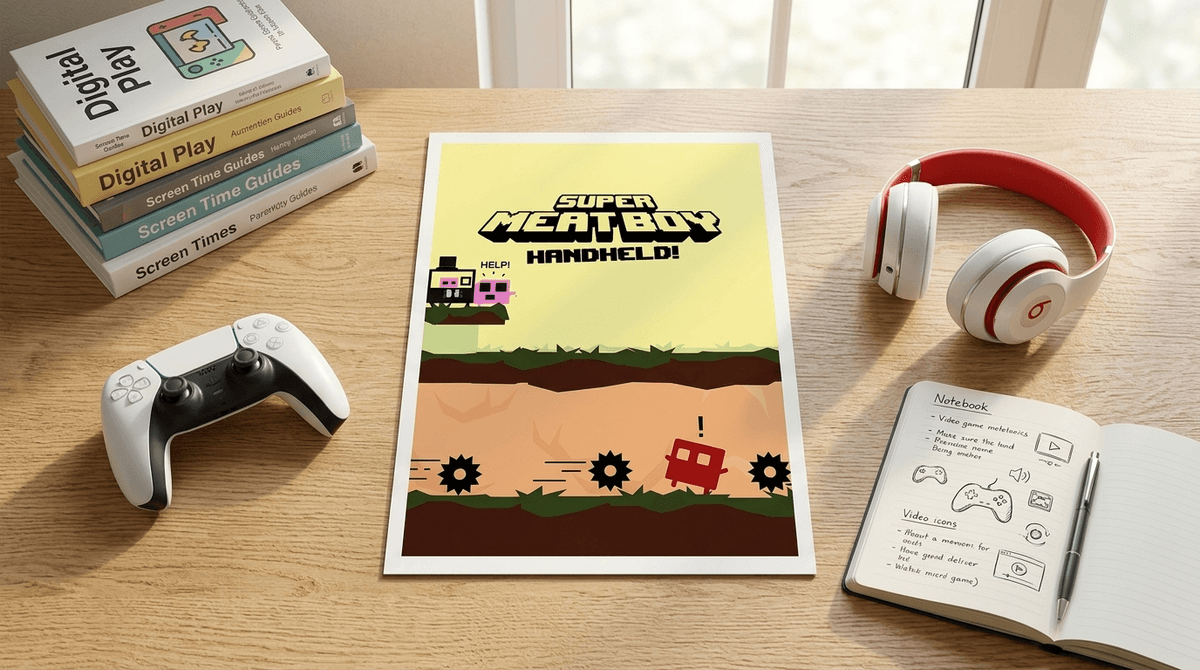
If you’ve spent any time looking over your kid’s shoulder while they play, you’ve probably seen a small, red, rectangular character jumping off walls and occasionally exploding into a red mess. That’s Meat Boy.
Super Meat Boy is a "precision platformer." The goal is simple: navigate a series of increasingly lethal levels filled with buzzsaws, salt, and lasers to save your girlfriend, Bandage Girl, from the villainous Dr. Fetus (yes, a fetus in a tuxedo inside a jar).
It’s an old-school game at heart, meaning it’s designed to be hard. Like, "throw your controller across the room" hard. But because the levels are short and you respawn instantly, it creates a highly addictive "just one more try" loop that can keep kids (and adults) glued to the screen for hours.
Despite being over a decade old, Super Meat Boy remains a staple in gaming culture. Kids love it for the same reason they love Roblox "Obbys" (obstacle courses) or Geometry Dash: the flex.
Beating a level in this game is a badge of honor. It requires frame-perfect timing and muscle memory. There’s also a certain rebellious appeal to the "edgy" 2010-era internet humor. It feels a little bit "naughty" because of the blood splatters and the crude character names, which is a magnet for middle schoolers who are tired of the polished, sanitized world of Bluey or Minecraft.
Let’s talk about the elephant in the room: the blood. In Super Meat Boy, the main character is literally a cube of meat. When he hits a saw blade, he doesn't just die; he disintegrates into a splash of red pixels.
As he moves through a level, he leaves a trail of red "blood" on every surface he touches. By the time your kid finishes a difficult level, the entire map is usually coated in red.
Is it "violent"? Technically, yes. But it’s important to distinguish this from the realistic, visceral violence you’d see in a game like Call of Duty or The Last of Us. There are no screams of pain, no realistic anatomy, and no "human" suffering. It’s more akin to a Road Runner cartoon where the Coyote gets flattened by an anvil. The "blood" functions more like a coat of paint that tracks your progress than actual gore.
Learn more about the difference between cartoon and realistic violence
The game’s sense of humor is... well, it’s a lot. The main antagonist is Dr. Fetus, who frequently flips the player off. There are characters made of bandages, characters that look like piles of poop, and a general "gross-out" aesthetic that was very popular in indie games during the early 2010s.
For most parents, this isn't a "dealbreaker" issue, but it’s definitely something to be aware of. If you’re a family that prefers more wholesome or intellectually stimulating content, Super Meat Boy is going to feel like a step backward. It’s the gaming equivalent of a middle-schooler making a fart joke at the dinner table.
While parents usually worry about the "gore," the bigger issue with Super Meat Boy is often the emotional regulation required to play it.
This game is designed to make you fail. You will die hundreds, if not thousands, of times. For a kid who struggles with "gamer rage" or has a hard time walking away when they’re frustrated, this game can be a nightmare. We see a lot of community data suggesting that highly difficult games can lead to increased household tension if boundaries aren't set.
If you notice your kid yelling at the screen or getting genuinely angry, it might be time to pivot to something with a more "cozy" vibe.
If your kid is obsessed with Super Meat Boy, they clearly enjoy a challenge. Here are some alternatives that offer similar gameplay but with different "vibes."
This is the gold standard for modern platformers. It’s just as difficult as Meat Boy, but instead of crude humor and blood, it features a beautiful story about mental health, anxiety, and perseverance. It’s a much more "intentional" choice for parents who want the challenge without the "brain rot" feel.
If your kid likes the "boss battle" aspect and the retro feel, Cuphead is incredible. The art style is based on 1930s cartoons. It’s notoriously difficult, but it swaps the "meat and gore" for a stunning, hand-drawn aesthetic.
For a younger sibling who wants to play a platformer like their older brother or sister, Super Mario Wonder is the perfect entry point. It’s creative, polished, and 100% "safe" for all ages.
If they are a bit older (13+) and like the "die and try again" loop, Hades is a masterpiece. It has more violence (stylized Greek mythology) but offers a deep narrative and incredible character development that makes the "dying" part of the game feel productive.
- Ages 5-9: Generally not recommended. Not because it’s "evil," but because the difficulty will likely result in a meltdown, and the humor is a bit too "edgy" for this group.
- Ages 10-12: Use your best judgment. If they can handle a bit of cartoon "red goo" and don't mind the juvenile humor, it’s probably fine. Just watch for the frustration levels.
- Ages 13+: This is the target audience. At this age, they usually understand the "ironic" nature of the humor and have the motor skills to actually progress in the game.
One thing that often surprises parents is the replay feature. When you finish a level in Super Meat Boy, the game shows you a replay of all your failed attempts at once. You see dozens of Meat Boys running and dying simultaneously until the one "successful" Meat Boy makes it to the end.
It’s actually a pretty cool visual representation of "learning from failure," which is a conversation you can have with your kid.
Ask them:
- "How many tries did that take?"
- "What did you have to change about your strategy to get through that saw blade?"
- "Does it feel better to win a game that’s easy or a game that’s this hard?"
Super Meat Boy is a "classic" for a reason, but it’s definitely a product of a specific era of internet culture that valued being "gross" and "hardcore." It’s not "brain rot" in the sense that it requires zero effort—in fact, it requires massive amounts of focus and skill.
However, if you’re looking for media that aligns with more "wholesome" or "emotionally intelligent" values, you might want to steer them toward Celeste or Hollow Knight.
- Watch a "Let's Play": Spend 5 minutes watching a YouTube video of the game. You'll know within 30 seconds if the "red goo" is a dealbreaker for your family.
- Set a "Rage Quit" Rule: If the game is causing more stress than fun, have a pre-agreed-upon rule that the console gets turned off for an hour.
- Check the Screenwise Survey: If you haven't already, take our survey to see how your kid's gaming habits compare to other families in your community. You might find that your kid is the only one in their friend group playing this, or you might find that it's the current "it" game in the 7th grade. Context is everything!