

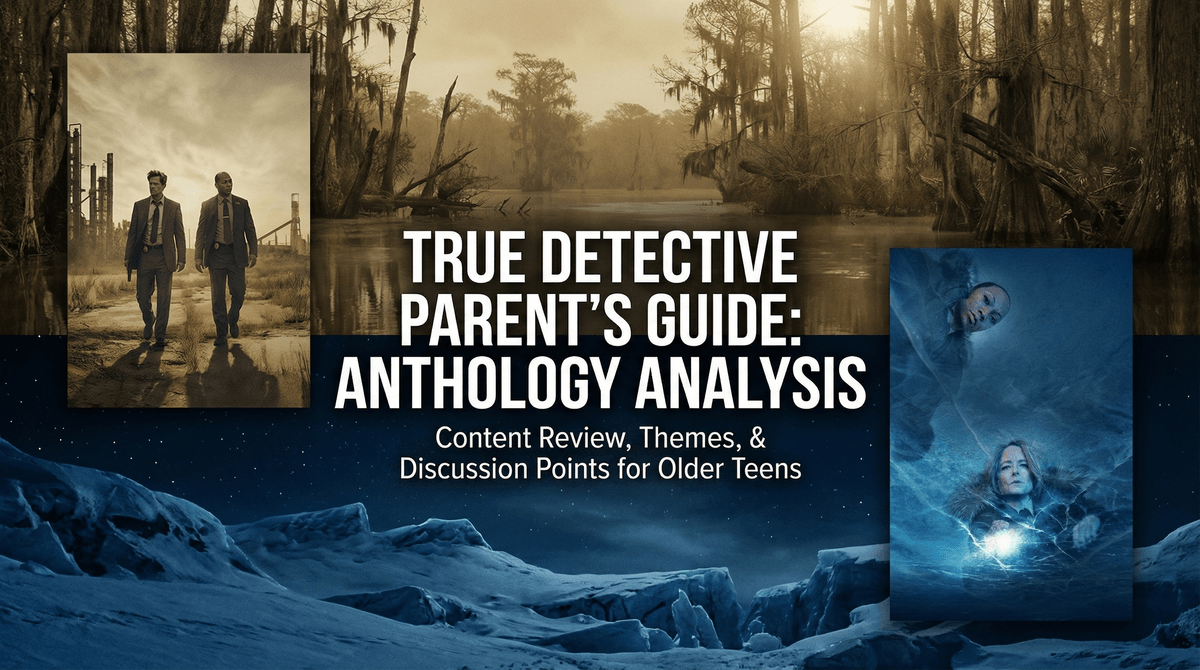
True Detective Seasons for Mature Teens: A Parent's Guide
Season 1 is the most accessible for mature 16+ teens who can handle dark themes and philosophical weight. Season 4 (Night Country) works for similar ages with strong female leads. Season 2 is a hard pass—it's a confusing slog even for adults. Season 3 sits in the middle but requires patience for its nonlinear storytelling.
If your teen loves cerebral crime dramas and you're okay with heavy violence, existential dread, and some graphic content, Season 1 is your entry point. Just be ready for some intense conversations afterward.
True Detective is HBO's anthology crime series where each season tells a completely different story with new characters, settings, and mysteries. Think of it like American Horror Story but for detective noir instead of supernatural horror.
The show became a cultural phenomenon with Season 1 in 2014, thanks to Matthew McConaughey's haunting performance and those iconic tracking shots. Each season tackles philosophical questions about morality, time, trauma, and what people are capable of when pushed to their limits.
It's prestige TV at its most ambitious—which means it's also dense, slow-burning, and absolutely not for everyone.
True Detective keeps popping up in "best TV of all time" lists, and older teens who are getting into serious television will inevitably encounter it. The problem? The show's reputation as "sophisticated crime drama" can obscure just how dark and graphic it gets.
We're talking ritualistic murders, child abuse themes, sexual violence, and protagonists who are deeply flawed and sometimes reprehensible people. This isn't Law & Order where justice prevails in 42 minutes. It's bleak, morally complex, and designed to make you uncomfortable.
The good news? If your teen is genuinely ready for this level of content, True Detective offers rich material for discussions about justice, corruption, masculinity, and how trauma shapes people. It's the kind of show that demands processing afterward.
Age recommendation: 16+ (mature 16-year-olds who can handle intense content)
The setup: Two Louisiana detectives (McConaughey and Woody Harrelson) investigate ritualistic murders over 17 years, told through multiple timelines.
Why it works for mature teens: Season 1 is genuinely brilliant television. The performances are career-defining, the cinematography is haunting, and the philosophical discussions about time, meaning, and human nature are the kind of thing that sticks with you. For teens interested in philosophy or psychology, Rust Cohle's nihilistic worldview becomes a fascinating character study.
The hard stuff: This season deals with child abuse, sexual violence against children (not shown but heavily implied), graphic crime scenes, and a pervasive sense of cosmic horror. There's nudity in strip club scenes, heavy drug use, and characters who say deeply disturbing things. The finale includes intense violence.
Parent move: If you're watching with your teen, the philosophical monologues are great conversation starters. Ask them what they think about Rust's pessimism versus Marty's attempts at normalcy. The show doesn't glorify either approach—both men are deeply damaged.
True Detective Season 2
Age recommendation: Skip it entirely
The setup: Three detectives and a criminal investigate a murder tied to California corruption and land deals.
Why it doesn't work: Season 2 is a mess. It's trying to do too much—four protagonists, convoluted plot threads, forced noir dialogue that sounds like a parody. Even adults who loved Season 1 struggled to stay engaged.
The hard stuff: All the violence and sexual content of Season 1, but without the narrative coherence to justify it. There's a particularly brutal sexual assault scene in episode 2 that serves no real purpose.
Parent move: Just... don't. If your teen insists because they loved Season 1, warn them it's a completely different experience and not in a good way. There are better ways to spend 8 hours.
Age recommendation: 16+ (same maturity level as Season 1)
The setup: An Arkansas detective (Mahershala Ali) investigates the disappearance of two children across three different time periods spanning 35 years.
Why it works for mature teens: This season is more about memory, aging, and how cases haunt the people who work them. Ali's performance is stunning, and the mystery is genuinely compelling. It's less graphic than Season 1, more focused on psychological weight than shock value.
The hard stuff: Child disappearance is the central trauma, which hits different than adult victims. There's violence but it's less frequent. The nonlinear timeline jumping between three eras can be confusing—you need to pay attention.
Parent move: This season is actually great for discussing how memory works, how cases affect investigators personally, and the long-term impact of trauma. The relationship between the detective and his wife is complex and worth unpacking.
Age recommendation: 16+
The setup: Two female detectives (Jodie Foster and Kali Reis) investigate when scientists at an Arctic research station disappear in the perpetual darkness of an Alaska winter.
Why it works for mature teens: Night Country brings strong female leads to the series and leans into atmospheric horror more than previous seasons. The Indigenous representation and themes about colonialism, environmental destruction, and generational trauma add layers beyond the central mystery. For teens interested in climate fiction or Indigenous stories, this season connects to bigger conversations.
The hard stuff: Body horror (frozen corpses in disturbing positions), violence against women as a plot element, supernatural/horror elements that can be genuinely unsettling. The darkness—both literal and thematic—is oppressive.
Parent move: The show explicitly addresses violence against Indigenous women and the failures of systems to protect them. This is heavy but important material if your teen is ready for it. The supernatural elements are more ambiguous than previous seasons—good fodder for discussion about what's real versus metaphor.
For 14-15 year olds: Not yet. Even the "best" seasons are too graphic and thematically heavy. If they're interested in detective stories, try Knives Out, Only Murders in the Building, or even Sherlock.
For mature 16-17 year olds: Seasons 1, 3, and 4 are on the table if they can handle:
- Graphic violence and disturbing imagery
- Sexual content and nudity
- Dark philosophical themes about meaninglessness and human evil
- Slow pacing that requires sustained attention
- Morally ambiguous protagonists who aren't role models
For 18+: All seasons are fair game, though Season 2 is still skippable for quality reasons rather than content concerns.
Red flags that your teen isn't ready:
- They're still processing trauma of their own
- They struggle with depression or existential anxiety
- They have a history of being deeply affected by dark content
- They prefer shows where good guys win and justice prevails
True Detective is designed to be uncomfortable and leave you unsettled. That's the point. But not everyone needs that experience at 16.
This isn't background TV. True Detective demands attention. If your teen is scrolling TikTok while watching, they're missing the whole point. The show rewards careful viewing—visual clues, dialogue callbacks, thematic parallels across timelines.
The violence has purpose but it's still graphic. Unlike torture porn horror, the violence in True Detective serves the story's themes about evil and human nature. But that doesn't make it easier to watch. Crime scenes are disturbing. Implications about what happened to victims are sometimes worse than what's shown.
The show is deeply cynical about institutions. Police departments, churches, government, corporations—they're all portrayed as corrupt or complicit. If you want your teen to respect authority figures, this show actively undermines that. (Whether that's a feature or bug depends on your worldview.)
Philosophy majors will love this; everyone else might find it pretentious. Rust Cohle's monologues in Season 1 are either profound or insufferable depending on your tolerance for nihilistic philosophy. Some teens will eat it up and want to discuss Nietzsche. Others will roll their eyes at the try-hard dialogue.
Co-watching is valuable here. Unlike most teen viewing, True Detective benefits from having an adult to process with afterward. The themes are heavy, the moral questions are complex, and having someone to debrief with makes the experience richer and less isolating.
Set expectations upfront: "This show is going to be disturbing. We can stop anytime, and we'll check in after each episode."
Use the pause button: When something particularly heavy happens, pause and talk about it. "How are you feeling about that scene?" "What do you think the show is saying here?"
Focus on the craft: Talk about the cinematography, the performances, the structure. This helps create some distance from the content while still engaging with it critically.
Process the philosophy: Rust's nihilism in Season 1 is compelling but also deeply pessimistic. Ask your teen if they agree with his worldview. What does the ending suggest about hope versus despair?
Discuss the gender dynamics: All seasons deal with masculinity and violence, often critically. Season 4 specifically interrogates male violence and female resilience. These are important conversations.
Know when to stop: If your teen is having nightmares, seems withdrawn, or is clearly not ready for this level of content, it's okay to say "let's table this for a year or two."
If your teen wants sophisticated mystery but isn't quite ready for True Detective:
- The Sinner (15+): Anthology crime series that's intense but less graphic
- Mare of Easttown (16+): Excellent detective work, still heavy but more grounded
- Broadchurch (14+): British crime drama that's emotionally intense but less violent
- Mindhunter (16+): Serial killer profiling that's cerebral over graphic
- Only Murders in the Building (13+): Mystery comedy that's genuinely clever
For teens who love the philosophical angle, try The Good Place for ethics discussions without the trauma.
True Detective Season 1 is genuinely great television that offers rich material for mature teens ready to engage with dark, complex storytelling. Season 4 brings fresh perspectives worth exploring. Season 3 is solid if your teen loved Season 1 and wants more. Season 2 is a waste of everyone's time.
But here's the real question: Is your teen ready for this level of darkness? Not "are they mature enough to handle the content" but "will this enhance their life or just add unnecessary heaviness?"
There's no rush. True Detective will still be there in a year or two. If you're on the fence, wait. If your teen is genuinely ready—intellectually curious, emotionally resilient, interested in serious storytelling—then Season 1 is a masterclass in television that's worth experiencing together.
Just keep the lights on afterward. This show gets under your skin.
- Start with Episode 1 of Season 1 and see how your teen responds. If it's too much, you'll know quickly.
- Check Common Sense Media ratings for specific episode warnings before watching.
- Have an exit strategy: "If this is too intense, we can switch to something else. No judgment."
- Process afterward: Make time to talk about what you watched, especially after heavy episodes.
And if you want to explore other prestige dramas for teens or shows that make you think, there's a whole world of sophisticated television that doesn't require quite this level of emotional fortitude.