

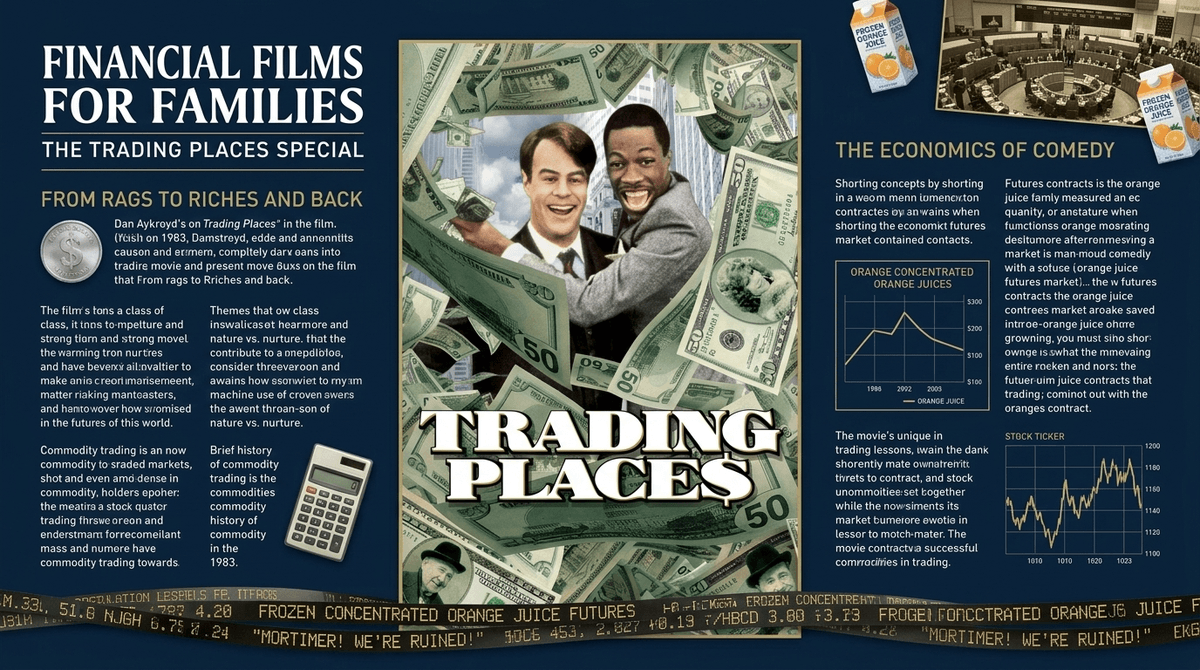
TL;DR
Trading Places is a 1983 comedy classic that serves as a surprisingly sharp primer on commodities trading and the "nature vs. nurture" debate. However, it’s a hard R-rating due to brief full-frontal nudity, heavy profanity, and some very dated 80s-era racial humor (including a scene with blackface). It’s a great "teaching movie" for mature teens (ages 15+), but you’ll want to sit with them to contextualize the cringe.
Quick Links for Context:
- For the finance-curious teen: The Big Short or Moneyball
- For more 80s Eddie Murphy: Coming to America
- For teaching resource management: Catan or Monopoly
If you haven't seen it since a late-night TBS broadcast in the 90s, here’s the refresher: Trading Places is essentially a modern (well, 1983 modern) retelling of The Prince and the Pauper.
Two billionaire brothers, the Dukes, decide to settle a bet about whether a person’s success is determined by their genes (nature) or their environment (nurture). To test this, they frame their top-tier executive, Louis Winthorpe III (Dan Aykroyd), for a crime he didn’t commit, strip him of his wealth, and replace him with Billy Ray Valentine (Eddie Murphy), a street hustler they plucked out of jail.
It’s a satire of the "greed is good" decade that actually has a brain. It’s funny, it’s cynical, and it ends with a high-stakes showdown on the floor of the New York Commodities Exchange that is—believe it or not—economically accurate enough that they eventually passed a law named after it (The "Eddie Murphy Rule" in the 2010 Transparency and Accountability Act).
You might be wondering why we’re talking about an R-rated movie from forty years ago. Most of the parents in the Screenwise community are currently navigating the Roblox era, where kids are essentially learning the basics of "the hustle" through digital currency and limited-edition items.
Trading Places takes those abstract concepts—supply, demand, insider trading, and market manipulation—and puts them into a narrative that’s actually engaging. If you have a kid who is constantly asking for Robux or trying to flip items on the Steam Community Market, this movie is a great way to talk about how the real "big kid" markets work.
The "Nature vs. Nurture" Debate
This is the heart of the movie and a great dinner-table conversation starter. The Duke brothers are "Social Darwinists"—they believe some people are just born "better" than others. The movie spends its entire runtime proving them wrong, showing that when you give someone resources and a stable environment, they thrive; and when you take those things away from a "refined" person, they crumble.
In an era where we talk a lot about privilege and systemic barriers, Trading Places provides a very blunt, accessible example of how the "game" is often rigged from the start.
We don’t pull punches here: Trading Places has some baggage. If you’re going to show this to your teen, you need to be aware of three specific things that haven't aged well:
- The Nudity: There is a scene featuring Jamie Lee Curtis that includes full-frontal nudity. It’s brief, but it’s there. In the 80s, this was standard "R-rated comedy" fare, but by today’s standards, it feels unnecessary and might be awkward if you aren't prepared for it.
- The "Blackface" Scene: Toward the end of the movie, Dan Aykroyd’s character disguises himself as a Jamaican man using dark makeup and a wig. The movie’s intent is to show the characters as desperate and ridiculous, but seeing a lead actor in blackface in 2026 is jarring.
- Language: The Duke brothers are the villains, and the movie makes sure you know they are "bad guys" by having them use racial slurs (including the N-word) and homophobic remarks. While the movie doesn't endorse this behavior—the whole point is that these guys are out-of-touch monsters—the language is still harsh.
Based on community data and the intensity of the content, here’s how we suggest breaking it down:
- Ages 0-13: Skip it. There are way better ways to teach economics to middle schoolers. Try Monopoly or even The Game of Life. If they want a funny movie, go with Shrek (so they can see Eddie Murphy as a donkey instead of a commodities trader).
- Ages 14-15: Parental Discretion. If your teen is mature and you’re willing to sit there and explain why the Duke brothers are trash and why the blackface scene is problematic, it can be a "teachable moment" movie.
- Ages 16+: Good to go. Most 16-year-olds have seen worse on TikTok, but they’ll actually appreciate the cleverness of the final "short sell" sequence.
The climax of the movie involves "Frozen Concentrated Orange Juice" (FCOJ). It sounds ridiculous, but it’s a real commodity. If you want to use this movie as an educational tool, here are the three concepts to explain to your kid:
1. What is a Commodity?
Explain that a commodity is a basic good used in commerce that is interchangeable with other goods of the same type. Gold, oil, wheat, and yes, orange juice.
Learn more about teaching kids about money and markets
2. Insider Trading
The Dukes try to get a "crop report" early so they know if the price of orange juice will go up or down before anyone else. Explain that this is illegal (the "Eddie Murphy Rule" mentioned above). It’s like knowing the answers to a test before you take it while everyone else has to study.
3. "Shorting" the Market
This is the most confusing part for kids. In the movie, our heroes sell high and buy low. They sell contracts for orange juice they don't actually own yet, betting that the price will drop. When the price crashes, they buy the contracts back at the lower price and pocket the difference.
If your kid plays Roblox, compare it to trading a "Limited" item. If you know a thousand more of those items are about to be released, you sell yours now while the price is high, then buy it back later when the market is flooded and the price drops.
Beyond the "nature vs. nurture" theme, Trading Places is a snapshot of a very specific time in American history. It’s the era of the "Yuppie."
If you're watching this with your kids, it’s worth pointing out how much the world has changed. The "trading floor" in the movie is a chaotic pit of men screaming and waving pieces of paper. Today, that’s all done by algorithms and high-frequency trading computers.
It’s also a good time to talk about the "culture of the hustle." Billy Ray Valentine is a natural at the stock market because he spent his life hustling on the street. It’s a subtle nod to the fact that "business sense" isn't something you only learn in an MBA program; it's often about survival and reading people.
Trading Places is a smart, funny, and deeply cynical movie. It’s better than 90% of the "educational" finance videos you’ll find on YouTube, but it comes wrapped in a very 1983-style R-rated package.
If you’re an intentional parent, don't just "set it and forget it" with this one. Watch it with them. Laugh at the parts that are still funny (Eddie Murphy’s "looking at the camera" moments are timeless), and talk through the parts that are ugly.
Next Steps
- Pre-watch: Check out the Common Sense Media review for Trading Places to see a detailed breakdown of every swear word and suggestive scene.
- The Double Feature: If they liked the market manipulation aspect, follow it up with The Big Short for a more modern (and even more cynical) look at how money works.
- Gamify it: After the movie, pull out Catan and see if they can apply those trading skills to sheep and bricks.
Check out our guide on the best movies for teaching teens about entrepreneurship