

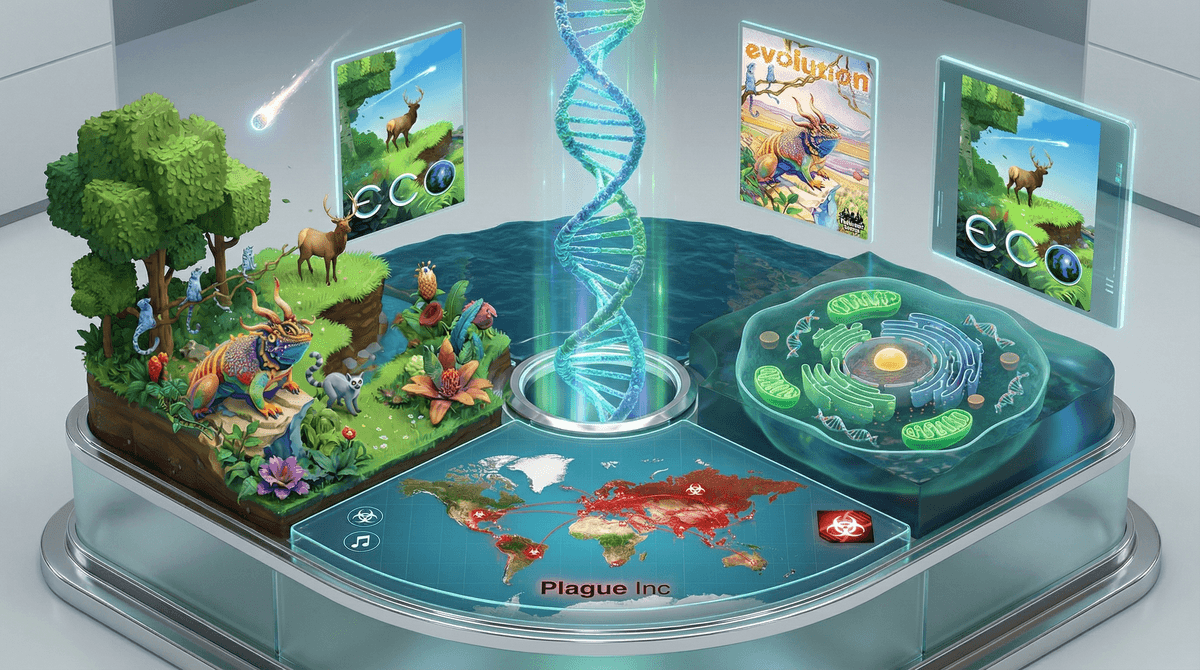
The Ultimate Guide to Fun and Educational Biology Games
TL;DR: Biology doesn't have to mean boring textbook diagrams. These free games turn cell division, ecosystems, and evolution into genuinely engaging experiences that align with actual science curriculum. Whether your kid needs to visualize photosynthesis or just thinks mitochondria are cool, these games deliver.
Top Picks:
- CellCraft - Build and defend a cell (Ages 10+)
- Immune Attack - Navigate the immune system (Ages 12+)
- Foldit - Solve real protein puzzles (Ages 13+)
- Evolution - The board game that teaches natural selection (Ages 12+)
Here's what makes biology uniquely suited to gaming: it's all about systems. Ecosystems, circulatory systems, cellular processes—they're interconnected, cause-and-effect driven, and often invisible to the naked eye. Games can simulate these systems in ways that textbooks simply can't.
When a kid plays a game where they have to balance predator-prey populations or manage cellular respiration under stress, they're not memorizing facts—they're experiencing the underlying principles. That's the difference between knowing that "mitochondria are the powerhouse of the cell" and actually understanding why a cell needs energy management.
CellCraft - Cell Biology
Ages 10+ | Free online
This Flash-turned-HTML5 game has your kid building and managing a cell from scratch. They'll place organelles, manage resources, and defend against viruses—all while learning what each cellular component actually does. The tutorial is genuinely funny (rare for educational games), and the gameplay gets surprisingly strategic.
What makes it work: Instead of memorizing that "ribosomes make proteins," kids learn it because they need to build more ribosomes to produce the proteins required for cell division. The cause-and-effect is immediate and visual.
Parent tip: The game takes 2-3 hours to complete. Perfect for a rainy afternoon, and it aligns directly with middle school cell biology units.
Immune Attack - Immune System
Ages 12+ | Free download
Developed by the Federation of American Scientists (so you know it's legit), this 3D game has players piloting a nanobot through the human body to fight infections. You'll learn about white blood cells, antibodies, and immune responses by actually using them as game mechanics.
The catch: The graphics are dated (think early 2000s), and the controls can be clunky. But the science is solid, and for kids who are into the immune system, it's genuinely engaging.
Curriculum connection: Perfect companion to high school biology units on the immune system and disease.
Foldit - Protein Folding
Ages 13+ | Free download
This is where it gets wild: Foldit is a puzzle game where players fold proteins—and the solutions actually contribute to real scientific research. Kids (and adults) have helped scientists understand diseases and develop treatments through their gameplay.
Why it matters: This isn't just educational—it's contributory. Your kid isn't playing a simulation of science; they're doing actual science. That's motivating in a completely different way.
Real talk: The learning curve is steep. This works best for kids who are already interested in biochemistry or who love complex puzzle games. It's not a casual experience, but for the right kid, it's transformative.
Phylo - DNA Sequence Alignment
Ages 12+ | Free online
Another citizen science game, Phylo turns DNA sequence alignment (normally done by computers) into a puzzle game. Players align genetic sequences from different species, and their solutions help improve the algorithms scientists use.
The appeal: It's basically Tetris meets genetics. The puzzles are genuinely fun, and there's a leaderboard for competitive kids.
Best for: Kids who like pattern recognition games and are curious about genetics or bioinformatics.
There are several solid options here:
Eco (Ages 10+ | $30 on Steam)
This is the most sophisticated ecosystem game out there. Players build civilizations while managing environmental impact. Every action affects the ecosystem, and if you're not careful, you'll trigger extinction events. It's basically Minecraft meets environmental science, and it's used in actual classrooms.
Species: Artificial Life, Real Evolution (Ages 12+ | $10 on Steam)
Watch evolution happen in real-time. This sandbox game simulates natural selection, genetic mutation, and speciation. You can speed up time and watch creatures adapt to environmental pressures over thousands of generations. It's mesmerizing and genuinely teaches evolutionary principles.
Niche (Ages 10+ | $20 on Steam)
A turn-based strategy game about keeping a species alive through natural selection. Your creatures have genes that affect their survival, and you'll breed them strategically to adapt to different biomes. It's like Pokémon breeding meets actual genetics.
Evolution - The Board Game
Ages 12+ | $30-40
Yes, a physical board game makes this list because it's one of the best ways to teach natural selection and adaptation. Players create species and give them traits (carnivore, burrowing, defensive herding) to survive in changing environments. The trait combinations lead to emergent ecosystems and food chains.
Why it works: The tactile, social nature of board games creates different learning opportunities than digital games. Kids see cause-and-effect across multiple species simultaneously, and they develop strategic thinking about adaptation.
Family game night bonus: This is actually fun for adults too. Not all educational games can say that.
Plague Inc. - Epidemiology (with caveats)
Ages 13+ | $1-15 depending on platform
The controversial pick. In Plague Inc., you create and evolve a pathogen to infect the world. It's morbid, but it teaches real epidemiology: transmission vectors, mutation, symptom severity vs. lethality, and how public health responses work.
The concerns: Obviously, the premise is dark. Post-COVID, this hits different than it did in 2012. Some kids will find it fascinating; others will find it disturbing.
The educational value: It's genuinely good at teaching how diseases spread and why public health measures matter. The game includes a mode where you fight diseases instead of creating them, which some parents prefer.
Bottom line: Know your kid. For mature teens interested in epidemiology or public health, it's valuable. For anxious kids or younger players, skip it.
Sometimes you don't need a 20-hour game—you need a 10-minute interactive that explains one concept really well:
- Cell Size and Scale - Free browser interactive from the University of Utah that zooms from a coffee bean down to atoms
- The Human Body by Tinybop - Pull apart a skeleton, feed the digestive system and watch the heart pump blood (iPhone and iPad, $3.99, ages 4+)
- Transcribe and Translate a Gene (Learn.Genetics, University of Utah) - Free browser activity: build the mRNA copy of a gene, then match codons to amino acids to see the protein it makes
- Photosynthesis Game - Free, ad-free iPhone and iPad game from a New Zealand biology teacher that walks through how plants turn light into sugar
These are great for reinforcing specific concepts before tests or for younger kids who aren't ready for complex games.
Ages 8-10: Start with simpler picks like The Human Body by Tinybop or Cell Size and Scale. Physical games like Evolution work well with parent guidance.
Ages 10-12: CellCraft, Niche, and Eco are the sweet spot. These games have enough complexity to be engaging but don't require advanced biology knowledge.
Ages 13+: Everything's on the table. Foldit and Phylo work for kids interested in contributing to real research. Immune Attack aligns with high school biology curriculum.
These aren't replacements for actual instruction. Biology games work best as supplements—they reinforce and visualize concepts that kids are learning in school. The games make abstract concepts concrete, but kids still need the foundational knowledge.
Not all "educational" games are created equal. Some are just digital flashcards with game mechanics slapped on. The games listed here actually use gameplay to teach systems thinking and cause-and-effect reasoning, not just memorization.
Time investment varies wildly. CellCraft takes a few hours. Foldit can become an ongoing hobby. The short interactives take 10 minutes. Set expectations accordingly.
Citizen science games are special. When kids play Foldit or Phylo, they're contributing to real research. That's incredibly motivating for some kids—it transforms "educational game" into "I'm actually doing science."
Biology games work because biology is inherently game-like: it's about systems, resource management, adaptation, and survival. The best biology games don't just teach facts—they teach thinking about biological systems.
Start with CellCraft if your kid is in middle school and learning cell biology. Try Evolution for family game night. And if you have a high schooler who's genuinely interested in biology, introduce them to Foldit or Phylo—they might discover a passion for scientific research.
Not every kid will love every game, but somewhere in this list is probably something that makes biology click for your kid. And honestly? That's worth way more than memorizing the Krebs cycle for a test they'll forget a week later.
Want more educational game recommendations? Check out our guides on chemistry games for kids, physics puzzle games, or games that teach systems thinking.