

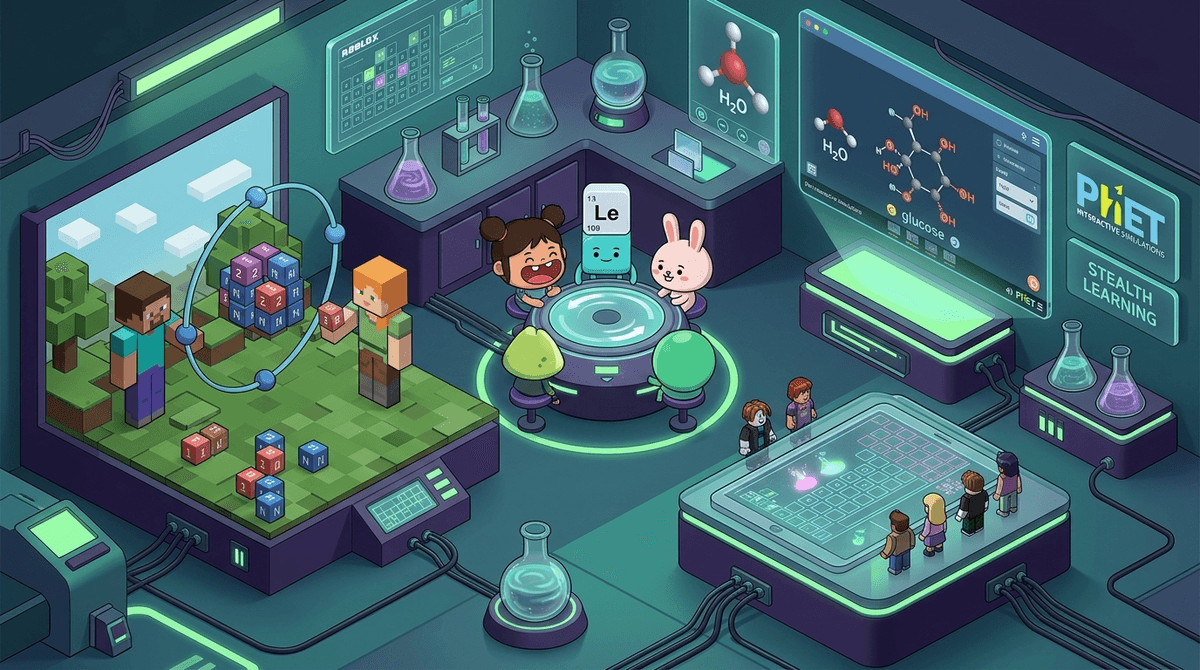
TL;DR: If the thought of a "home chemistry kit" makes you envision permanent purple stains on your ceiling, digital chemistry games are your new best friend. You can skip the vinegar-and-baking-soda mess and let your kids explore atomic structures and volatile reactions in worlds they already love.
Top Recommendations:
- Best for Creative Building: Minecraft Education Edition (available as a toggle in standard Bedrock edition)
- Best for Little Scientists (Ages 4-8): Toca Lab: Elements
- Best for Virtual Experiments: Roblox (specifically "Chemistry Lab" simulations)
- Best for Serious Learning: PhET Interactive Simulations
We aren't talking about digital textbooks or boring multiple-choice quizzes that feel like homework in a trench coat. Modern chemistry games are "sandbox" experiences. They allow kids to manipulate elements at the molecular level to see what happens.
In these games, "chemistry" means taking a bunch of Hydrogen and Oxygen atoms and actually seeing them bond to form water, or realizing that adding Magnesium to a sparkler in Minecraft actually changes the color of the flame. It’s about trial, error, and the occasional (safe) virtual explosion.
Let’s be real: Chemistry is hard to visualize. It’s a lot of invisible things doing invisible things. Games make the invisible visible.
Kids love it because they get to play "mad scientist" without a lecture. Parents love it because it’s one of the few times screen time feels genuinely productive. According to our community data, about 65% of parents with kids in grades 4-8 are actively looking for "stealth learning" opportunities—games that are fun enough that the kid doesn't realize they're actually memorizing the periodic table.
Find "stealth learning" games for middle schoolers
If your kid plays Minecraft (and let’s face it, about 80% of kids aged 6-12 do), they already have a world-class chemistry lab sitting on their tablet or console.
By enabling the "Education Edition" toggle in their world settings, they get access to four specific tools:
- The Element Constructor: Allows them to build elements by choosing the number of protons, electrons, and neutrons.
- The Compound Creator: Where they combine those elements into over 30 compounds (like soap, salt, or glue).
- The Lab Table: This is where they design products like bleach or ice bombs.
- The Material Reducer: They can take a standard Minecraft block (like grass) and reduce it to its component elements.
It’s brilliant because it uses the game’s existing "crafting" logic. Instead of crafting a wooden sword, they’re crafting a helium balloon. It makes the periodic table feel like a cheat code for the game.
Roblox is a bit of a Wild West. For every high-quality chemistry sim, there are ten "brain rot" obbys that do nothing for your kid's IQ. However, creators have built some surprisingly robust chemistry labs within the platform.
The benefit of Roblox chemistry is the social aspect. Kids can work in a "lab" together, which mimics real-world collaborative science. The downside? You have to keep an eye on the "bank account drain" factor. Some games might try to sell your kid a "Super Scientist" lab coat for 500 Robux.
Learn more about how Robux is in fact real money
Ages 4–8: The Explorers
At this age, it’s about "What happens if I do this?" They don't need to know the atomic weight of Carbon; they just need to know that things change when you heat them up or freeze them.
- This is hands-down the best intro to the periodic table for little kids. It personifies the elements as cute characters. You take an element and put it in a centrifuge, heat it on a Bunsen burner, or mix it with "mystery chemicals." It’s tactile, adorable, and zero-stress.
- While more broad "science" than pure chemistry, it introduces basic concepts of materials and reactions in a way that’s very accessible for preschoolers.
Ages 9–13: The Experimenters
This is the sweet spot where they can start to understand actual formulas.
-
As mentioned above, this is the gold standard for this age group.
Minecraft (Education Mode)
- Check out sites like PBS Kids or Coolmath Games for simple browser-based mixing games that teach the basics of pH levels and acidity.
Ages 14+: The Serious Scientists
If your teen is struggling with high school chem, these "games" are actually powerful study tools.
- Created by the University of Colorado Boulder, these are less "gamey" and more "interactive lab." They are incredible for visualizing things like molarity, gas properties, and molecular polarity. It’s what actual teachers use in the classroom.
- A more gamified version of a lab manual. It challenges players to identify organic compounds and balance chemical equations to progress.
When we talk about chemistry games, the "safety" concerns aren't about chemical burns—they're about the usual digital suspects:
- Community/Chat: In Roblox, ensure your child's chat settings are restricted. Even in a "Chemistry Lab," people can be weird.
- Microtransactions: Chemistry shouldn't cost $20 in digital currency. Stick to games that are either one-time purchases (like Toca Lab) or part of a platform you already own (like Minecraft).
- The "Explosion" Factor: Some kids might get a little too obsessed with the "blowing things up" part of chemistry. It’s a great time to talk about the difference between a digital TNT block and why we don't mix random liquids under the kitchen sink.
Check out our guide on setting up Roblox parental controls
If you see your kid playing these games, don't just walk by. Use it as a bridge to real-world conversation. You don't need to be a scientist to ask these:
- "Wait, why did that turn green when you added the Copper?"
- "Is that what actually happens in real life, or is that just a Minecraft thing?" (Pro tip: In Minecraft, some things are real science, some are 'game logic'—figuring out which is which is a great critical thinking exercise).
- "If we wanted to make that reaction in the kitchen, what would we need?" (Then maybe actually go make some Oobleck together).
Chemistry games are a massive win for intentional parents. They take a subject that is historically "the hard class" in school and turn it into a sandbox for creativity.
If your kid is already spending time on screens, shifting even 20% of that time from watching mindless YouTube shorts to building molecules in Minecraft is a major upgrade. It’s not about making them a future Nobel Prize winner (though, hey, maybe!); it’s about fostering a sense of curiosity about how the world is put together.
- Check your Minecraft settings: If you have the game, look for the "Education Edition" toggle in the world settings. It's free.
- Download Toca Lab: If you have a younger kid, it's the best $4 you'll spend this month.
- Ask your kid: "Have you ever tried the chemistry stuff in your games?" You might be surprised—they might already be doing it.