

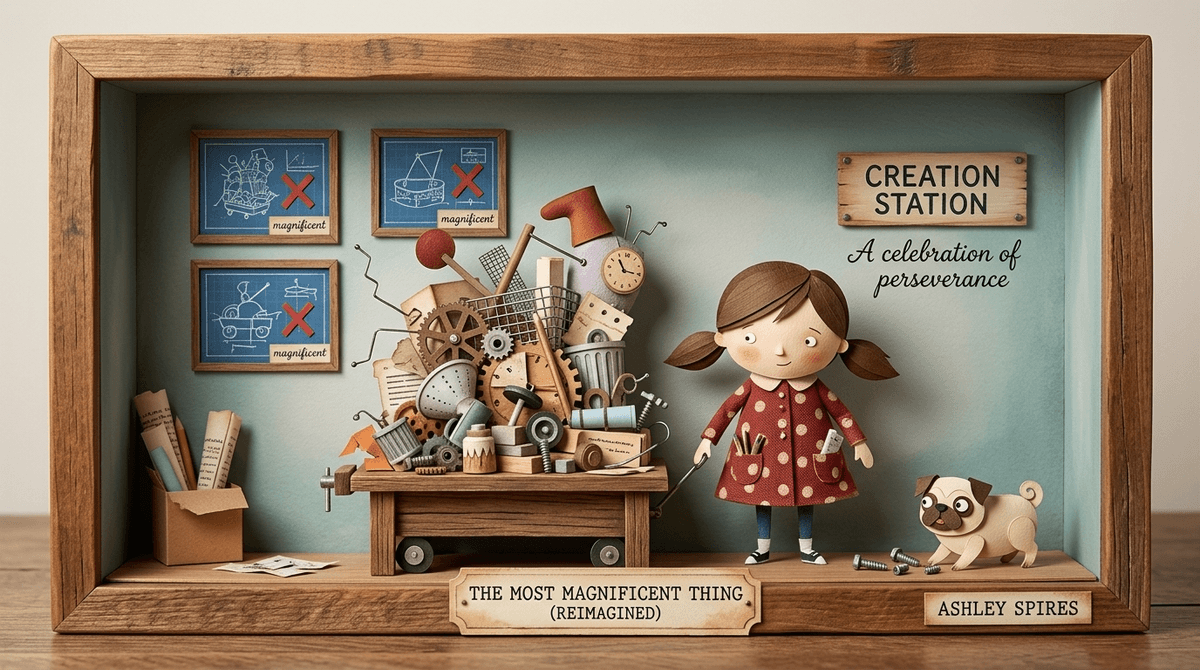
TL;DR: If your kid has ever had a full-blown meltdown because a LEGO tower collapsed or a drawing didn't look "right," The Most Magnificent Thing by Ashley Spires is your new best friend. It’s a masterclass in the "growth mindset" that manages to be charming rather than preachy.
Quick Links for Resilient Makers:
- The Book: The Most Magnificent Thing
- The Movie: The Most Magnificent Thing (Short Film)
- The STEM Follow-up: Rosie Revere, Engineer
- The Digital Maker Space: Minecraft
At its core, The Most Magnificent Thing is a picture book about a "regular girl" and her best friend (a pug) who decide to build something... well, magnificent. She has the plan, she has the tools, and she has the vision.
But then reality hits. She builds, she fails. She tinkers, she fails. She gets "mad. Really mad." She eventually explodes (relatable), quits, and takes a walk. It’s during that walk—the cooling-off period—that she starts to see the "right" parts in all her "wrong" inventions.
It’s a 32-page antidote to the "perfectionist" culture that kids are swimming in right now. In a world of filtered Instagram rooms and perfectly edited YouTube "first tries," this book shows the messy, angry middle part of creating something new.
We talk a lot about "brain rot" and kids spending too much time on YouTube, but the real danger isn't just the content—it's the loss of the "frustration reflex." When everything in the digital world is instant, the physical world (where glue takes time to dry and wood splits) feels "Ohio" (weird/bad) to them.
The Most Magnificent Thing matters because it validates the anger. It doesn't tell kids "don't be frustrated." It tells them "be frustrated, then go for a walk, then come back and look again." That is the fundamental loop of engineering, coding, and basically being a functional adult.

If your child connects with the girl in the book, you can lean into that "Maker" energy with these other high-quality picks.
This is the gold standard for the "resilient maker" genre. Rosie builds "gadgets and gizmos" but hides them for fear of failure. It’s a great companion to The Most Magnificent Thing because it focuses on the idea that the only true failure is quitting.
Produced by the Obamas, this show is actually... really good? It’s not just "colors and shouting." It follows a young Black girl who asks "Why?" about everything. It’s perfect for the 4-7 age range and focuses on the scientific method in a way that doesn't feel like a classroom lecture.
If you want a live-action show that isn't hosted by someone trying way too hard to be a "content creator," this is it. Emily Calandrelli is a literal MIT-trained engineer who makes science experiments look like the coolest thing on earth. It’s high-energy but high-value.
If you want to move from reading about making to actually making, Minecraft is the ultimate digital sandbox. In "Creative Mode," it’s essentially infinite LEGOs. It teaches spatial reasoning and logic. If your kid is frustrated that their physical "magnificent thing" keeps falling over, Minecraft lets them build the vision without the laws of gravity getting in the way (initially). Read our guide on how to make Minecraft more educational
For kids 8 and up, Scratch is where they can start "engineering" their own games and animations. It’s block-based coding developed by MIT. Like the girl in the book, they will run into bugs. Their code will break. Learning to debug is just the digital version of "taking a long walk."
- Ages 3-5: Focus on the story and the dog. Use the book as a "social-emotional" tool. When they get mad at a puzzle, remind them: "Remember the girl in the book? Maybe we need a walk?"
- Ages 6-8: This is the sweet spot for the "engineering" aspect. Start introducing tools—real ones. Low-temp glue guns, cardboard cutters (with supervision), and duct tape.
- Ages 9+: They might feel "too old" for a picture book, but the themes apply to their first Roblox studio project or a complex LEGO Technic build.
Since we're talking about makers, we have to talk about Roblox. Many parents see their kids "making" games in Roblox and think, "Great! They're becoming the next tech mogul."
Here’s the no-BS take: Roblox can be an incredible tool for learning game design via Roblox Studio. However, for 95% of kids, Roblox is a consumer platform, not a maker platform. They aren't building the "magnificent thing"; they're spending your money on "Skibidi Toilet" avatars.
If you want them to be makers, steer them toward the creation side of the platform, or better yet, Scratch.
Check out our guide on the difference between Roblox playing and Roblox making
When you finish reading The Most Magnificent Thing, don't just close the book and go to bed. Try these conversation starters:
- "What was the part of her invention that she actually liked at the end?" (This helps them see that 'failure' usually contains the seeds of success).
- "What do you do when you get 'really mad' at a project?" (Validate the anger! It’s okay to be mad. It’s what you do with the anger that matters).
- "If we were going to build something 'magnificent' tomorrow out of the recycling bin, what would it be?"
The Most Magnificent Thing is a must-have for any intentional parent’s bookshelf. It’s short, it’s funny, and it tackles the most difficult part of childhood: realizing that your hands can't always do what your brain wants them to do yet.
It’s not just a book about engineering; it’s a guide on how to fail without losing your mind. And in 2026, that might be the most important skill we can give our kids.
- Buy or borrow the book: The Most Magnificent Thing
- Watch the short film: It’s a great 20-minute "quiet time" activity that expands on the book's themes.
- Set up a "Maker Bin": Grab a plastic tub and fill it with "trash"—toilet paper rolls, egg cartons, old CDs, and plenty of tape.
- Explore more "Growth Mindset" media: Check out our curated list of growth mindset books and shows