

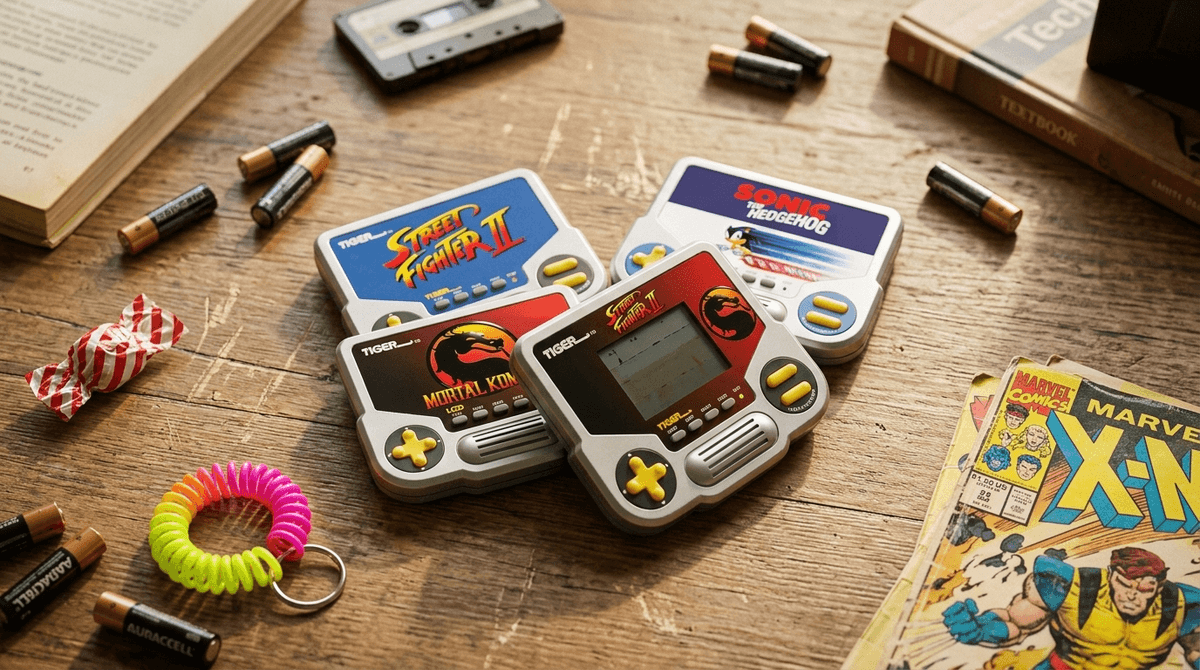
TL;DR: Tiger Electronics LCD handhelds were the "budget" gaming solution of the 80s and 90s that promised the thrill of Street Fighter II but delivered a blinking, beeping nightmare of static sprites. They were objectively terrible, yet they taught us a lot about branding, hardware limitations, and how to spot "junk" digital content.
Quick Links for Retro Nostalgia & Better Alternatives:
- The Toys That Made Us (Netflix) - A great documentary series that covers toy history.
- Game Boy - The gold standard Tiger was trying (and failing) to copy.
- Tamagotchi - The LCD tech used for good (mostly).
- Nintendo Switch - What handheld gaming looks like when it actually works.
- Sonic the Hedgehog - The actual game, not the Tiger fever dream version.
If you grew up in the 90s, you remember the silver plastic rectangles. They had colorful stickers on the front featuring the hottest IP of the day—everything from The Little Mermaid to Mortal Kombat.
Unlike the Game Boy, which used a dot-matrix screen capable of rendering actual moving pixels, Tiger handhelds used fixed LCD segments.
Think of a digital watch or a calculator. You know how when you press down on the screen of a calculator, you can see all the "8888" shadows? That was a Tiger game. Every possible frame of animation was pre-etched onto the screen. To "move" a character, the game would simply turn off one segment and turn on the one next to it.
The result? A "game" that felt more like a frantic exercise in rhythmic button-mashing against a static, confusing background.
Tiger Electronics were masters of the "Branding Trap." They knew that a 9-year-old in 1992 desperately wanted to play Street Fighter II, but a Super Nintendo cost $199 and the cartridge was another $60.
Enter the Tiger handheld: it was $19.99 at Walgreens. It had the official logo. It had the cool art.
It was the ultimate "we have food at home" version of gaming. Parents loved them because they were cheap, required only two AA batteries that lasted forever (mostly because the tech was so primitive), and kept a kid quiet in the backseat for at least twenty minutes before the frustration set in.

Let's not let nostalgia cloud the truth: these games were hot garbage. Here is why they failed as actual entertainment:
1. Zero Physics, Zero Logic
Because the "sprites" were fixed, there was no such thing as momentum or fluid movement. If you were playing Sonic the Hedgehog 2 on a Tiger, Sonic didn't run. He just flickered from one spot to the next. Collision detection was a suggestion at best. You either "occupied" the same LCD segment as an enemy or you didn't.
2. The Sound of Madness
The audio was a series of high-pitched "beeps" and "boops" that had no relation to the actual music of the franchise. It was the kind of repetitive noise that could drive a parent to pull over the minivan and toss the device out the window.
3. Unfair Difficulty
These games weren't hard because they were well-designed; they were hard because you couldn't see what was happening. The static backgrounds were often so busy and colorful that they camouflaged the black LCD segments you were supposed to be watching.
4. One Game, One Device
This is the biggest kicker for kids today to wrap their heads around. You didn't "download" games. You didn't swap cartridges. If you bought the Beauty and the Beast game, you were playing that—and only that—until the end of time.
Why are we talking about 30-year-old plastic junk? Because the Tiger Electronics legacy is alive and well in the App Store.
Today, we see "reskinned" games—apps that use a popular character (like Bluey or Spider-Man) to mask incredibly shallow, repetitive, and often broken gameplay. Just like Tiger used the Batman: The Animated Series license to sell a terrible LCD game, modern developers use "brain rot" trends to get kids to click on low-quality apps.
Understanding the Tiger era helps us explain to our kids why branding doesn't equal quality. Just because a game has MrBeast or Roblox characters on the thumbnail doesn't mean the game is actually fun or worth their time.
If you're looking to teach your kids about digital literacy, the Tiger Electronics story is a perfect case study.
- The "Hype" vs. "Reality" check: Show them old commercials for Tiger games on YouTube. They look epic, right? Then show them gameplay footage. It’s a great way to talk about how marketing works.
- Hardware Matters: It’s a lesson in why a Nintendo Switch costs more than a knock-off tablet from a pharmacy. Quality hardware allows for quality experiences.
- The Value of Intentional Play: Tiger games were "distraction" toys, not "engagement" toys. They were designed to kill time, not to build skills or tell stories. When we look at modern games like The Legend of Zelda: Breath of the Wild, we see the opposite—an experience designed for depth.
If you want to dive deeper into this with your kids, I highly recommend watching the "Toys" or "Video Games" episodes of The Toys That Made Us. It’s a fun, slightly snarky look at how these companies operated. It’s great for ages 10+ and sparks some really good conversations about entrepreneurship and why some toys stand the test of time while others end up in a landfill.
If your kid is asking for a "cheap" handheld, steer clear of the modern equivalents of Tiger (those "400-in-1" consoles you see at kiosks). Instead, consider these:
- Nintendo Switch Lite: The actual modern successor to the handheld throne.
- Analogue Pocket: For the serious retro enthusiast parent who wants to show their kids what the Game Boy was actually like.
- Playdate: A modern, indie take on the "crank-operated" handheld that proves simple graphics can still be innovative and fun.
Tiger Electronics LCD games were the junk food of the 90s digital world. They were cheap, unsatisfying, and everywhere. While we might remember them fondly through a lens of nostalgia, they serve as a reminder that intentional parenting involves looking past the sticker on the box.
We want our kids to have digital experiences that are rich, thoughtful, and well-designed—not just something to keep them quiet while we're in the checkout line.
- YouTube Search: Look up "Tiger Electronics Commercials" with your kids. Ask them: "Does that look like the games you play today?"
- Audit the Apps: Look at your kid's tablet. Are there any "Tiger-style" games? (High branding, low quality, repetitive gameplay). Maybe it's time to swap those for something with a bit more substance like Minecraft or Toca Life World.
- Talk about "Brain Rot": Use the Tiger example to explain that even in the "olden days," companies were trying to sell us low-effort content just to get our attention.