

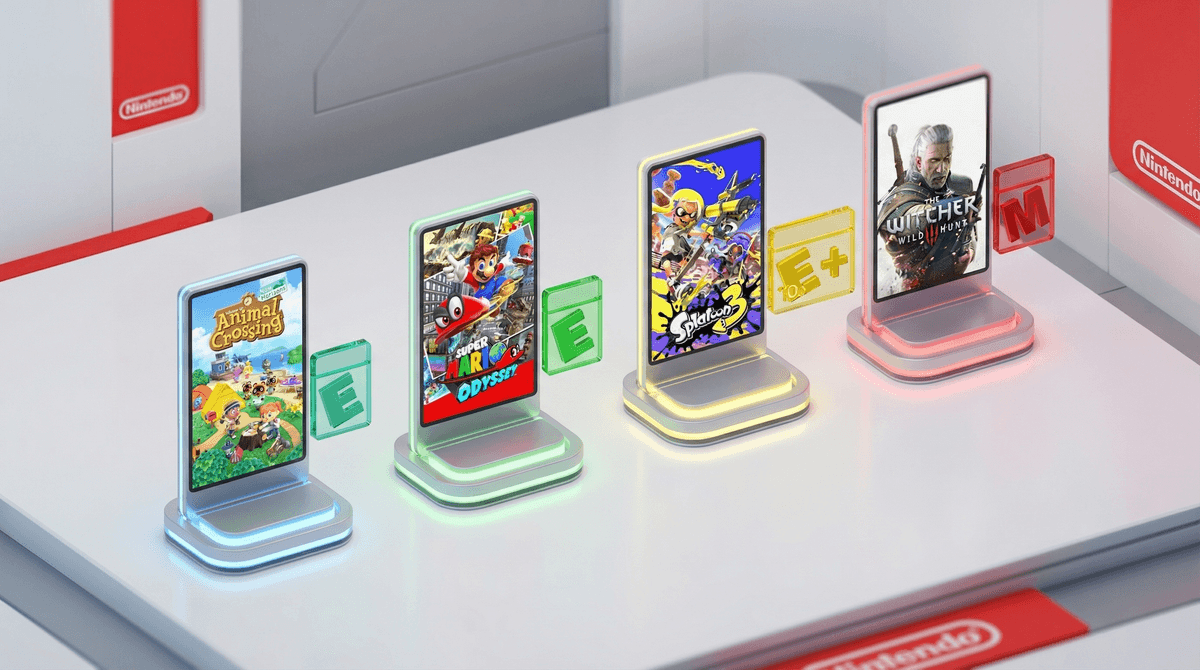
The Nintendo Switch uses the ESRB (Entertainment Software Rating Board) system to rate games, just like every other console in North America. You've probably seen these letter ratings on game boxes: E for Everyone, E10+ for Everyone 10 and up, T for Teen, M for Mature, and the rarely-seen AO for Adults Only.
Here's the thing though: the ESRB rating is just the starting point, not the finish line. A game rated E10+ might be perfectly fine for your mature 8-year-old, or way too intense for your sensitive 12-year-old. The rating tells you what's in the game (violence, language, suggestive themes), but it doesn't tell you whether your specific kid can handle it.
The Switch is genuinely the most family-friendly console on the market right now. Nintendo's first-party games (Mario Kart 8 Deluxe, Animal Crossing: New Horizons, Splatoon 3) are almost universally kid-appropriate. But the Switch also has thousands of third-party games, including plenty of M-rated titles like The Witcher 3 and Doom Eternal. So you can't just assume everything on the platform is fine.
Let's break down what these ratings actually mean:
E (Everyone): Think Kirby and the Forgotten Land, Pokemon Scarlet/Violet, or Super Mario Odyssey. Minimal violence (cartoon bonking), no blood, no bad language. Safe for ages 6+, though younger kids might need help with reading or game mechanics.
E10+ (Everyone 10+): This is where you get games like The Legend of Zelda: Breath of the Wild and Minecraft. There's fantasy violence, maybe some mild language, possibly some scary moments. Most 8-10 year olds can handle these fine, but check the content descriptors.
T (Teen): Games rated T, like Fortnite or Stardew Valley, may have violence, suggestive themes, crude humor, or stronger language. The violence is usually not realistic or graphic. Many parents are comfortable with their 10-12 year olds playing T-rated games, especially the less intense ones.
M (Mature 17+): These games contain intense violence, blood and gore, sexual content, and/or strong language. They're genuinely not appropriate for younger kids. Yes, I know "everyone plays Call of Duty" — that doesn't make it age-appropriate for your 11-year-old.
The ESRB does a decent job, but it's a blunt instrument. Here's what the rating doesn't tell you:
Difficulty level: Cuphead is rated E10+ but it's brutally difficult and will frustrate many kids (and adults). Meanwhile, Untitled Goose Game is also E10+ and delightfully chill.
Reading requirements: Many E-rated games require solid reading skills. If your 6-year-old can't read yet, they'll struggle with Pokemon or Paper Mario.
Online interactions: The ESRB always includes "Online Interactions Not Rated by the ESRB" because they can't control what other players say or do. Splatoon 3 is E10+ and adorable, but online play means potential exposure to inappropriate usernames or behavior.
Microtransactions and loot boxes: The ESRB now labels games with "In-Game Purchases" but doesn't differentiate between cosmetic items and pay-to-win mechanics. You need to research individual games to understand the monetization.
Scary factor: Some games rated E or E10+ can be genuinely frightening. Luigi's Mansion 3 is rated E10+ but has jump scares that terrify some younger kids.
Here's what I typically see working for different age groups, though your kid might be different:
Ages 6-8 (K-2nd Grade)
Stick with E-rated games, prioritize games with co-op modes so you can play together. Super Mario Bros. Wonder, Kirby and the Forgotten Land, and Paw Patrol games are solid bets. Avoid online multiplayer at this age.
Ages 8-10 (3rd-4th Grade)
Most E10+ games are fair territory now. Mario Kart 8, Animal Crossing, Minecraft, and Pokemon are incredibly popular at this age. Some kids can handle Zelda: Breath of the Wild, others find it too intense or difficult.
Ages 10-12 (5th-6th Grade)
This is when peer pressure around games like Fortnite really kicks in. Many parents allow some T-rated games at this age, especially less violent ones like Splatoon 3 (which is actually E10+) or sports games. Check out our guide on Fortnite if you're on the fence about that particular battlefield.
Ages 13+ (7th Grade and Up)
Most T-rated games are appropriate now. M-rated games are still worth scrutinizing — there's a big difference between Hades (stylized Greek mythology violence) and Grand Theft Auto (realistic crime simulation).
Use the Switch's parental controls: Nintendo's parental control app is actually excellent. You can set time limits, restrict games by rating, disable online communication, and get daily/monthly play reports. Here's how to set them up.
Read beyond the rating: Before buying any game, check Common Sense Media, read parent reviews, and watch gameplay videos on YouTube. The ESRB tells you what is in the game, but reviews tell you how much and in what context.
The "everyone else is playing it" argument: By 5th grade, about 60-70% of kids are playing Fortnite or Roblox according to most surveys. That doesn't mean your kid needs to. But it also doesn't mean you're a bad parent if you allow it with proper boundaries. Understanding why Fortnite is so appealing can help you make an informed decision.
Physical vs. digital purchases: With physical cartridges, you can more easily control which games your kid has access to. With digital purchases, everything's on the device. The parental controls can restrict by rating, but it's another thing to think about.
Online play is the wild card: Even the most innocent game becomes unpredictable with online multiplayer. Voice chat, text chat, and player behavior can't be controlled by Nintendo or the ESRB. Many parents allow online play only with known friends, not random matchmaking.
The ESRB rating is a useful starting point, but it's not a substitute for parental judgment. A game rated E10+ might be perfect for your 8-year-old or too much for your 12-year-old, depending on their maturity, sensitivity to violence, and gaming experience.
The good news: The Switch has an absolutely massive library of genuinely excellent, age-appropriate games. You don't need to cave on M-rated games to give your kid something fun to play. Mario, Zelda, Animal Crossing, Splatoon, and hundreds of indie gems offer hundreds of hours of entertainment without graphic violence or adult content.
The reality: Your kid will probably ask for games that push your boundaries. That's normal. Use those moments as opportunities to talk about your family's values, to teach media literacy, and to help them understand why you make the decisions you make. And if you decide to allow a game that's slightly above their age range? That's okay too — just make sure you're making an informed, intentional choice, not just giving in because you're tired.
- Set up Nintendo Switch parental controls if you haven't already
- Explore age-appropriate Switch games for your child's age and interests
- Have a conversation with your kid about why ratings exist and what they mean
- Check in regularly about what they're playing and who they're playing with online