

TL;DR
Sushi Go! is the ultimate "gateway" game for families looking to move past the luck-based slog of Candy Land and into actual strategy. It’s fast (15 minutes), portable, and teaches card drafting, probability, and basic arithmetic without feeling like "educational" homework.
- Best for: Ages 7+ (though 6-year-olds can play with help).
- The Vibe: High-speed decision-making with adorable art.
- Core Skill: Risk vs. Reward (and keeping a straight face when you steal the last Sashimi).
If you’ve ever been to a revolving sushi bar where the plates whiz past and you have to make a split-second choice between the spicy tuna and the gyoza, you already understand the mechanics of this game.
Sushi Go! is a "pick and pass" card game. Everyone starts with a hand of cards, picks one to keep, and passes the rest to the person on their left. This continues until all the cards are gone. You do this for three rounds, tally up the points, and the person with the best "dinner" wins.
It’s the simplified cousin of "drafting" games like 7 Wonders or Magic: The Gathering. It takes the complex mechanics of professional-level strategy games and strips them down into something a second-grader can master in five minutes.
In a world where kids are often stuck in "brain rot" loops of Skibidi Toilet or mindless Roblox obbys, Sushi Go! offers a different kind of dopamine hit. It’s fast-paced enough to hold an ADHD-level attention span but deep enough that you actually have to think.
The "Just One More" Factor
Because a full game only takes about 15 minutes, it’s the perfect "filler" game. You can play a round while waiting for pizza to arrive or right before the "screens off" bedtime routine. It doesn't have the soul-crushing length of Monopoly, which usually ends in a family feud and someone crying under the table.
The Ohio-Level Weirdness of the Art
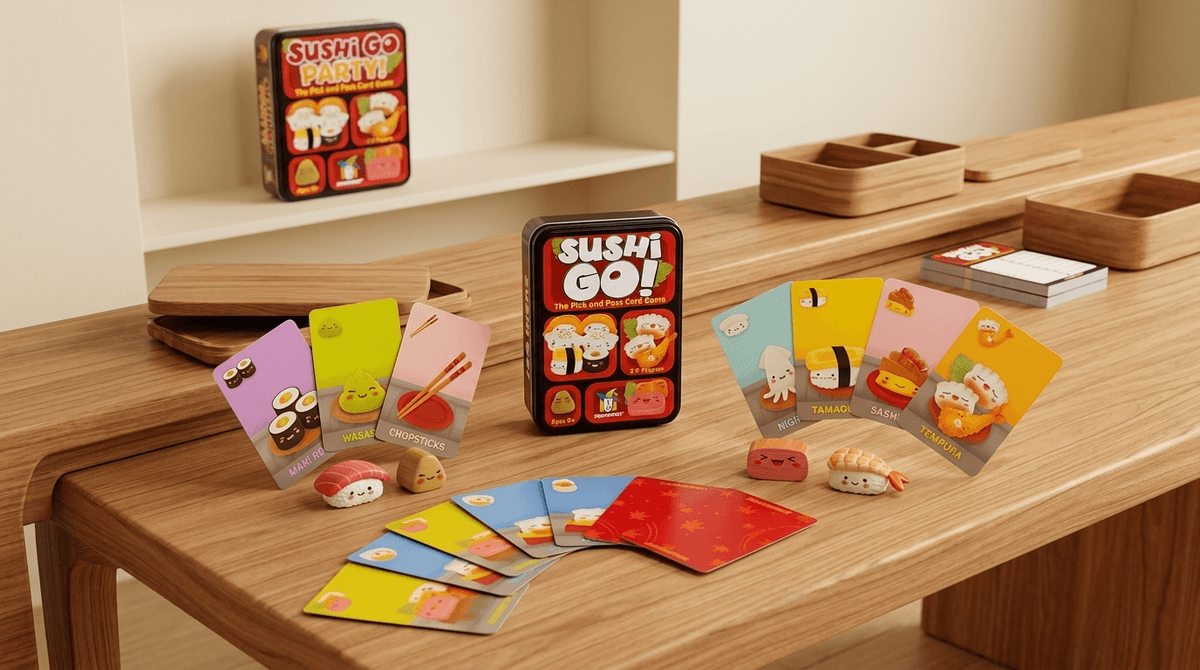
The cards are undeniably cute. We’re talking smiling Nigiri, anthropomorphic Tempura, and Pudding with tiny faces. For a generation raised on the absurd aesthetics of the internet, the art style feels familiar and non-threatening. It’s "kawaii" culture at its best, making the competitive aspect feel lighter than it actually is.
Learn more about why "cozy" aesthetics matter in kids' media
Don't let the smiling Wasabi fool you; there is real math and psychology happening here.
If you play a Wasabi card, your next Nigiri is worth triple points. This teaches kids sequential planning. They have to hold onto that Wasabi and pray the Squid Nigiri (the high-value one) actually makes its way back to them.
Maki rolls give points to whoever has the most at the end of the round. This introduces competitive awareness. Kids have to stop looking only at their own hand and start glancing at what their siblings are building. If Timmy has five Maki rolls and you have four, you have to decide: do you grab one more to tie him, or pivot to Sashimi?
Pudding cards don't score until the very end of the third round. Whoever has the most gets 6 points; whoever has the least loses 6 points. This is a brutal lesson in long-term consequences. It’s the "entrepreneurship" side of the game—sacrificing immediate points in round one to ensure you don't get hit with a penalty in round three.
There are a few ways to get your sushi fix, and depending on your family size, one is definitely better than the others.
The classic tin. It’s small, fits in a purse or backpack, and plays 2-5 players. It’s the "no-frills" version. If you’re traveling or just want to test the waters, start here.
This is the "deluxe" version and, honestly, the one most intentional parents should probably just buy from the jump. It expands the game to 8 players and includes a "menu" board. You can swap out different types of cards (like replacing Tempura with Miso Soup) so the game stays fresh. It’s the Minecraft of card games—highly customizable.
This is the dice-based version of the game. Instead of passing cards, you’re passing dice. It’s a bit more tactile and involves more luck. If your kid loves the "click-clack" of dice or games like Yahtzee, this is a solid alternative, though it lacks the tight strategy of the card version.
The box says 8+, but that’s a conservative estimate.
- Ages 5-6: They can play "Open Handed." Instead of passing the cards face down, keep everything visible. This allows you to coach them through the math. "If you take this Tempura, you need one more to get 5 points. See if there's one in the next hand!"
- Ages 7-9: This is the sweet spot. They’ll understand the "hate-drafting" mechanic (taking a card specifically so you can't have it) and will start to develop their own "meta" strategies.
- Ages 10+: They will likely start beating you. This is where the game transitions from a "learning tool" to a legitimate competitive activity.
While Sushi Go! is generally wholesome, it can get "sweaty" (gamer-speak for overly competitive).
The "Chopsticks" card allows a player to take two cards from a single hand. In the hands of a savvy 10-year-old, this can be used to "swipe" the two cards someone else desperately needed. If you have a child who struggles with losing or feels "targeted" in games, Sushi Go! is actually a great, low-stakes environment to practice those social-emotional skills.
Because the game is over so fast, the "sting" of a loss doesn't last as long as it does in a two-hour session of Risk. You can always "run it back" immediately.
Read our guide on helping kids handle competitive gaming stress
If you want to use Sushi Go! as a bridge to other conversations, here are a few entry points:
- Probability: "We saw three Sashimi cards in the first hand. Since there are only a few in the whole deck, what are the odds we'll see more in the next hand?"
- Sunk Cost Fallacy: "You have two Sashimi, but there are only two cards left in the round. Is it worth trying for the third, or should you pivot to a 2-point Nigiri?"
- Digital vs. Analog: "How does this feel different from playing a game on the iPad? Do you like being able to see everyone's faces when you steal the Pudding?"
Sushi Go! is a rare triple-threat: it’s cheap (usually under $15), it’s easy to learn, and it actually builds cognitive skills. It’s the perfect antidote to the passive consumption of YouTube or the mindless clicking of "cookie clicker" style apps.
If your game closet is currently full of games that make you want to poke your eyes out, swap one of them for this. It’s a gateway to a world of better board gaming, and it might just be the most fun your family has with a deck of cards all year.
- Buy the original: If you want a portable "restaurant game."
- Buy Sushi Go Party!: If you have more than 4 people in your house.
- Graduate to: Ticket to Ride or Catan once they’ve mastered the drafting mechanic.