

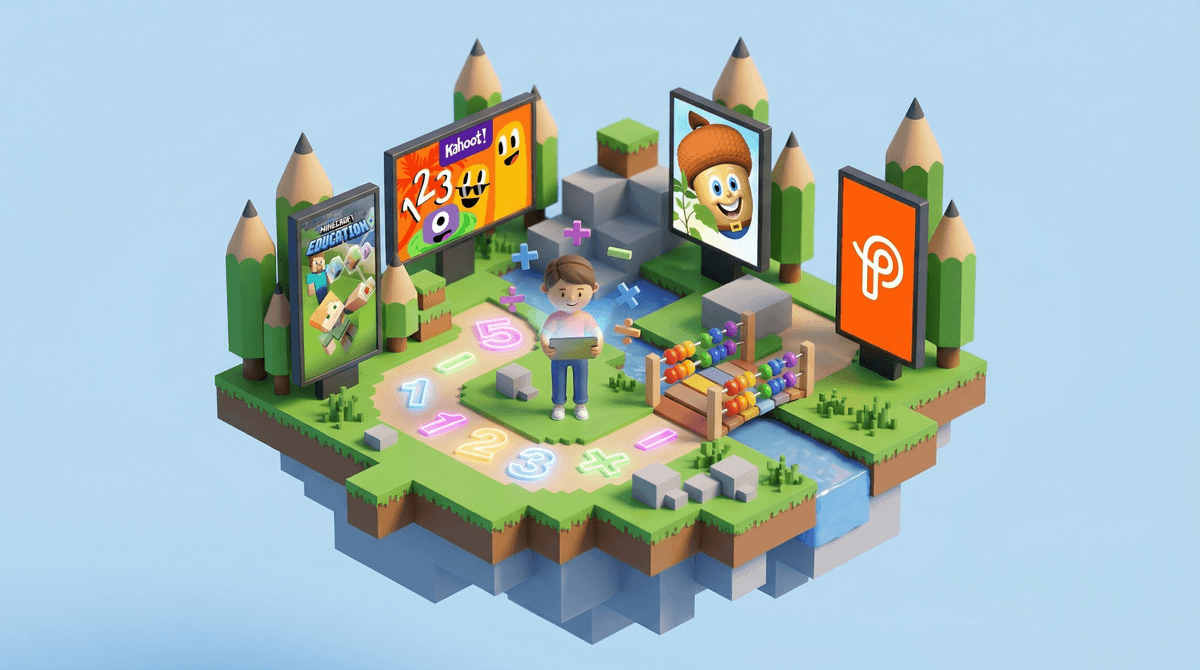
Look, we all know the drill. Your 7-year-old has already hit their screen time limit, but they're begging for "just five more minutes" on the tablet. What if those five minutes could actually reinforce the math concepts they're struggling with at school—without them realizing they're doing homework?
That's the magic of sneaky math games. These are apps and games that disguise math practice as genuinely fun gameplay. We're not talking about digital worksheets with a cartoon mascot slapped on top. We're talking about games where kids are so engaged in building, solving puzzles, or competing that they don't even notice they're practicing addition, subtraction, or number sense.
According to our community data, about 50% of families allow unsupervised tablet use, while 35% keep it limited and supervised. If your kid is going to be on a screen anyway—and let's be real, with an average of 4.2 hours of daily screen time in our community, they probably are—you might as well make some of those minutes count.
Seven-year-olds are in that sweet spot where they're developing fluency with basic operations (addition and subtraction within 20, understanding place value) but they're also deeply motivated by play. Traditional flashcards? Torture. A game where they need to solve math problems to feed a hungry monster? Suddenly they're a math genius.
The key is that these games use math as a tool to achieve a goal they actually care about—not as the goal itself. It's the difference between "solve 20 addition problems" and "collect enough coins (by solving addition problems) to unlock a new character."
But here's the thing: not all "educational" games are created equal. Some are basically just drill-and-kill with better graphics. The best sneaky math games have actual gameplay loops that would be fun even without the educational component.
This is the gold standard for a reason. It's basically a Pokémon-style RPG where kids battle monsters and explore worlds—but to cast spells and win battles, they have to answer math questions aligned to their grade level. The game adapts to their skill level, so it's not too easy or frustratingly hard.
The catch: The free version is solid, but kids will absolutely beg you for the premium membership ($10-15/month) to get pets, outfits, and other cosmetic upgrades. You can learn more about how these freemium models work if you want to understand what you're dealing with. Set expectations early about what you will and won't pay for.
Ages: 6-12, but particularly great for 7-8 year olds
This one teaches number sense and basic operations through adorable characters called Nooms. Kids combine and split these creatures to learn about addition, subtraction, and the relationships between numbers. It's genuinely clever and doesn't feel like schoolwork at all.
The catch: It's a paid app (around $8), but no in-app purchases or subscriptions. One-and-done.
Ages: 4-8
If your kid is already obsessed with Minecraft (and honestly, what 7-year-old isn't?), the Education Edition has built-in math challenges and lessons. They're building and problem-solving in the game they already love.
The catch: This requires a bit more parent involvement to set up the educational worlds and challenges. Regular Minecraft also has math learning potential through building and resource management, but it's more indirect.
Ages: 7+
This free app gives you a short, engaging story each day with math problems woven in at different difficulty levels. It's designed to be done together, making it a nice screen-time-plus-quality-time combo.
The catch: It's not a game kids will play independently for 30 minutes. It's more of a 5-10 minute daily routine.
Ages: 3-9
Bright, engaging lessons that feel like games, with a clear progression path. Kids earn rewards and can play in a safe online environment. It's more structured than something like Prodigy, which some kids actually prefer.
The catch: Subscription-based ($10-15/month), and the aesthetic is very "educational software" which might not hook every kid.
Ages: 3-9
Screen time isn't all created equal. Our community averages 4.2 hours of daily screen time, but there's a huge difference between 4 hours of YouTube shorts and 30 minutes of Prodigy plus 3.5 hours of other stuff. Don't beat yourself up about using educational games—they're a tool in your parenting toolkit.
Set boundaries around purchases. Many of these games have premium features or in-app purchases. Have a conversation upfront about what's included and what's not. "You can play this game, but we're not buying the premium membership" is a totally reasonable boundary.
Balance is key. These games are great supplements, but they shouldn't replace hands-on math practice, real-world math (cooking, shopping, building), or just playing outside. With 55% of kids in our community gaming regularly, it's worth being intentional about what kinds of games dominate their time.
Check in on what they're actually learning. Just because a game claims to be educational doesn't mean your kid is learning. Watch them play for a few minutes. Are they actually thinking about the math, or have they found a way to guess randomly until they get it right? Some games are better designed than others to prevent this.
Sneaky math games work because they meet kids where they are: motivated by fun, not by the promise of future academic success. If your 7-year-old is going to be on a tablet anyway—and the data suggests they probably are—games like Prodigy or DragonBox are genuinely better uses of that time than most alternatives.
Just remember: these are supplements, not replacements for good teaching and real-world practice. But on a rainy Tuesday when everyone's tired and you need 20 minutes of peace? A sneaky math game is a win-win.
Try one game this week. Don't overwhelm yourself trying to research and download five apps. Pick one from this list, set it up, and see if your kid engages with it.
Set clear expectations. Before handing over the tablet, have a quick conversation about time limits and whether you'll be paying for premium features.
Ask your kid's teacher. Many teachers have favorite apps they recommend. They might even give you insight into what specific skills your child could use extra practice on, so you can target the right game.
Want to understand your family's overall screen time patterns better? Take the Screenwise survey to see how your family compares to others in your community and get personalized recommendations.