

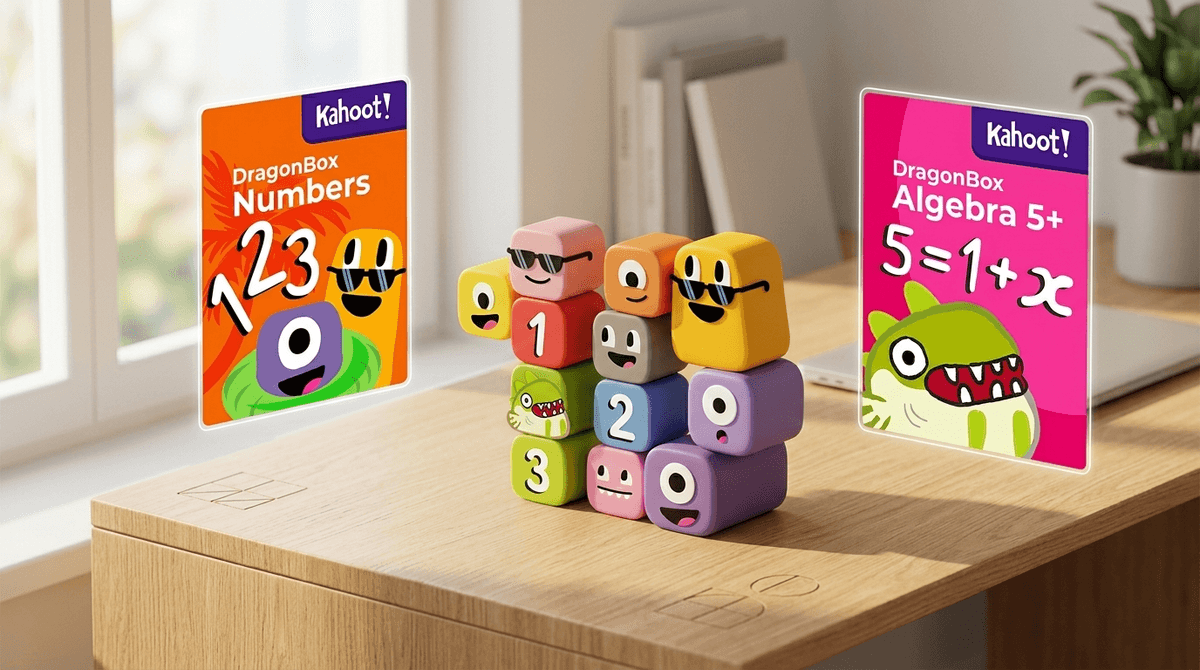
TL;DR: If you’re tired of "educational" apps that are just digital flashcards disguised with annoying sound effects, DragonBox Numbers is the antidote. It’s a tactile, sandbox-style game that teaches "number sense"—the actual logic of how math works—rather than just rote memorization. It’s perfect for kids ages 4-8 and carries zero "brain rot" risk.
Quick Links for the Math-Curious:
- The Foundation: DragonBox Numbers
- The Next Step: DragonBox Big Numbers
- For the Older Kids: DragonBox Algebra 5+
- A Solid Alternative: Bedtime Math
Let’s be real: most "math games" for kids are basically chocolate-covered broccoli. They give the kid a math problem, and if the kid gets it right, they get to play a 5-second animation of a rocket ship. The "math" and the "game" are two completely different things.
DragonBox Numbers is different because the math is the game.
The app introduces kids to "Nooms." These are colorful, stackable characters that represent numbers 1 through 10.
- The 1-Noom is a tiny little guy.
- The 2-Noom is two 1-Nooms stacked together.
- The 10-Noom is a tall, imposing fellow.
When a kid plays, they aren't looking at symbols like "4 + 2 = 6." Instead, they are physically (well, digitally) grabbing a 4-Noom and dropping a 2-Noom on top of its head. The two characters then merge into a 6-Noom. If they want to subtract, they use a "blade" tool to slice the 6-Noom back into a 4 and a 2.
It’s intuitive, it’s visual, and it’s honestly a bit mesmerizing even for adults. It’s less about "doing schoolwork" and more about playing in a digital sandbox where the laws of physics are the laws of mathematics.
We spend a lot of time worrying about "screen time," but we often fail to distinguish between passive consumption and active construction.
Watching endless loops of Skibidi Toilet or mindless "unboxing" videos on YouTube Kids is the digital equivalent of eating candy for dinner. It’s fine in moderation, but it’s not building anything.
DragonBox Numbers is different. It builds "number sense." In the education world, number sense is the ability to understand that a number isn't just a squiggle on a page; it’s a quantity that can be broken apart and put back together. Kids who have strong number sense don’t struggle as much when they hit "real" math later on, because they aren't just memorizing formulas—they see the logic.
If your kid is currently obsessed with Roblox and you’re looking for a way to pivot them toward something that doesn't involve "Ohio" memes or begging for Robux, this is a top-tier choice.
Find educational apps that build logic skills without being boring
Kids don't like being lectured, and they certainly don't like feeling like they’re being "tricked" into learning. DragonBox Numbers works because it feels like a collection game.
There are four main modes:
- Sandbox: This is where they just mess around with Nooms, stacking them and slicing them to see what happens.
- Puzzle: This requires them to use the Nooms to fill a specific shape, which introduces basic addition and subtraction logic.
- Ladder: A more structured progression where they "earn" new Nooms.
- Run: A fast-paced mode that encourages quick thinking without the high-stress "game over" vibes of traditional arcade games.
The sound design is great, the animations are quirky, and there’s a genuine sense of discovery. When a kid realizes they can turn a 10 into ten 1s, it’s a "lightbulb" moment that feels like a win, not a chore.
The developers (part of the Kahoot! family) have a very specific "pedagogy" (fancy word for teaching style). Once your kid masters the basics of DragonBox Numbers, there’s a very clear path forward:
Ages 6-9. This takes the Noom concept and applies it to long addition and subtraction. It involves a lot of "trading" (carrying the one), but because it’s done with visual resources, it actually makes sense to a 7-year-old.
Ages 5-10. This is the app that put them on the map. It teaches the fundamental rules of algebra (isolating the variable) using icons and "dragons" instead of X and Y. By the time the kid finishes the game, they are solving basic algebraic equations without even realizing it. It’s basically magic.
Ages 5+. If you want to get them into Chess.com eventually but they find the board intimidating, this turns every piece into a character with a story. It’s the best way to teach the game, period.
- Ages 4-5: Stick to the "Sandbox" and "Puzzle" modes. Sit with them for the first 10 minutes to show them how to "slice" a Noom. They’ll take it from there.
- Ages 6-7: They will likely fly through the main levels. This is a great time to introduce the "Run" mode to build some speed.
- Ages 8+: If they haven't used it before, they might find the "Numbers" app a bit young, so you might want to skip straight to DragonBox Big Numbers or DragonBox Algebra 5+.
This is the part where I get to give you the "all clear."
- No Ads: You won’t see weird ads for "Age of Origins" or other inappropriate mobile games.
- No In-App Purchases: Once you buy the app (or subscribe via Kahoot+), you own the content. No "buying gems" to progress.
- No Social Features: There is no chat, no "friends list," and no way for a stranger to contact your child. It is a completely offline, safe experience.
- Privacy: They aren't harvesting your kid's data to sell to advertisers.
In a world where Roblox is a constant minefield of "is this game safe?", DragonBox Numbers is a peaceful, gated garden.
The only "downside" is that these apps are usually paid. In a world of "free" (but predatory) apps, paying $5-10 for a math app can feel like a hurdle.
But here’s the no-BS truth: If the app is free, your kid is the product. You’re either paying with your wallet or you’re paying with your kid’s attention span and data. DragonBox Numbers is worth the price of a latte.
Also, don't expect this to replace a math curriculum. It’s a supplement. It builds the intuition, but they’ll still need to learn how to write numbers on paper and do their homework. Think of this as the "lab" where they get to experiment, while school is where they learn the formal language.
Instead of saying "Go do your math app," try these prompts:
- "Can you show me how to make a 10 using only 2s and 3s?"
- "Which Noom is your favorite? Why does the 9-Noom look so grumpy?"
- "Show me how you slice a big number into small ones."
By asking them to teach you, you’re reinforcing the concepts they just learned.
DragonBox Numbers is one of the few apps that actually lives up to the "educational" label. It’s respectful of a child’s intelligence, it’s beautifully designed, and it actually works. If you’re looking to reduce screen time guilt while actually giving your kid a leg up in school, this is a "must-download."
Next Steps
- Download: Grab DragonBox Numbers on the App Store or Google Play.
- Explore: Check out our guide on how to manage screen time for preschoolers.
- Compare: If you're looking for more variety, read our review of Prodigy Math to see how it compares.
- Chat: Get a digital wellness plan for a 5-year-old