

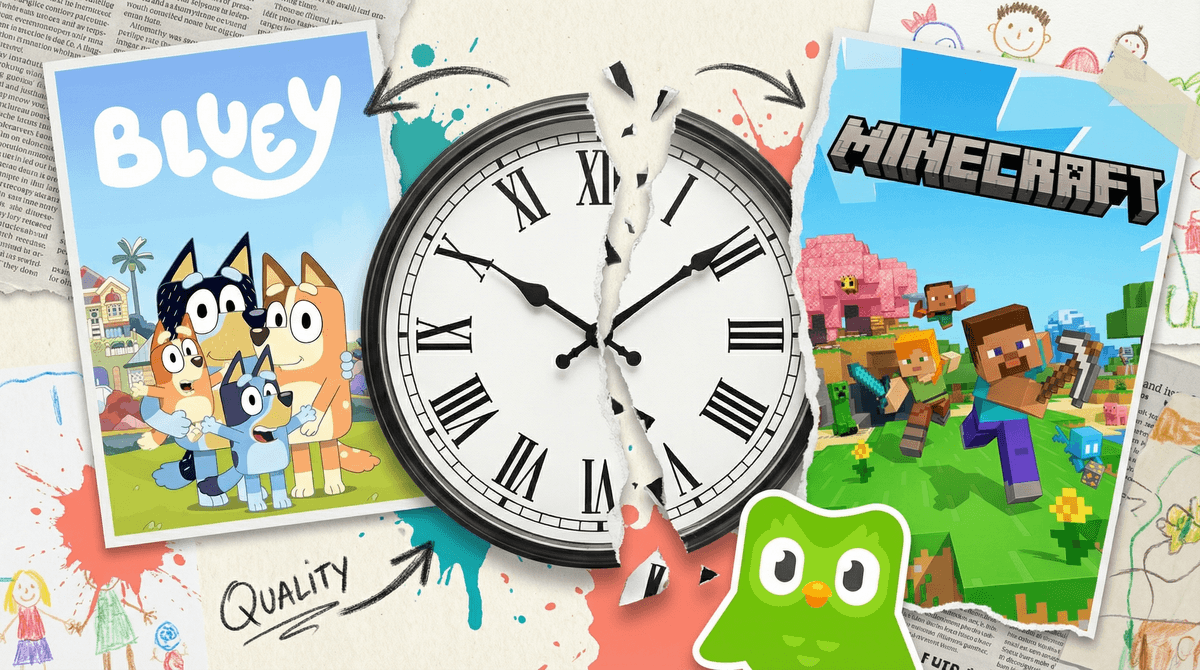
Let's start with the uncomfortable truth: "screen time" is a completely meaningless metric.
Seriously. Lumping together a FaceTime call with grandma, a Duolingo lesson, doomscrolling TikTok, and playing Minecraft with friends into one number is like measuring "food time" and treating a family dinner the same as stress-eating Cheetos at 11pm.
The American Academy of Pediatrics used to give us nice, clean numbers: "No screens under 2! One hour for preschoolers! Two hours max for older kids!" It felt good, right? A clear rule to follow (or feel guilty about breaking). But in 2016, they walked it back. Not because they went soft, but because the research showed that hours simply aren't the right thing to measure.
What actually matters? The three C's: Connection, Content, and Context.
Think about your own screen use for a second. An hour reading long-form journalism feels completely different than an hour of Instagram Reels. Watching a nature documentary with your kid while you talk about it? Not the same as parking them in front of YouTube autoplay while you make dinner (which, by the way, is sometimes necessary and that's okay).
The same applies to kids. Consider:
- 30 minutes of Bluey where your 5-year-old is learning about emotional regulation and family dynamics
- 30 minutes of unboxing videos where someone's shrieking about toys they're paid to promote
- 30 minutes of Duolingo actually learning Spanish
- 30 minutes of Roblox building a game with friends vs. gambling on virtual slot machines (yes, that's in there)
Same time. Wildly different experiences. Wildly different impacts.
Connection
Is the screen replacing human connection or facilitating it?
This is the big one. Screens become problematic when they're a barrier between people, not when they're a tool for bringing people together.
Green flags:
- Playing Mario Kart together on the couch
- Video calls with long-distance relatives
- Sharing funny videos and actually laughing together
- Your kid excitedly showing you their Minecraft build
Red flags:
- Everyone at dinner scrolling separately
- Screens as the default "shut up and leave me alone" tool
- Your kid can't make it through a car ride without a device
- You realize you haven't had a real conversation in days
Content
What is actually being consumed?
Not all content is created equal, and you know this instinctively. The question is whether you're actually paying attention to what your kids are watching, playing, or scrolling through.
Gravity Falls? Brilliant storytelling with complex characters and actual plot. Random YouTube channels with thumbnails of people making shocked faces? Probably not enriching anyone's life.
Stardew Valley? Teaching resource management, planning, and patience. Candy Crush? Literally designed by psychologists to be addictive.
You don't need to preview everything (that's exhausting), but you should know the general landscape of what your kid is consuming. Check out our media guides for age-appropriate recommendations.
Context
What else is happening in your child's life?
This is where the "it depends" really kicks in. Two hours of screens hits different when:
- Your kid spent the afternoon at soccer practice vs. hasn't left the house in three days
- It's a rainy Sunday vs. a beautiful Saturday afternoon
- They're connecting with friends online vs. avoiding real-world social situations
- They just finished homework vs. are procrastinating on a project
- They're sick on the couch vs. choosing screens over every other option
The same amount of screen time can be totally fine or a red flag depending on what else is in the mix.
Instead of counting hours, watch for these signs that screens might be becoming a problem:
Displacement: Are screens crowding out sleep, physical activity, face-to-face socializing, homework, or hobbies? If your kid used to love drawing but now only wants to watch drawing videos, that's worth noticing.
Mood changes: Does stopping screen time lead to complete meltdowns? Is your kid irritable, anxious, or zoned out? Are they sneaking devices or lying about usage?
Physical signs: Headaches, eye strain, disrupted sleep (especially from late-night use), or a kid who never moves anymore.
Social withdrawal: Choosing screens over hanging out with friends IRL, or struggling to engage in conversations without referencing online content.
Your gut feeling: If you feel like something's off, something's probably off. You know your kid.
Stop counting hours. Start paying attention.
The goal isn't zero screen time (that's not realistic or even desirable in 2026). The goal is intentional screen time that serves your family's values and your kid's development.
Some families will naturally have more screen time than others, and that's okay. A kid who's learning to code will be on screens more than a kid whose passion is soccer. A family who loves movie nights together will have more screen time than a family of hikers. Neither is wrong.
What matters is that screens aren't the default, they're not replacing real-world experiences wholesale, and the content is generally aligned with what you want for your kid.
-
Spend a week observing instead of restricting. What are your kids actually doing on screens? How do they act during and after? What's getting displaced?
-
Talk to your kids about their screen use. What do they love about it? How do they feel after long sessions? (You might be surprised by their self-awareness.)
-
Focus on the green flags rather than just restricting. Add in more of the good stuff—co-viewing, creative screen time, connection-based use—rather than just taking away.
-
Set boundaries around context, not hours. Maybe it's no screens during meals, or not until after outdoor time, or not in bedrooms at night. Rules that protect what matters to your family.
-
Explore our age-based guides to understand what's developmentally appropriate and what other families in your community are doing.
The screen time wars are exhausting. Let's call a truce and focus on what actually matters.