

TL;DR: The 2025 Gaming Cheat Sheet
If you’re standing at pickup and a 4th grader just told you your shoes are "so Ohio" while they did a weird neck-stretching dance, here is the quick download:
- Ages 5-7: Focus on "digital dollhouses" like Toca Life World and gentle entry points like Bluey: The Videogame.
- Ages 8-10: This is the Roblox era. It’s less of a game and more of a mall where they also occasionally play "Dress To Impress." Minecraft remains the creative gold standard.
- Ages 11-13: The pivot to competitive social gaming. Fortnite is the town square, and Gorilla Tag is the VR obsession that might result in a broken lamp.
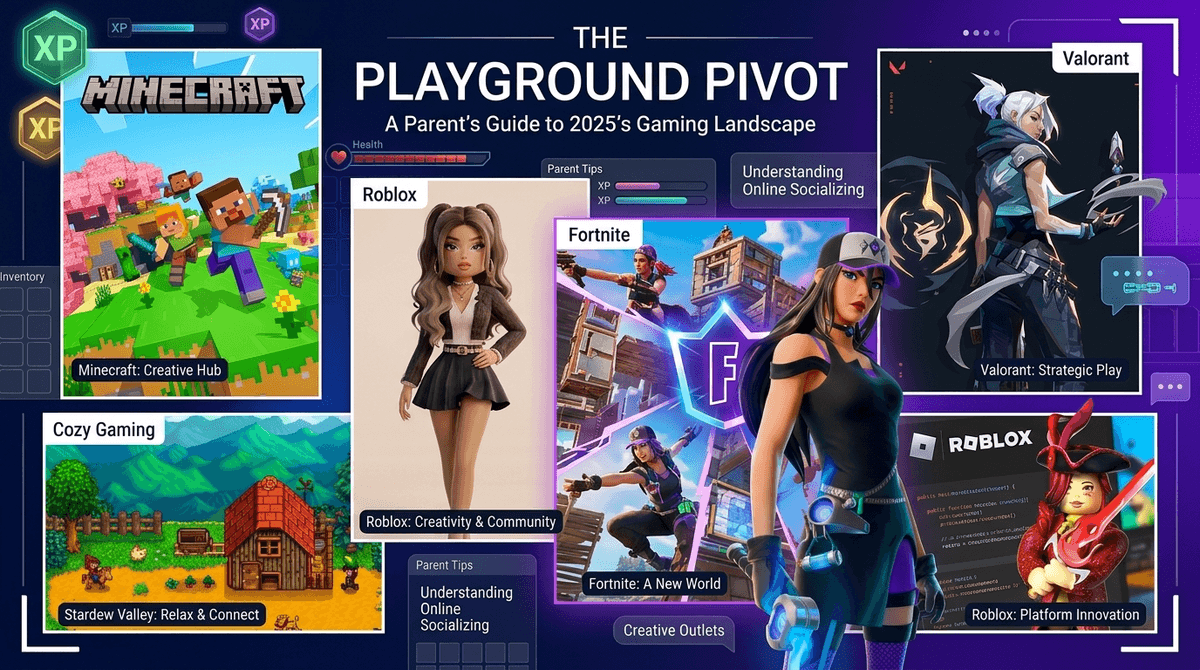
- Ages 14+: High-stakes strategy and social connection. Valorant and League of Legends dominate, alongside "cozy" escapes like Stardew Valley.
Find age-appropriate games like Roblox but safer
The "Playground Pivot" is that moment—usually around 3rd grade—where gaming stops being a solo activity on an iPad and becomes the primary way kids socialize. In 2026, if a kid isn't "on," they're often out of the loop on the jokes, the slang (yes, including "Skibidi Toilet" and "Ohio"), and the shared experiences that happen in virtual worlds.
We aren't just looking at games anymore; we're looking at social ecosystems. Understanding these tiers helps you decide when to open the gates and when to keep the deadbolt on.
At this age, gaming should feel like a digital version of the toy chest. We want to avoid "dark patterns"—those annoying pop-ups that beg for money—and focus on creativity.
This is essentially a digital dollhouse. Kids can move characters around, dress them up, and tell stories. It’s high on the "WISE" score because it encourages open-ended play without the pressure of winning or losing.
If you want zero-stress gaming that actually aligns with educational standards, this is the spot. It’s browser-based, free, and doesn’t have a chat function. It’s the "safe harbor" of the internet.
While many older kids play "Survival," the 5-7 crowd thrives in Creative Mode. It’s digital LEGOs with infinite bricks. It’s a great way to introduce basic 3D navigation without the stress of "Creepers" blowing up their hard work.
Learn more about setting up a safe Minecraft server for your family
This is the most challenging age for parents. This is when the peer pressure to join Roblox hits a fever pitch.
Let’s be real: Roblox is a mess. It’s a platform hosting millions of user-generated games. Some are brilliant (like Bird 100), and some are absolute "brain rot" (low-quality games filled with memes like Skibidi Toilet).
- Entrepreneurship or Money Pit? Kids love the idea of "working" in games like Adopt Me! to earn currency, but the platform is designed to make them want Robux (real money). It’s less "teaching business" and more "teaching consumerism."
- Social Dynamics: This is where they learn to navigate chat. You’ll hear them talk about being "preppy" or "noobs."
A 2025 favorite. It’s the digital version of the card game. It’s flashy, it’s about collecting, and it’s a much more controlled environment than a massive open-world MMO.
The gold standard for "pure" gaming. It’s creative, weird, and can be played on the couch with siblings. If you’re looking to pivot away from "tablet rot," the Nintendo Switch is your best friend here.
In middle school, gaming becomes about status and skill. If you aren't "cracked" (really good) at a game, you might feel the social sting.
It’s not just a battle royale anymore. With the addition of LEGO Fortnite and Rocket Racing, it’s trying to become the "new" Roblox but with better graphics and tighter controls. The main concern here isn't the cartoon violence; it's the toxic chat and the "item shop" FOMO (Fear Of Missing Out).
If your kid has a Meta Quest VR headset, they are playing this. You play as a gorilla and move by swinging your real-life arms. It’s a great workout, but the unmoderated voice chat is a literal jungle. It’s where kids go to say the things they know they shouldn't.
[Brawl Stars](https://screenwiseapp.com/media/brawl-stars-app
A mobile hero-shooter that’s massive right now. It’s fast, colorful, and highly addictive. It’s the game kids are playing under their desks at school.
By high school, the "brain rot" usually clears out (mostly), and kids gravitate toward games that require genuine mastery or provide a "third space" to hang out with friends.
A tactical shooter that requires intense focus and teamwork. It’s replaced Call of Duty for many teens because of its stylized art and character-based play. It’s highly competitive.
For the "hardcore" gamer. It’s beautiful, incredibly difficult, and a major cultural touchstone. It’s the "prestige TV" of gaming.
The ultimate "cozy" game. Many teens (and adults) use this to decompress. You farm, you fish, you build relationships. It’s the perfect antidote to the high-stress environment of competitive shooters.
When deciding if a game is right for your kid, forget the ESRB rating for a second and do a "Vibe Check":
- The Interaction Check: Does this game have open voice chat with strangers? (If yes, that’s a "hard mode" parenting task).
- The Wallet Check: Are there "loot boxes" or gambling-adjacent mechanics? Learn more about how Robux is in fact real money.
- The Loop Check: Is the game designed to be "un-put-downable"? Games like [Brawl Stars](https://screenwiseapp.com/media/brawl-stars-app use streaks and notifications to keep kids coming back every hour.
You’ll hear the term "brain rot" used to describe things like Skibidi Toilet mods in Roblox. It’s easy to roll your eyes, but remember: every generation has its version of this. We had Ren & Stimpy or Beavis and Butt-Head.
The pull isn't the quality of the content; it's the inside joke. Being "in" on the weirdness is a form of social currency. As long as it isn't replacing their actual brain cells or sleep, a little bit of weirdness is just part of growing up digital.
If your kid says something is "Ohio," they mean it’s weird, cringe, or subpar. If they say "Rizz," they mean charisma. If they say "Skibidi," they’re likely just making a noise because it’s a meme.
The most important thing you can do is play with them for 20 minutes. Sit down, let them show you their Roblox avatar, and ask them why they like it. You’ll learn more in those 20 minutes than in any manual. You’ll see the "predatory" pop-ups in real-time and can talk about them right there.
Gaming in 2026 is the new neighborhood playground. It’s where they make friends, lose friends, and learn how to exist in a community.
- Don't ban, curate. Instead of saying "No Roblox," try "We only play Roblox on the big TV in the living room."
- Balance the diet. If they play 40 minutes of a high-stress shooter like Fortnite, suggest 20 minutes of a "cozy" game or a creative outlet like Scratch.
- Watch the clock (and the mood). The game isn't the problem; the reaction to the game ending usually is.
- Take the Screenwise Survey: Understand your family's gaming habits compared to your local community.
- Set "Digital Deadlines": No gaming 1 hour before bed to let the dopamine levels reset.
- Check the "WISE" Scores: Before downloading a new game, check its Screenwise media page to see its educational and wellness value.