

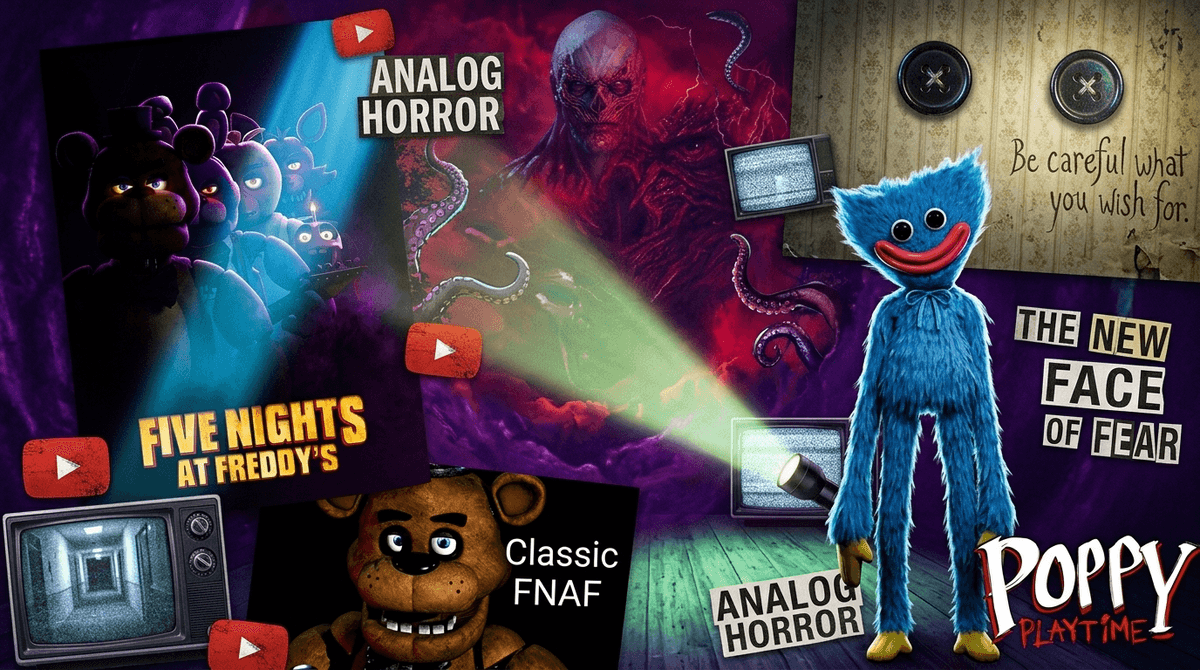
TL;DR: The Quick Cheat Sheet
If you’re short on time because you’re currently scrubbing "Skibidi" lyrics out of your brain, here’s the gist: Kids aren’t scared of the same stuff we were. While we had Freddy Krueger, they have "mascot horror"—think murderous Chuck E. Cheese characters.
- The Big Names: Five Nights at Freddy's, Poppy Playtime, and Skibidi Toilet.
- The 2025 Vibe: A return to "prestige" monsters like the new Nosferatu and high-concept jumpscares.
- The Verdict: Most of this is a developmental rite of passage, but "analog horror" on YouTube can be a dark rabbit hole for younger kids.
See if your 10-year-old is ready for FNAF
If your kid has asked for a plushie of a blue monster with way too many teeth (Huggy Wuggy) or a bird that looks like it’s seen things (Opila Bird), you’ve met the mascots.
Mascot horror is a genre of games and videos where things that should be for children—toys, fast-food mascots, daycare centers—are actually terrifying death traps. The trend exploded with the Five Nights at Freddy's game and has morphed into a massive ecosystem of YouTube "lore" videos.
Kids love it because it feels like "forbidden" knowledge. It’s scary, but it’s wrapped in a package that looks like it belongs in their toy box. It’s the ultimate subversion of the "safe" world we try to build for them.
The landscape has shifted from the "slasher" movies of our youth to something much more atmospheric and, frankly, weirder. Here is how the current "Monster Mash" breaks down:
The Vibe: Haunted animatronics in a pizza parlor. Why it’s huge: It’s the "gateway drug" to horror. The movie was a massive hit, but the real obsession is the "lore"—thousands of hours of YouTube theories explaining the backstories of the robots. It’s basically a soap opera with jump scares. Parent Reality Check: It’s surprisingly bloodless. It relies on tension and loud noises rather than gore.
The Vibe: An abandoned toy factory where the toys (like Huggy Wuggy) want to hug you to death. Why it’s huge: It’s more visually "creepy" than FNAF. It’s also everywhere on Roblox in the form of fan-made clones. Parent Reality Check: This is where things get a bit more intense. The chase sequences in the game can be genuinely stressful for kids under 10.
The Vibe: Heads coming out of toilets fighting humans with cameras for heads. Why it’s huge: It’s the ultimate "Gen Alpha" meme. While adults see "brain rot," kids see an epic war story. It’s more "weird/action" than "horror," but the character designs are definitely body-horror adjacent. Parent Reality Check: It’s loud, it’s chaotic, and it’s arguably annoying, but it’s not "scary" in a traditional sense. It’s just... a lot.
The Vibe: Gothic, artistic, and genuinely terrifying. Why it’s huge: Robert Eggers is bringing back the "real" vampire. No sparkling, no romance—just a rat-faced demon in the shadows. Parent Reality Check: This is for your older teens. It’s "prestige horror," meaning it’s slow, atmospheric, and likely to cause actual nightmares rather than just a quick jump.
Check out our guide on the "mascot horror" trend and why it's so addictive
Not all horror is created equal. If your kid is begging for a scary movie night, here’s how to navigate it without ending up with a kid in your bed at 3 AM.
The "Gateway" Horror (Ages 7-10)
At this age, kids want to feel brave. Give them stories where the kids win and the monsters are slightly goofy.
- Goosebumps (Disney+ Series): A modernized take on the books. It’s spooky but grounded in high school drama.
- The Nightmare Before Christmas: The gold standard for "spooky but sweet."
- Coraline: Warning: This is actually quite creepy. The "Other Mother" with button eyes is a hall-of-fame monster. It’s great for testing the waters.
The "Middle School Thrills" (Ages 11-14)
This is the "FNAF" sweet spot. They want stakes and jump scares, but maybe not the psychological trauma of an R-rated flick.
- A Quiet Place: Day One: High tension, scary creatures, but very little "mess." It’s a masterclass in building dread.
- Stranger Things: It’s the cultural touchstone for this age group. The monsters (Demogorgons, Vecna) are top-tier, but the focus is on the friendship.
- Scary Stories to Tell in the Dark: Based on the books that traumatized us as kids. It’s an anthology, so if one monster is too much, it’ll be over in 15 minutes.
The "I’m Practically An Adult" Tier (Ages 15+)
If they’re watching these, they’re looking for the "real" horror experience.
- Smile 2: This is intense. The "monster" is an invisible entity that forces people to smile before doing something horrific. It’s psychological and gory.
- M3GAN: A killer AI doll. It’s a bit campy and very "2025." It’s a great conversation starter about AI and tech.
- Barbarian: Wait. No. Actually, don't let them watch this. It’s incredible, but it’s "I need therapy" levels of weird for a teenager. Skip it until they're in college.
You might be wondering: Why would my kid want to watch a toilet with a head sing a song, or a giant blue toy chase someone through a vent?
- Controlled Fear: Horror allows kids to experience the physiological rush of fear (adrenaline, cortisol) in a safe environment. When the movie ends, they’re still on the couch with a bowl of popcorn. It’s "bravery practice."
- Social Currency: On the playground, knowing the lore of Garten of Banban is like knowing the stats of a baseball player was for us. It’s how they connect.
- The "Uncanny Valley": Kids are fascinated by things that look almost human but are slightly off. That’s why animatronics and dolls are so effective.
Learn more about the developmental benefits of "safe" horror
The biggest risk isn't necessarily the monsters themselves; it's the YouTube algorithm.
If your kid watches one video about Five Nights at Freddy's, YouTube will likely suggest "Analog Horror" like The Mandela Catalogue. These are fan-made, lo-fi videos that use psychological tricks and disturbing imagery that is way more intense than the games.
How to Talk About It:
- The "Behind the Scenes" Talk: Remind them that every monster is a creation. "Did you know they used a puppet for that?" or "That sound is actually just a slowed-down vacuum cleaner." De-mystifying the monster takes away its power.
- The "Body Check": Ask them, "How does your stomach feel when you watch this?" If they say it feels "tight" or "hurts," that’s their body telling them they’ve reached their limit.
- The "No-Shame" Exit: Make it okay for them to turn it off. "Hey, if this gets too weird, we can just switch to Bluey and I won't tell your friends."
Modern monsters are weird, loud, and often found in a toilet or an abandoned toy factory. While it feels like "brain rot" to us, for them, it’s a complex world of storytelling and "spooky" fun.
The goal isn't to ban the monsters—it's to be the "Safe Base" they can return to when the jump scares get a little too real. If they're obsessed with Huggy Wuggy, let them be—just maybe keep the YouTube "Lore" videos to the living room TV instead of a tablet in a dark bedroom.
- Check the "Lore": If they’re into a specific monster, ask them to explain the story to you. You’ll be surprised how much "entrepreneurship" and "detective work" goes into following these trends.
- Audit the YouTube Feed: Take a quick scroll through their history. If you see "Analog Horror" or "Creepypasta," it might be time for a boundary.
- Plan a "Safe" Movie Night: Start with something like Goosebumps to gauge their tolerance.